
Business & Finance
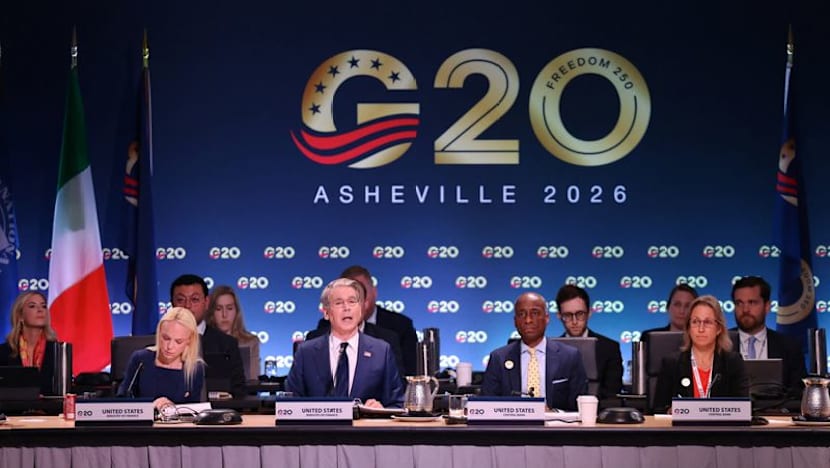
US pushes G20 to cut trade imbalances, focus on China
Key Points
US pushes G20 to cut trade imbalances, focus on China The US presses G20 countries to confront trade gaps with China, but divisions over subsidies, rare earth curbs and Russia cloud a joint communique. The Trump administration was pushing on Tuesday (Sep 1) for G20 countries to agree on ways to reduce global trade and fiscal imbalances as another bond market sell-off revives worries about growing debt levels and renewed inflation pressures.
US pushes G20 to cut trade imbalances, focus on China
The US presses G20 countries to confront trade gaps with China, but divisions over subsidies, rare earth curbs and Russia cloud a joint communique.
ASHEVILLE: The Trump administration was pushing on Tuesday (Sep 1) for G20 countries to agree on ways to reduce global trade and fiscal imbalances as another bond market sell-off revives worries about growing debt levels and renewed inflation pressures.
A sell-off in global bond markets deepened on Tuesday, with Japan's 10-year bond yield hitting 3 per cent for the first time since 1996, the latest manifestation of market angst about energy-driven inflation, potential monetary tightening and worsening fiscal conditions.
Government bond yields rose in major economies including the United States, Japan, the euro zone and Germany as well as Britain, where the bond yields surged 10 basis points after a public holiday on Monday amid fresh worries over renewed attacks in the Middle East.
US Treasury Secretary Scott Bessent told Reuters on Sunday that he would urge G20 members to re-examine their terms of trade with China and consider higher trade barriers to Chinese goods to pressure Beijing to rebalance its economy away from exports and toward domestic consumption.
China's massive export push has pressured economies across the globe, especially as the United States has imposed high tariffs on Chinese goods and outright bans on some products, such as Chinese vehicles.
With chronically weak domestic demand, China has doubled down on exports of electric vehicles, semiconductors and other goods, and its total exports rose 23.9 per cent in July year-on-year, prompting growing calls in the EU for tougher curbs on Chinese imports.
It remains unclear whether the US will be able to bring the diverse forum together to agree on a joint communique on how to reduce global imbalances.
G20 member China has shown little interest in longstanding calls for it to reduce industrial subsidies and rebalance its economy, while its yuan currency remains significantly undervalued by most measures.
The US has thus far not produced a critical plan to reduce its excessive fiscal deficits, which economists say is essential for reducing its $1 trillion-plus annual global trade deficit.
"CHINA WOULD NEED TO SPEND MORE"
European Economy Commissioner Valdis Dombrovskis agreed that China is a major source of global economic imbalances, but that the US and Europe have their roles to play in a more balanced global economy.
"To put short the summary of this analysis, which we have been doing over the upscale couple of years, China would need to spend more, US would need to spend less, and EU would need to invest more."
"It's important that all economic blocs take action to address the imbalances that increases obviously the efficiency of global policy response, and that obviously concerns also specifically China," Dombrovskis said. "And of course, another important element is just mentioning that everyone needs to see how it is a growth agenda for everyone. So also China needs to see how it is a growth agenda for China."
China's goods trade surplus with the European Union hit €360.6 billion last year, a 15 per cent increase on 2024, and has expanded further this year as Chinese firms have sold more to the EU and imported less.
Polish Finance Minister Andrzej Domanski said that he supported the US view that China’s trade surplus with partners was a major problem, adding that the European Union was taking steps to address the issue, such as imposing customs duties on e-commerce parcels, most coming from China.
"We do know that Chinese currency is hugely undervalued, that China is supporting very actively subsidising its exports, and this is a problem for Europe as well,” he told Reuters late on Monday. “Many, many European countries have these high deficits with China, and definitely we need to take action."
Beijing has also exploited its dominance in processing of critical minerals by placing export restrictions on rare earths in April 2025, a response to US President Donald Trump's tariffs that have also hit non-US companies.
Japanese Finance Minister Satsuki Katayama, speaking at a news briefing on Monday evening after the first day of talks, said she had told her G20 counterparts that arbitrary export restrictions on critical minerals were harming the global economy and should be withdrawn.
Officials said the section on global imbalances in the planned joint communique was proving particularly difficult, with China opposed to any singling out of 'non-market economies' or firm words on critical mineral supply curbs.
European countries were also keen to include strong language critical of Russia's war against Ukraine.
Many European ministers expressed surprise and dismay to see Russian Finance Minister Anton Siluanov sitting at the G20 table when US Treasury Secretary Bessent opened the meeting on Monday, the first time Russia has attended the forum in person since it invaded Ukraine in 2022
[Image text:] 2
25
ASHEVILLE2026
020
62
20
620
20
020
C20
020
@20
@20
2.20
020
020
020
@20
20
20
20
020
020
020
020
020
20
020
e20
20
20
20
e2
UNITEDSERTES
220
2
020NTEDSTATES