
Science
Sunken WWII hospital ship colonized by devil firefish and rare monk seals
Key Points
Sunken WWII hospital ship colonized by devil firefish and rare monk seals A sunken World War II hospital ship off the coast of Albania has attracted both invasive devil firefish and rare Mediterranean monk seals, leading researchers to weigh the risks and benefits of these wrecks for local ecosystems. The ship, called the Po, sank off Vlora Bay in 1941 after being hit by a torpedo from a British Fairey Swordfish aircraft during the Greco-Italian War, one of the conflicts within World War II....
Sunken WWII hospital ship colonized by devil firefish and rare monk seals
A sunken World War II hospital ship off the coast of Albania has attracted both invasive devil firefish and rare Mediterranean monk seals, leading researchers to weigh the risks and benefits of these wrecks for local ecosystems.
The ship, called the Po, sank off Vlora Bay in 1941 after being hit by a torpedo from a British Fairey Swordfish aircraft during the Greco-Italian War, one of the conflicts within World War II. It is now acting as an artificial reef, with over 80% of its surface teeming with marine life, researchers reported July 27 in the journal Frontiers in Ocean Sustainability.
This phenomenon, by which submerged structures attract marine life, is called the artificial reef effect, and it occurs when marine life colonizes a newly introduced solid structure underwater. These structures can provide shelter because crevices and dens serve as hiding places, as well as food from the algae and other organisms that grow on its surface.
While there has been research on Vlora Bay generally, there was no historical biological or quantitative data for the Po wreck itself. The study was conducted to find out more about how its structure affected the surrounding seabed and how marine organisms have colonised.
While there has been research on Vlora Bay generally, there was no historical biological or quantitative data for the Po wreck itself. The new study sought to find out more about how the ship's structure affected the surrounding seabed and how marine organisms have colonized it.
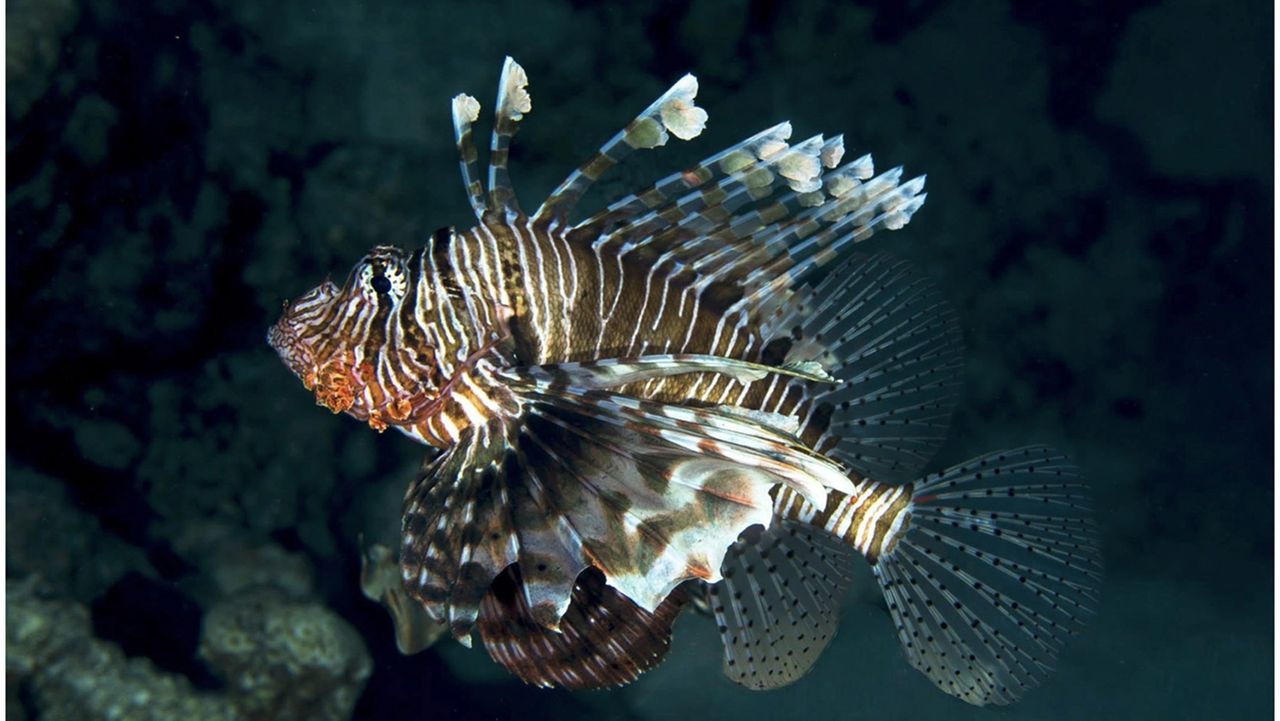
Devil firefish (Pterois miles) are native to warm coastal waters and coral reefs of the West Indian Ocean and the Red Sea. However, the new study found these fish swimming around the shipwreck off the coast of Albania, around 800 miles (1,300 kilometres) away, between June 2022 and September 2024, with up to seven individuals observed simultaneously. The study authors suggested that shipwrecks like Po could be attracting these invasive animals from their natural habitat toward more temperate waters.
“Unfortunately, I can't call it a true scientific surprise, because the effects of climate change are now sadly well known and predictable," Simone Modugno, a biologist and scientific diver at the University of Ferrara in Italy and co-author of the study, told Live Science. "What's perhaps most surprising is the speed with which these climate changes are occurring, acting as a driver and amplifier for the incursions of tropical and alien organisms. I'm talking about impressive salinity and abnormally high temperatures, with persistent peaks of extreme heat."
Get the world’s most fascinating discoveries delivered straight to your inbox.
The researchers noted that the presence of these fish is part of a wider problem: More invasive species are migrating from the Red Sea through the Suez Canal and into the Adriatic Sea due to warming global temperatures. Modugno said she expects a "serious problem" involving the devil firefish within the next 10 years.
"For at least three years, I've observed a steady and unstoppable increase in fish such as Pterois miles along the Albanian coast, as well as other invasive plant species, mollusks, and shellfish, as well as the spontaneous return of the Mediterranean monk seal," Modugno said. "Now, the Albanian coasts are experiencing constant overgrazing, just like the Greek and sub-Italian coasts, and the lionfish population is literally exploding.”
The study confirmed that this was one of the northernmost reported occurrences of the firefish in the Adriatic Sea.
Related stories
However, invasive species aren't the only ones attracted to these shipwrecks. The researchers also noted 28 fish species living around the wreck, egg clusters belonging to the Ommastrephidae family of squid, and even sightings of the rare Mediterranean monk seal (Monachus monachus).
Most notably, researchers captured a monk seal resting within the sheltered cavities of the wreck in August 2023, which was the first confirmed sighting of the species in Vlora Bay since 1996.
This monk seal species typically breeds in sheltered sea caves across Mediterranean beaches. However, tourism and other human activities have forced the species into more isolated and dangerous caves. This, along with other threats from fishing entanglement, continue to threaten the seals. The sighting indicates that monk seals are using these artificial reefs as potential resting opportunities when their natural habitats are fragmented, the researchers said in the study.
Modugno S, Castro R, Pustina I, Kromidha G, Dedej Z and Meçöllari A (2026) First assessments on marine geomorphology and bio-colonization through the study and survey of the wreck of the Hospital Ship “Po” along the Albanian coasts (Vlora Bay). Front. Ocean Sustain. 4:1762680. doi: 10.3389/focsu.2026.1762680
Robyn is a UK based journalist specialising in science, nature and the environment. She previously worked as a nature and science reporter for Newsweek and other trade publications spanning the sustainability sectors. She holds a bachelor's degree in journalism from Kingston University.
You must confirm your public display name before commenting
Please logout and then login again, you will then be prompted to enter your display name.
Sunken WWII (ORG)
WWII (EVENT)
World War II (EVENT)
Albania (LOCATION)
Mediterranean (LOCATION)
Po (LOCATION)
Vlora Bay (LOCATION)
British (ORG)
Frontiers (ORG)
Ocean Sustainability (ORG)
the West Indian Ocean (LOCATION)
the Red Sea (LOCATION)
Simone Modugno (PERSON)
the University of Ferrara (ORG)
Italy (LOCATION)