
Weather
As the climate changes, South Asia's farmers rethink how – and what – they grow
Key Points
As the climate changes, South Asia's farmers rethink how – and what – they grow From India's prized mangoes to olives taking root in Pakistan, farmers are finding new ways to produce food in a hotter, less predictable world. UTTAR PRADESH/KHYBER PAKHTUNKHWA: Across parts of South Asia, changing weather patterns are making harvests increasingly difficult to predict.
As the climate changes, South Asia's farmers rethink how – and what – they grow
From India's prized mangoes to olives taking root in Pakistan, farmers are finding new ways to produce food in a hotter, less predictable world.
UTTAR PRADESH/KHYBER PAKHTUNKHWA: Across parts of South Asia, changing weather patterns are making harvests increasingly difficult to predict.
The effects are putting pressure on crops, livelihoods and food security.
Some farmers are trying different approaches to adapt to changing conditions.
In northern India, mango growers are changing how they manage their orchards as extreme weather threatens their crop. In neighbouring Pakistan, farmers are turning to olives that can thrive in hot and dry conditions.
PROTECTING INDIA'S KING OF FRUITS
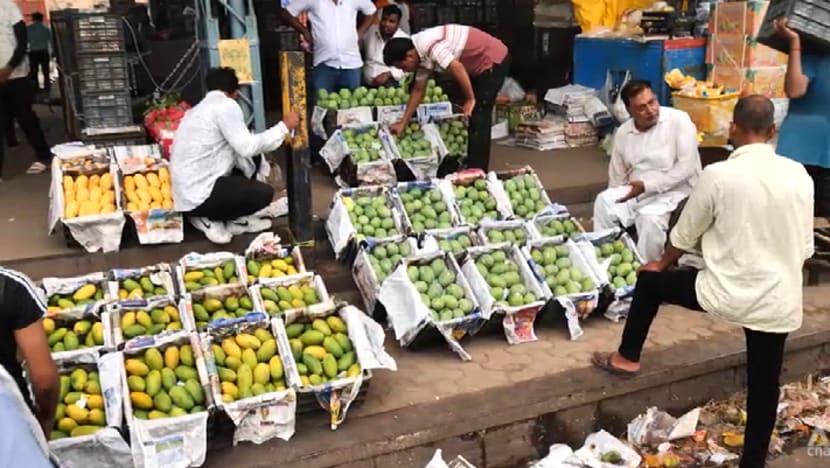
Nearly half of the world's mangoes are produced in India, and almost all are consumed at home. Only about 1 per cent is exported, making the fruit that reaches overseas markets especially sought after.
But this prized crop is coming under threat from extreme weather.
The northern state of Uttar Pradesh produces more than 20 per cent of India's mangoes. The flowering season typically begins in the first quarter of the year – a critical stage that determines the size of the harvest.
Mango farmer Ashok Kumar said temperatures between 14°C and 28°C are ideal during this period.
"If the temperature remains in this range, the flowers have a 40-hour window to be pollinated easily," he told CNA.
But erratic weather swept across the region early this year, and farmers saw the effects by harvest time.
Farmer Deepak Kumar grows four mango varieties in his orchard, including the Dashehari, which is especially vulnerable to extreme weather.
"Due to unseasonal rain, some of these fruits are smaller than usual. Our production would have been 200kg on average, looking at the size of those trees. But now it would be hardly 100kg per tree,” he said.
The smaller harvest meant a 30 per cent drop in his income.
WHEN APPEARANCE MATTERS
The quality of the fruit can also determine how much farmers earn, with size, colour and smell all important to buyers.
To protect the mangoes from strong sunlight and insects, farmers cover individual fruits with brown paper bags. The bags also help preserve their natural colour.
Ashok Kumar said bagged mangoes can fetch him at least 50 per cent more.
But even that does not always work.
This season, Deepak Kumar found an unusual “rusty” discolouration on some of his mangoes. He blamed the inhospitable weather. More heat can mean more pests, he said, while more rain can encourage insects and fungus.
For farmers, unpredictable weather can mean unpredictable income. The effects extend well beyond individual orchards.
Across northern India's mango belt, the crop provides a livelihood for entire villages. Many farm workers come from families that have tended the orchards for generations. When production is disrupted, the impact is felt across the community.
A 2025 study found that mango yields can fall by as much as 11 per cent for every 1°C rise in temperature during the growing season.
Farmers say increasingly erratic heatwaves are forcing them to irrigate their orchards more often to keep surface temperatures cool, adding to costs and consuming groundwater.
Scientists say this is not sustainable in the long run.
Arvind Kumar, head of the horticulture department at Sardar Vallabhbhai Patel University of Agriculture and Technology in Uttar Pradesh, said farmers need to grow varieties suited to the conditions where they are grown.
“For every region, a specific variety is available. In parallel, our scientists are working on identifying local climate-resilient varieties.”
GROWING MANGOES IN LESS SPACE
While scientists work on longer-term solutions, some farmers are changing the way they plant their orchards.
One approach is high-density farming, where mango trees are planted much closer together.
Instead of being 9m apart, as in traditional orchards, the trees can be planted just 3m apart. More trees on the same amount of land can mean higher yields.
While heatwaves and unseasonal rain can still damage some fruit, farmers say these orchards can be up to four times more profitable than traditional ones.
Mango farmer Arvind Kumar Bhati said varieties that are in high demand also tend to perform well under high-density farming.
“But for some reason the uptake of this technique is still low even though it is beneficial in many ways,” he added.
There are other advantages. Farmers can grow several mango varieties or plant another crop in the shade of the trees. A smaller area to manage can also mean lower spending on pest control, fertilisers and irrigation.
But changing farming methods may not be enough as extreme weather becomes a bigger threat.
Experts say research into climate-resilient mango varieties has yet to keep pace with work on staple crops such as rice and wheat.
Vibha Varshney, head of the biodiversity and food unit at the Centre for Science and Environment, a New Delhi-based environmental research and advocacy organisation, said one reason could be that mangoes, unlike staple crops, are not seen as a source of everyday nutrition.
But she pointed to the fruit's economic importance, both domestically and as an export.
As the world's appetite for Indian mangoes grows, the long-term rule of the king of fruits will ultimately be decided by how well the country’s orchards adapt to growing climate pressures.
A PAKISTANI PROVINCE’S BET ON OLIVES
In Pakistan's northwestern province of Khyber Pakhtunkhwa, some farmers are turning to a crop more commonly associated with the Mediterranean.
Olive farmer Salahuddin Khattak has been growing the fruit in Manki Sharif, about 60km from Peshawar, since 2002.
He continued to expand his farm as rising temperatures, prolonged droughts and erratic weather made farming more uncertain, while neighbouring farmers struggled with traditional crops.
With support from the provincial government, he planted varieties imported from countries including Italy and Tunisia that can thrive in hot and dry conditions.
"Our area is also very big in Pakistan for olive cultivation, so it may be very helpful if we concentrate on this crop," he said.
Olives can also provide another source of income through olive oil.
Pakistan imports around US$4.5 billion worth of edible oil each year, and there are hopes that growing more olives at home could help reduce that dependence.
Even a small farm with 100 or 200 olive trees could produce several hundred litres of oil, said Salahuddin.
A RESILIENT CROP
Khyber Pakhtunkhwa faces climate pressures at both extremes. Some parts of the province face prolonged drought and low rainfall, while others receive heavy rain and are vulnerable to floods. Temperatures can also cross 45°C in some areas.
In southern Khyber Pakhtunkhwa, where water scarcity is a growing concern, farmers say olives are particularly suited to the harsh conditions because they require relatively little water.
Authorities in the province are encouraging farmers to use drip irrigation, which delivers water directly to the roots instead of flooding fields.
Officials say promoting olive cultivation is central to Pakistan's climate adaptation efforts as the country seeks to safeguard its food security.
In 2024, floods destroyed nearly 24,000ha of farmland and killed close to 2,000 livestock.
A year later, the country's agriculture sector was hit hard by floods again. A preliminary government assessment put damage to the sector at PKR430 billion (US$1.5 billion).
FROM SMALL BEGINNINGS TO WIDER CULTIVATION
Authorities have expanded public-private partnerships aimed at increasing olive cultivation across Khyber Pakhtunkhwa.
At Sang Bhatti in Swabi district, olive cultivation began more than two decades ago on a relatively small area of land.
Much of the surrounding land was then used to grow crops such as cotton, maize and wheat. Today, olive trees cover an area nearly the size of 130 football fields.
Before olive trees are planted across the province, they are first nurtured at the Khyber Pakhtunkhwa Agriculture Institute. There, young olive plants are raised in climate-controlled greenhouses before being transplanted into orchards.
The institute is also grafting productive olive varieties onto wild olive trees, turning trees that do not bear fruit into productive ones without extensive replanting.
The Pakistan Business Council, a business policy advocacy group, says the country has more land suitable for olive cultivation than Spain, one of the world's largest olive oil producers.
Officials believe expanding olive cultivation could strengthen rural livelihoods, increase domestic edible oil production and help farmers adapt to a changing climate.
RISK OF OVERRELIANCE
But experts caution that there is no single solution to making agriculture climate resilient.
Zainab Naeem, an associate research fellow at the Sustainable Development Policy Institute, an Islamabad-based policy research organisation, warned against relying too heavily on one crop.
Pakistan's varied landscape – which includes deserts, mountains and forests – means climate adaptation needs a diverse approach, she said.
"The challenge here is that we must not introduce monoculture, one specific kind of crop,” she said.
Naeem said farming also needs to remain viable for those growing other crops.
But whether the country can build a truly climate-resilient agriculture sector will depend on how quickly innovation, better water management and climate-smart farming reach fields across the nation.