
Weather
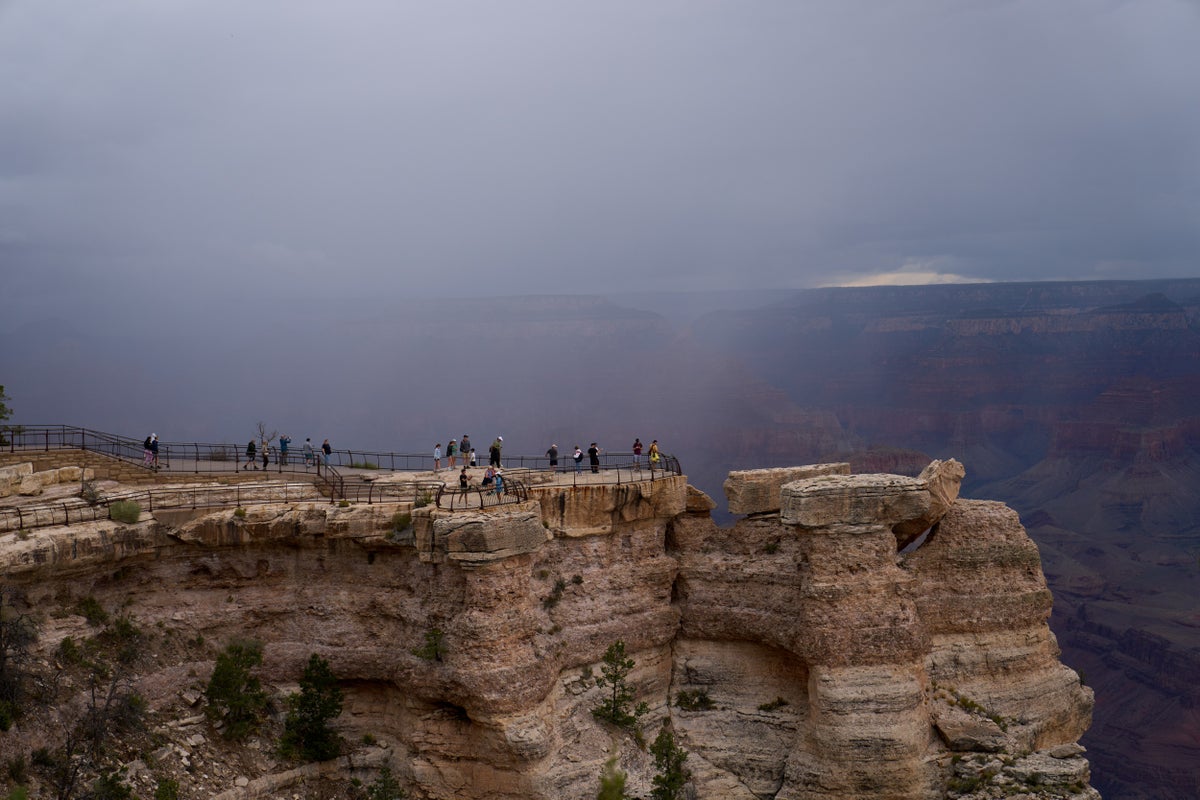
Hikers recount scrambling through cactus as trail turned into a river during deadly Grand Canyon flood
Key Points
Hikers recount scrambling through cactus as trail turned into a river during deadly Grand Canyon flood Within minutes, torrential rains, gusting winds and even hail enveloped hikers along the creek - Bookmark Late-afternoon cloud cover builds with predictable regularity across the desert, accompanied by swirling winds and darkening skies before the downpour begins. While some storms bring only light rain, an August deluge hit a remote stretch of the North Rim of the Grand Canyon with extreme...
Hikers recount scrambling through cactus as trail turned into a river during deadly Grand Canyon flood
Within minutes, torrential rains, gusting winds and even hail enveloped hikers along the creek
- Bookmark
Late-afternoon cloud cover builds with predictable regularity across the desert, accompanied by swirling winds and darkening skies before the downpour begins.
While some storms bring only light rain, an August deluge hit a remote stretch of the North Rim of the Grand Canyon with extreme force. Far beneath the rim, scores of trekkers were pitching tents along Bright Angel Creek, looking up at the sheer rock faces they were scheduled to climb on their return journey.
Thick, muddy water quickly surged down the creek bed. A deafening roar echoed off the canyon walls as the torrent slammed against boulders, dragging along fallen limbs, silt, and heavy debris.
Fierce summer thunderstorms and sudden flash floods are familiar occurrences across the southwestern region of the United States. Though campers in the canyon last Saturday were aware of the hazards, this particular storm proved exceptionally destructive, tearing away crucial footbridges and inflicting more structural damage than decades of previous floods combined.
The deluge left two people dead and at least one person is still missing. Rescuers evacuated over 80 individuals from the canyon by air, while the National Park Service began evaluating the extent of the destruction.
Forecasts warned of severe storms and flood risks
Extreme weather alerts preceded the deluge, which several survivors characterized in interviews with The Associated Press as a once-in-a-generation storm. Witnesses detailed rushing to elevated terrain to escape the rising currents, while others sought shelter under rock overhangs to avoid being struck by tumbling stones.
"It was for sure some of the worst acute fast-forming weather I have ever seen in my time, whether it’s in the mountains or marine environments or in the desert Southwest," said Drew Harrell, an emergency medicine physician with University of New Mexico Hospital who was on a training mission at the time as medical director for Grand Canyon National Park.
Harrell, who is experienced in remote medical operations and has completed the rim-to-rim trek more than 12 times, had reviewed forecasts alongside his group prior to launching their annual expedition. Their primary concern had been extreme desert heat rising past 100 degrees Fahrenheit, rather than precipitation.
However, Harrell noted that the storm materialized almost instantly as his six-person team reached "The Box," a narrow section covering the final 3 miles (4.8 kilometers) before Phantom Ranch, a secluded stop located at the canyon floor.
"It went from relatively clear skies to blowing winds in the time frame of about a minute," he said, estimating the gusts at 40 mph (64 kph).
Hikers had little time to act
Walkers along the creek were caught off guard as heavy rain, powerful winds, and hail descended in a matter of minutes.
"We were concerned that there would be rocks and just flooding coming down from both sides of the canyon on top of us," said Parth Desai, another physician who was with the group.
Drawing on their medical training, the physicians evaluated risks and adjusted their plans as environmental conditions rapidly worsened.
"We saw basically the flood, waterfalls coming up out of nowhere, boulders, mud, landslides happening everywhere," Desai said. "And then we were concerned about a lightning strike."
The group attempted to push ahead down the path toward Phantom Ranch, navigating past cottonwood trees felled by initial wind gusts before spotting a second wave of incoming debris. To escape, they scrambled through patches of cactus up toward safer, elevated positions.
Floodwaters overtake what is usually a shady oasis
Further up the waterway at Cottonwood Campground, Mike Sumaruk and a companion were resting following a nearly 7-mile (11-kilometer) descent into the ravine when heavy winds and torrential rain hit the area.
"I jumped into my tent because I thought it was going to blow away and was trying to hold it down," he said in a phone interview Tuesday.
Moments later, a loud roaring sound filled the canyon.
"I thought it was like thunder in the distance, but it wasn’t going away. And I said, that’s not thunder, and I unzipped the tent and got out and saw the huge wall of water," Sumaruk said. "We just left everything."
Although the resident of Tulsa, Oklahoma, has climbed numerous mountain peaks over the years, this marked his first venture into the Grand Canyon. He noted its remarkable beauty, expressing disappointment that he could not explore more of the landmark.
Sumaruk located an emergency phone at an unattended ranger outpost to inform officials that he and roughly 12 other hikers were trapped. A ranger arrived on foot to assist the group, who remained in place until Sunday before being evacuated by helicopter to the South Rim, where Red Cross personnel and support counselors met them.
Harrell similarly commended the park staff, pointing specifically to the rangers working inside the canyon who relocated dozens of individuals at Phantom Ranch to high ground before floodwaters swept away the bridges.
"They mitigated the opportunity for there to have been more serious loss of life or injuries," Harrell said.
The trail turned into a river
Tom Monroe and two companions started their trek early Saturday from the North Rim. Aware of the monsoon season and having observed light rainfall the previous day, they attempted to monitor conditions despite poor mobile phone service.
Monroe explained that they chose to continue after a passing hiker mentioned a favorable forecast, while another coming up the route reported clear conditions.
Their destination was Cottonwood Campground. Within the first mile of their walk, light rain began to fall.
"Then it started just opening up, holy hell raining on us," said Monroe, 59, of Flagstaff, Arizona, who runs a business making custom food-storage bags for campers.
Believing the squall would quickly pass, the three pushed forward. Instead, heavy rain persisted alongside thunder and lightning, causing runoff to pour down the path until it resembled a fast-flowing river, according to Monroe.
One member of the group sought refuge inside a small wall alcove, while Monroe sheltered beneath a rock overhang that shielded him from rain, mud, sand, and tumbling debris.
"On either side you could see rocks the size of footballs or beach balls coming down the cliffs from the top," he said.
The third companion, positioned further down the path, was forced to scale a steep embankment and cling to tree roots to avoid being carried away by the rushing water.
Monroe noted that the 20-minute torrent felt interminable.
"None of us can really stop thinking about it," Monroe said in a phone interview Wednesday, safely back home in Flagstaff.
Flooding doesn't dampen hikers' outdoor plans
Despite the ordeal, Monroe and his companions were already preparing another outdoor excursion for the coming weekend, opting for car camping closer to home.
Sumaruk is likewise considering a return to the Grand Canyon once access is restored. He intends to monitor progress as the National Park Service undertakes the extensive effort of repairing a heavily damaged primary water line, restoring miles of destroyed trails, and replacing destroyed bridges.
Acknowledging that unpredictable weather occurs and recognizing that full recovery will take time, Sumaruk noted that years of research and months of preparation preceded his trip.
"I'm definitely going to give it another shot," he said.
Grand Canyon (LOCATION)
the North Rim (LOCATION)
the Grand Canyon (LOCATION)
Angel Creek (LOCATION)
the United States (LOCATION)
the National Park Service (ORG)
The Associated Press (ORG)
Southwest (LOCATION)
Drew Harrell (PERSON)
University of New Mexico Hospital (ORG)
Grand Canyon National Park (ORG)
Harrell (PERSON)
Phantom Ranch (ORG)
Walkers (PERSON)