
World News
Targeted enforcement, surveillance led to reduced littering at hotspots: NEA
Key Points
Targeted enforcement, surveillance led to reduced littering at hotspots: NEA The National Environment Agency also shared footage from camera surveillance that detected high-rise littering. SINGAPORE: Continued efforts to clean up targeted littering hotspots have yielded results, with the number of fines and corrective work orders issued dropping in the first half of this year compared to the same period last year. Giving an update on the public cleanliness situation, the National Environment...
Targeted enforcement, surveillance led to reduced littering at hotspots: NEA
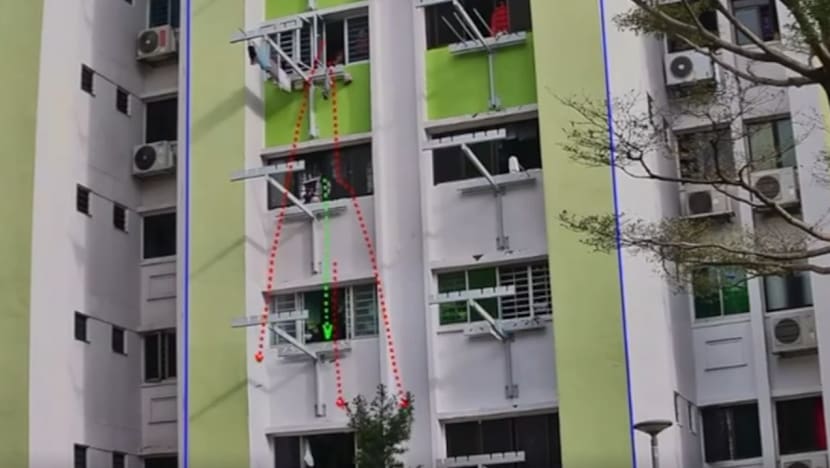
The National Environment Agency also shared footage from camera surveillance that detected high-rise littering.
SINGAPORE: Continued efforts to clean up targeted littering hotspots have yielded results, with the number of fines and corrective work orders issued dropping in the first half of this year compared to the same period last year.
Giving an update on the public cleanliness situation, the National Environment Agency (NEA) on Friday (Sep 4) said it issued around 5,300 fines for ground littering offences in the first half of 2026.
This is compared with about 7,000 in the same period last year.
It issued 267 corrective work orders to offenders in the first half of 2026, compared with 373 across the same period last year.
The agency cited the area around 628 Ang Mo Kio Avenue 4 as one example, saying it is no longer considered a "cleanliness hotspot" after its litter count fell 54 per cent between July 2025 and June 2026.
NEA identifies these hotspots using litter counts, public feedback and observations on the ground, before deploying measures such as targeted enforcement, surveillance and engagement.
There are currently 12 such hotspots islandwide.
In addition, NEA has been enhancing its camera surveillance capabilities to better detect high-rise littering.
It has been using trajectory analytics since July 2025 to trace objects thrown from high-rise units. A month later, it extended camera surveillance periods from 14 days to up to 28 days.
Surveillance cameras are also being deployed more strategically to tackle high-rise littering, with NEA collaborating with town councils to identify locations for targeted surveillance.
The agency introduced a six-month pilot in October 2025 to provide each town council with two high-rise littering surveillance camera deployments a month to monitor hotspots.
All 19 town councils participated in the pilot, with 73 camera deployments conducted under the pilot from October 2025 to April 2026.
The pilot achieved a catch rate of 34 per cent, compared with 26 per cent across around 1,300 camera deployments islandwide by NEA over the same period.
One such deployment was at Tampines Street 45, where NEA and Tampines Town Council shared intelligence, monitored the site and deployed a camera, which detected a high-rise littering act and enabled follow-up investigations.
NEA said the results show how town councils' ground knowledge can complement its existing deployment approach, and support more targeted intervention for high-rise littering cases.
"Building on these results, NEA will continue to work closely with town councils to support more targeted surveillance and intervention against high-rise littering," the agency said.
"These efforts complement NEA’s ongoing surveillance and enforcement against high-rise littering, which continues to require sustained attention," the agency added.
High-rise littering feedback cases have averaged about 28,600 a year since 2023.
In 2025, NEA conducted around 2,200 camera deployments and took about 500 enforcement actions for high-rise littering offences.
Asked how surveillance cameras have helped with high-rise littering, Marsiling-Yew Tee Town Council said it has observed marked improvements in cleanliness and a reduction in reports of high-rise littering at identified locations.
The town council supports the initiative by identifying suitable locations for the deployment of cameras, based on residents’ feedback and observations by its staff and conservancy workers.
"The cameras are intended to provide an additional means of targeted surveillance, particularly at locations with persistent high-rise littering feedback, and can support NEA’s investigation and enforcement efforts," a spokesperson said.
TOILET CLEANLINESS
NEA also provided an update on coffee shop toilet grants, launched in November last year to help improve the cleanliness standards of washrooms in coffee shops.
The agency has received 219 eligible applications, of which 44 coffee shops have completed toilet renovations or started deep cleaning.
The number of eligible applications has increased since May this year, when the authority had received 171.
The two grants, the Coffeeshop Toilet Renovation Grant and Coffeeshop Toilet Deep-Cleaning Grant, were introduced following the recommendations of the Public Toilet Taskforce to address persistent cleanliness issues at coffee shops and hawker centres.
The renovation grant covers up to 95 per cent of costs, capped at S$50,000 per coffee shop. The deep-cleaning grant co-funds up to 95 per cent of a two-year cleaning contract, capped at S$25,000.
Coffee shops have since used the renovation grant to upgrade cubicles with new fittings, improved lighting and more efficient flushing systems, among other enhancements.
Alongside this, NEA has continued its enforcement efforts. In 2025, it conducted about 7,500 inspections of public toilets at premises such as coffee shops, hawker centres and shopping malls, followed by about 4,000 inspections in the first half of 2026.
Since late 2025, NEA has also stepped up audits of poor-performing coffee shops, alongside enforcement against premises owners who fail to meet required cleanliness standards. About 150 enforcement actions have been taken against coffee shop owners in the first half of 2026.
TRAY RETURN
The average tray and crockery return rate at hawker centres is at 94 per cent, which is slightly higher than 93 per cent in 2024. This is also well above the 65 per cent in August 2021, which was before the start of NEA's table littering enforcement.
Some of the top-performing hawker centres include Fernvale Hawker Centre & Market, Market Street Hawker Centre, and Chong Pang Market and Food Centre.
In the first half of 2026, NEA issued 52 warning letters and three fines, down from 628 warning letters and seven fines in the same period in 2025.
TARGETING RAT ACTIVITIES AT SOURCE
NEA is also targeting rat activity at its source, particularly in areas with high trade activity and poor refuse management.
Since Apr 1, 2025, the agency has stepped up enforcement against premises managers and owners for rat-related lapses, including poor refuse management and conditions that provide shelter for rats.
The number of enforcement actions fell from about 600 in the first half of 2025 to around 490 in the same period this year.
The agency is currently carrying out enhanced interventions in four areas with poor refuse management practices, under the Cleaner Neighbourhood initiative.
At Yishun Avenue 11, refuse management lapses fell by more than 60 per cent from March to July 2026, following engagements with trade premises, closer coordination with the town council and the deployment of surveillance cameras. Five enforcement actions were taken for improper refuse disposal.
Islandwide, the average number of rat burrows detected fell to about 3,400 per two-month surveillance cycle in the first half of 2026, from about 5,400 in the same period last year.
NEA said sustained housekeeping and proper refuse management were key to keeping rat populations under control, as they can rebound quickly when food sources and places of shelter are readily available.
The agency is also using technology to improve surveillance and detection of rat activity, with the tools to be refined based on operational experience.
Separately, it is working with service providers to trial autonomous pavement sweepers at parks, while using artificial intelligence and video analytics to identify issues such as overflowing litter bins and littered areas.