
Education
I got used to hiding a part of my name. Then I learnt what I was leaving out
Key Points
I got used to hiding a part of my name. Then I learnt what I was leaving out A recurring problem during a flight booking sent Mr K B Ryan Joshua Mahindapala searching for the story behind a family name he had rarely acknowledged.
I got used to hiding a part of my name. Then I learnt what I was leaving out
A recurring problem during a flight booking sent Mr K B Ryan Joshua Mahindapala searching for the story behind a family name he had rarely acknowledged. Here's what he learnt along the way about identity and heritage.
Not long ago, I was booking flight tickets online. After choosing my seats, I arrived at the part I always dread: passenger details.
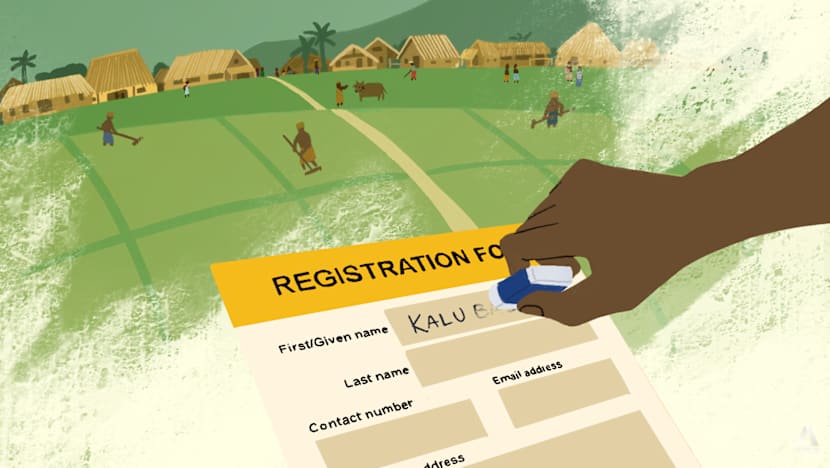
My name, as my identity card states it, is K B Ryan Joshua Mahindapala. It’s a mouthful that has never neatly fit into the blank boxes of airline websites demanding a first and last name, within character limits.
As always, I typed, deleted and rearranged, hoping the airline's virtual booking system and my passport could come to some sort of agreement about who I am.
As always, I found myself thwarted over and over, wishing for simplicity. Why did I have to have this unwieldy, untidy name?
MAKING MYSELF SMALLER
In my daily life, I go simply by "Ryan". I rarely gave any thought or effort to acknowledging the two letters that precede it in my full, official name – nor did I ask anyone else to.
The habit began nearly two decades ago, in secondary school.
Back then, when classmates asked what the K B stood for, I told them: Kalu Badalge.
I said it proudly, with no shame. Growing up, my family had told me the words meant "blacksmith", and I remember nodding, feeling like this was enough to explain who I am and where I come from.
I thought my classmates would react the same way. Instead, what I got was giggling.
I wondered what I had said that was so funny. But I don't think they meant any harm by it.
In my experience as an educator, teenagers have a habit of reacting to the unfamiliar by attempting to find the funny in it rather than engaging it with sincere curiosity.
But word soon got around, and for a while it became a lightning rod for teasing from my peers at school.
I never mentioned it to my parents or relatives. I simply drew my own conclusion: it was not wise to hand my full name out to just anyone, or brandish it in public.
By the time I reached adulthood, the reflex was fully formed.
I stopped acknowledging my first two initials to casual acquaintances. In situations where it couldn't be helped, I introduced myself as "Ryan" before others could raise a brow at the full iteration of my name.
In formal situations such as job interviews, nerves led me to believe that leaving openings for an interviewer to stumble over my full name, printed on my resume, might cost me the job. In my head, my trusty opener "Please, call me Ryan" was my secret weapon to remove all awkwardness. It gave me an equal chance, even before the interview had properly begun.
Over time, I convinced myself that the safest version of me was the shortest one. Those two letters had never felt like they truly belonged to me anyway, nor I to them.
Did it really matter so much if I hid them from view – even if that view was my own?
WHAT PARTS OF ME HAVE I BEEN SELF-CENSORING?
For some reason, on this day, I found myself pausing over the flight booking page. I stared at the two letters I could never seem to make fit, that I had spent so many years trying to censor from my identity.
With them, what else had I been unwittingly censoring about myself?
Pulling up a new browser window, I tried searching "Kalu Badalge" on Google. The results weren't very helpful, only circling the name without ever landing on it.
With the pending flight demanding my attention, I set my search aside for the moment. But a few days later, I typed "Kalu Badalge" into an AI chatbot and asked what it meant.
The answer arrived in seconds.
"Kalu Badalge" follows a traditional Sinhalese naming pattern: a "ge-nama" or hereditary house name that comes before a person's given names. "Kalu" means "dark" while "badal" means "smith" or "artificer". Put those together with "ge", meaning "house of" and you get "Kalu Badalge" – "the house of the dark smith".
The name points to an ancestry based in metalwork, to forebears traditionally linked with the Navandanna, the artisan communities of old Sri Lanka.
I didn't take a machine's word for it. I asked for historical sources.
I was led to scholarly works more than a century old, out of copyright and free for anyone to read. Other sources were not as easily available, with some needing paid access, so I had to do my own separate searches based on inferences drawn by the chatbot.
What I found and pieced together was not a comprehensive genealogy of my own family, but the history and traditions behind the name I inherited.
Naming patterns like this, it turns out, reach back at least to the era of the Kandyan kingdom, which stood in Sri Lanka's highlands until 1815.
This was a world in which hereditary craft service bound smith households to royal court, temple or chief, with family trades sometimes becoming names handed down through generations, long before Dutch surveyors began recording them in the 1700s.
Such names are plausibly 400 to 500 years old – already centuries old when Sir Stamford Raffles first stepped ashore in Singapore in 1819.
When we scrub these inconveniences out of our names, what else are we scrubbing from the canvas of our heritage?
I asked my family whether they knew any of this.
They had always known, and had told me growing up, that Kalu Badalge meant "blacksmith". From what I told them of my search, they encouraged me to keep looking.
They had only pieces of the full picture – half-memories of stories passed down by grandparents and great-grandparents, stories that shifted a little depending on who was telling it.
This is simply what happens so often to information that is preserved through telling rather than writing. It can become a generational game of broken telephone, the message eventually getting lost in the passage of time – until somebody thinks to look for it again.
WHO I AM, IN FULL
Names in Singapore are so often compressed archives of identity and heritage: the "bin" and "binte" that record a parent, the "s/o" and "d/o" ("son of" and "daughter of") on identity cards, surnames spelt three ways across one family depending on which clerk did the romanising.
Even the shortest, simplest surname can hearken back to a clan, a dialect or a village its bearer has never known.
Yet we tend to treat some names as mere admin problems. We apologise for complicated spellings or tricky pronunciations at counters. We trim them for convenience, ignore the rest. We apologise for "inconvenient" names – or even pick new names altogether. Names that are cleaner, neater.
But when we scrub these inconveniences out of our names, what else are we scrubbing from the canvas of our heritage?
Lately, I've stopped apologising for my name or trying to explain it away. I am who I am, and no paperwork can shrink or sand that down.
Those two letters that once made me self-conscious, no longer bother me at all. They point to a time and place inhabited by real people who lived – and a naming tradition associated with skilled tradesmen and houses named for their work.
Living in Singapore in the 21st century, I'll confess that I know nothing of metal. And yet, I imagine a connection between the profession that gave rise to my name and the work I do today.
Theirs demanded heat, repetition and patience to create something new. For me, writing and teaching bring their own pressures and call for different forms of repetition and patience. Both entail working on something until it takes shape.
This revelation has made my family's history feel personal rather than academic.
Before this, I'd never had thoughts of visiting Sri Lanka. But now, I find myself curious to see for myself the land from which my family and my name came, where generations of craftsmen once worked and left a legacy that endures today.
If there is a part of your own name you cannot fully explain or understand, it has never been easier to ask. It costs nothing, but the gains could be more valuable than you think.
As for the flight that started all this, my booking went through that day. Every letter eventually found its place, as the airline's virtual system demanded.
Nothing changed in those blank boxes – but something in me certainly has.
K B Ryan Joshua Mahindapala is a Singaporean lawyer turned writer and educator. He frequently writes on topics related to heritage, culture and identity.
If you have an experience to share or know someone who wishes to contribute to this series, write to voices [at] mediacorp.com.sg (voices[at]mediacorp[dot]com[dot]sg) with your full name, address and phone number.