
UK News
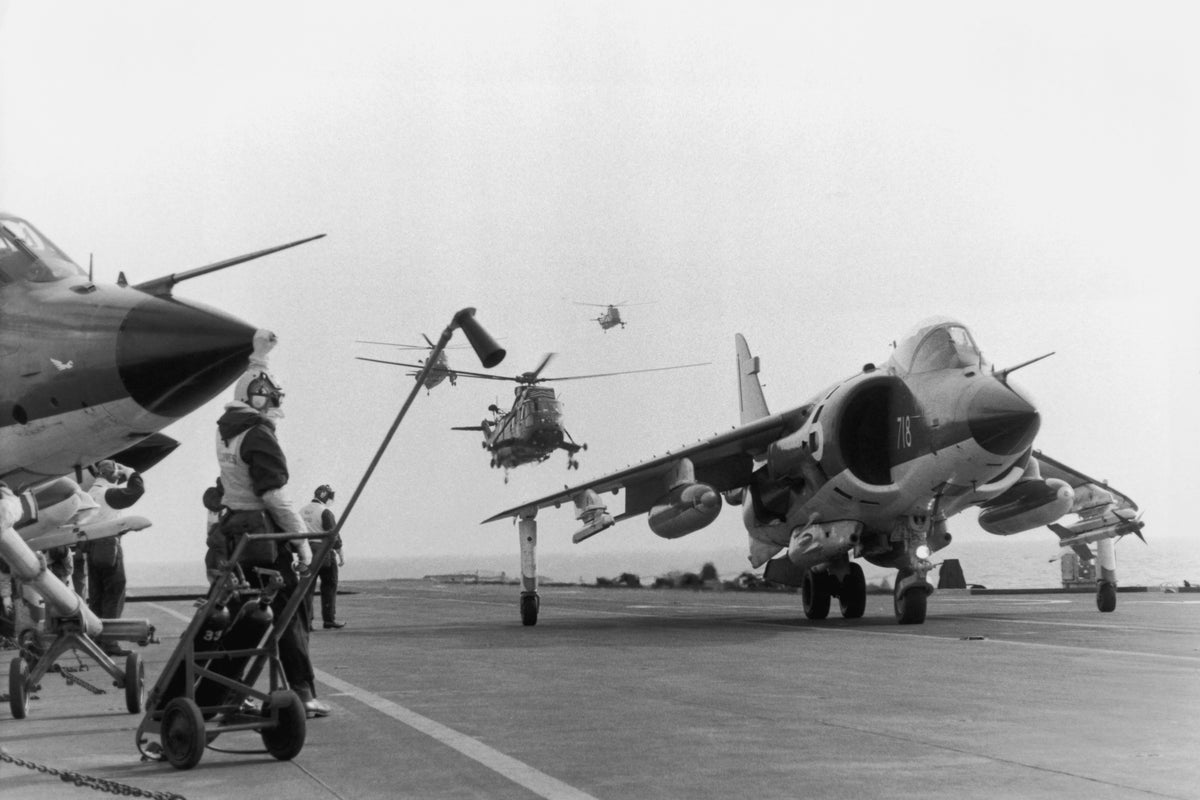
Argentina has threatened to seize the Falklands. There is one problem: their military is in tatters
Key Points
Argentina has threatened to seize the Falklands. There is one problem: their military is in tatters The Argentine president said Britain was ‘in decline’ in a broadcast on Thursday, as a result of what he called ‘crises of a migratory, demographic and economic character’ - Bookmark - CommentsGo to comments Javier Milei told his nation on Thursday that Argentina would “prevail” in its efforts to reclaim the Falkland Islands, after Donald Trump said he would reconsider the United States’...
Argentina has threatened to seize the Falklands. There is one problem: their military is in tatters
The Argentine president said Britain was ‘in decline’ in a broadcast on Thursday, as a result of what he called ‘crises of a migratory, demographic and economic character’
- Bookmark
- CommentsGo to comments
Javier Milei told his nation on Thursday that Argentina would “prevail” in its efforts to reclaim the Falkland Islands, after Donald Trump said he would reconsider the United States’ long-standing neutrality and cast doubt on Britain’s ability to defend itself.
Emboldened by Trump’s blessing, the Argentine president said in a televised address that he would sanction oil companies drilling in the British overseas territory in a move likely to escalate tensions with London.
“It is clear that they are in decline,” he said. “However, Argentina is flourishing, and it will prevail ... Our national claim is facing a clear and present danger and requires a proportional response. We will not allow it.”
The comments came after president Trump suggested the United States might not come to Britain’s aid in the event of an attack and questioned whether London would have the capabilities to fend off another invasion on its own.
An expanded defence partnership with the United States has helped Argentina to undertake a major transformation of its armed forces, more than four decades after suffering a resounding defeat to the British in 1982.
But analysts say Argentina is still “years off being able to even consider any military options in the Falklands”, while Britain can still project power to reinforce the islands and remain a global player - but should take the threats as a “wake up call”.
How powerful is Argentina's military?
Buenos Aires has steadily been rebuilding its military under Milei, who has been in power since 2023, through deals made with Europe and the United States. The country still only spends around 0.8 per cent of GDP on defence, worth around $3.9bn. Exact figures on active personnel were not immediately available.
Philip Ingram MBE, a former intelligence and security officer with the British Army, told The Independent: “The Argentinians are in a much weaker position militarily today than they were in 1982. And no matter what we say about British defence at the moment - and it is in an absolutely appalling condition - actually we’ve got a greater ability to defend the Falklands today than we had.”
The Argentine government in 2024 agreed to buy 24 second-hand US-made F-16 fighter jets from Denmark for $300 million, with the first six arriving in December last year. Milei framed the deal as the most important military acquisition in 50 years, and the ministry of defence said the jets - expected in batches of six each year until 2028 - would form the backbone of the air force.
Buenos Aires announced late in August that it was moving forward with a deal to buy 235 Stryker armoured vehicles from the United States. The government said they were also enhancing cooperation through joint training exercises with the US military.
Argentina has around 200 medium TAM tanks, though the marshy terrain of the Falklands would not lend itself to tank warfare.
The Argentine fleet is also weaker than it was in 1982. The country no longer operates an aircraft carrier or operational submarines. It can field three aging destroyers and six corvettes. Argentina would have shorter supply lines in the event of a conflict, with the Falklands around 300 miles from the mainland.
How does it compare to the British military?
Britain has scaled back its defence spending from the height of the Cold War, but remains a global power with a blue water navy - able to operate across oceans - and the ability to field expeditionary forces in other countries.
As of April 2025, there were around 182,000 people across the armed forces, including 147,000 full-time personnel. In the 2025/26 financial year, the UK spent £62 billion on defence - worth 2.3 per cent of GDP in 2025, expected 2.6 per cent in 2026.
The government has committed to spending at least 3.5 per cent of GDP on defence by 2035 - but only last week it was reported that new chancellor John Healey, who resigned as defence secretary in June over the lack of funding for the military, was expected to scrap his own target of spending 3 per cent by 2030 in the October budget.
Successive US governments have urged Britain - and other Nato allies - to increase spending to meet the demands of emerging challenges around the world without overreliance on Washington. Col. Ingram agreed that Trump was trying to encourage Britain to spend more in his comments on the Falklands.
Ingram said that despite the woeful relative condition of the military, technological advances would make it easier to defend the islands than in 1982. Britain can fly jets directly to the islands without stopping in the Atlantic due to advanced refuelling capabilities.
The UK still has a premier intelligence service with ties around the world, he said. And already stationed in the region are a number of fighter jets, a naval vessel, and a permanent military company.
“We’ve got enough to disrupt any Argentina activity that is coming towards the islands and to police it,” he said. “And we can reinforce it very quickly indeed from the United Kingdom. It would take every asset that we’ve got, but we could reinforce it.”
Ingram said Britain’s two contemporary Queen Elizabeth-class aircraft carriers, which can carry up to 72 aircraft each, are more capable than those available forty years ago. The Royal Navy has 52 vessels in its surface fleet, plus nine submarines, while the armed forces have 1,024 armoured fighting vehicles, 507 fixed-wing planes, around 250 helicopters and 189 UAVs.
And Britain’s intelligence service, recently ranked Europe’s most powerful agency, is now constantly tuned in to Argentina’s activities in the area.
“We still remain a global player, but only just. But we have a greater defensive capability on the Falklands that will deter Argentina,” Ingram concluded, suggesting Milei would escalate through lawfare sooner than military action in an effort to distract from political isssues at home.
Mr Milei, who has traditionally taken a diplomatic approach to the issue, and who lists Margaret Thatcher among his idols, on Thursday threatened to use economic and diplomatic tools to “dissuade” what he called a “violation of our sovereignty”.
Britain insisted on Friday that its commitment to the Falklands is “absolute and unshakable”, and analysts said that while the threats may come as a “wake up call”, Britain has a greater ability to defend the islands today than it had in 1982.
Join our commenting forum
Join thought-provoking conversations, follow other Independent readers and see their replies
Comments
Argentina (LOCATION)
Falklands (LOCATION)
Argentine (ORG)
Britain (LOCATION)
Javier Milei (PERSON)
the Falkland Islands (LOCATION)
Donald Trump (PERSON)
the United States (LOCATION)
Trump (ORG)
British (ORG)
London (LOCATION)
Buenos Aires (LOCATION)
Milei (ORG)
Europe (LOCATION)
Philip Ingram MBE (ORG)