
World News
DNA, fingerprints and photos: Singapore police join international effort to identify Nepal flood dead
Key Points
DNA, fingerprints and photos: Singapore police join international effort to identify Nepal flood dead With nearly 4,900 people still missing after Nepal’s devastating floods, Singapore police forensic specialists are helping local authorities identify the dead and bring answers to families desperately searching for loved ones. At Kathmandu’s Tribhuvan University Teaching Hospital, photos and names of those lost after the devastating flood on Aug 26 are plastered on a wall: a makeshift...
DNA, fingerprints and photos: Singapore police join international effort to identify Nepal flood dead
With nearly 4,900 people still missing after Nepal’s devastating floods, Singapore police forensic specialists are helping local authorities identify the dead and bring answers to families desperately searching for loved ones.
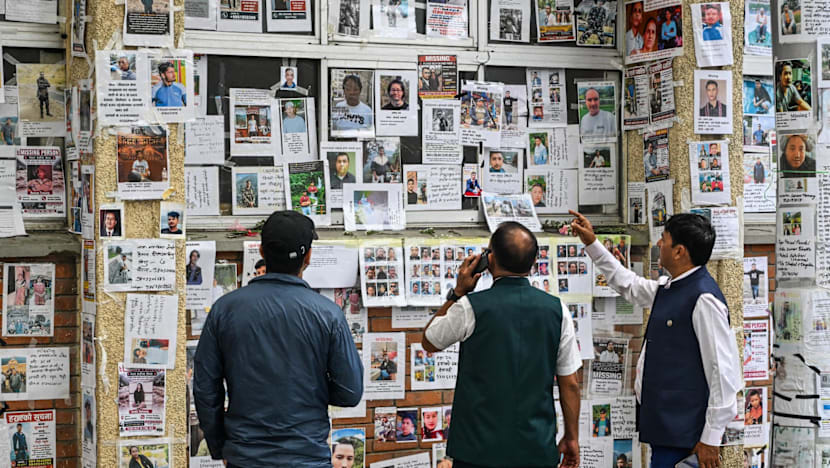
KATHMANDU: At Kathmandu’s Tribhuvan University Teaching Hospital, photos and names of those lost after the devastating flood on Aug 26 are plastered on a wall: a makeshift missing persons’ bulletin board.
They are the faces behind the tragedy.
There are hundreds of posters put up here by family members of the missing: for locals, newlyweds, foreigners, members of the army and children. All of it is out of pure desperation for just a little bit of information about what might have happened to them.
Twenty-nine-year-old Sahil Dewan is here looking for his brother, Samim, a cargo driver working near the Nepal-China border.
He sent his family a photo shortly before the flood struck and spoke to them on the phone. They have not heard from him since.
“All of us have been trying to locate him. Our entire family has been praying and trying to find him,” Dewan said.
Soon, he said, he plans to try and travel to the disaster zone himself, in a desperate final effort.
More than a week after the flood, those still searching are confronting an increasingly grim reality: most of those being found are no longer alive, despite several extraordinary rescues offering flashes of hope.
The recovery of the dead is also far outpacing efforts to identify them, creating new pressures on Nepal’s forensic services. As of Sep 5, 1,342 bodies have been found, yet fewer than 100 have been identified and returned to their families.
According to police, 4,886 people remain missing or out of contact, leaving the eventual scale of the disaster unclear.
Authorities have collected more than 2,200 DNA samples, including from 1,260 bodies and more than 1,000 relatives searching for loved ones. Details of 1,270 unidentified bodies have also been uploaded online in an effort to help families find a connection.
To ease the mounting pressure on Nepal’s disaster victim identification (DVI) operations, a specialist team from the Singapore Police Force (SPF) is now on the ground in Kathmandu, joining forensic experts from India, China and South Korea in supporting local authorities.
The 35-person contingent of SPF forensic specialists began departing Singapore on Sep 1. They will examine the dead and collect evidence that could help establish their identities, including DNA, fingerprints and photographs.
“I think typically in a flood situation, especially at this point in time, the bodies are quite badly decomposed, and the effect of the water actually causes some damage to the bodies,” said Eugene Wang, assistant commissioner of Singapore Police and DVI commander.
At another area of the Teaching Hospital, another set of photographs shows those realities of the difficulties identifying victims.
Dozens of photos are strung up of the unidentified dead, many in a deep state of decomposition. They are waiting to be matched to a name and a family.
“That's why bodies can become fragmented and that complicates and makes it a lot more difficult in terms of the DVI process. We want to work towards that identification that will help towards reconciliation and give some peace and hope to the families,” Wang told CNA.
And more are still being recovered. They keep arriving by the day.
SOUTHERN SEARCHES
The sheer number of unidentified bodies has overwhelmed mortuaries in parts of the country.
In Chitwan in southern Nepal, about 150 km from the capital, authorities have begun temporarily burying victims after forensic samples are taken.
The floodwaters that surged down the Trishuli River system travelled hundreds of kilometres bringing with them mud, debris and the dead.
Here, the scale quickly overwhelmed local capacity. Hospitals across Chitwan had mortuary space for only about 50 bodies when more than 200 had already been recovered in the district.
Before burial, forensic teams collect DNA and preserve identifying information for each set of remains, while the location of individual graves is recorded.
The system is designed so that if DNA later produces a match, authorities can locate and exhume the remains and return them to relatives for the appropriate final rites.
Many victims have been recovered far from where they disappeared. By Sep 5, 360 bodies had been found in Chitwan, more than twice the number recovered in Rasuwa, where the disaster began.
Here, Nepali police continue to scour the waters, a grim task growing tougher by the day.
Finding all the missing dead bodies will be a very challenging task, which can hopefully be completed with foreign assistance, said Om Bahadur Rana, the deputy inspector general of Nepal Police.
“A lot of countries are affected by disasters. It could be any other country next time. The support has been great,” he said.
Nepal has appealed internationally for more DNA testing kits, laboratory freezers and equipment for handling human remains as it struggles with the scale of the operation.
A crisis response team from Singapore's Ministry of Foreign Affairs has also been in Nepal since Aug 27, searching for information on nine Singaporeans who remain missing.
Singapore authorities have collected DNA samples from the next-of-kin of the missing Singaporeans to assist with identification efforts, while officials on the ground are pursuing possible leads and working with Nepali authorities for information on their whereabouts.
“We're chasing every possible lead, and within the constraints that are set by the Nepali authorities, we're doing everything that we can to assist in the search of the missing Singaporeans and leaving no stone unturned,” said Joshua Lim, a first secretary (Political) at the Singapore High Commission in New Delhi.
MFA said it is in close contact with families of those missing, providing regular updates, assistance on the ground and other support.
Where road safety conditions permit, the crisis team has also travelled out to disaster-hit areas including Nuwakot, Chitwan and Pokhara to follow up and gather as much information as possible, Lim said.
For the Singapore police delegation, the scale and conditions here are unlike anything they would encounter at home.
“We are operating in a very different operating environment. Mentally, our team is prepared” said Patrick Tan, assistant commissioner of Singapore Police and the contingent commander.
“I think this is the main challenge we are facing now. But with our training and our teamwork, we can overcome the challenges by working closely and with our Nepali counterparts,” he said.
While the team is hopeful of finding answers about the missing Singaporeans, Wang said they were “humbled” to be able to help in any way they can.
For thousands of families, the wait for answers continues.
Among them is Banjyan Tamang. Her son Rohit is one of eight missing family members, she said, from the Rasuwa district near the Tibetan border, one of the areas worst hit by the disaster.
But unlike the families whose photographs cover these walls, she does not have one to put up. Nor does she own a mobile phone on which she could show images of those she has lost.
“One of the photos on top there resembled my son but when I checked the name, it was someone else who looks exactly the same,” she said.
“There is no trace of them until now. What should I do? If they are safe and alive anywhere, I am ready to go rescue them myself,” she added.
“But at this point, we don’t know whether we are looking for the dead or the living.”
Singapore (LOCATION)
Nepal (LOCATION)
KATHMANDU (PERSON)
Tribhuvan University Teaching Hospital (ORG)
Sahil Dewan (PERSON)
Samim (PERSON)
China (LOCATION)
Dewan (PERSON)
DVI (ORG)
the Singapore Police Force (ORG)
India (LOCATION)
South Korea (LOCATION)
Eugene Wang (PERSON)
the Teaching Hospital (ORG)