
Education
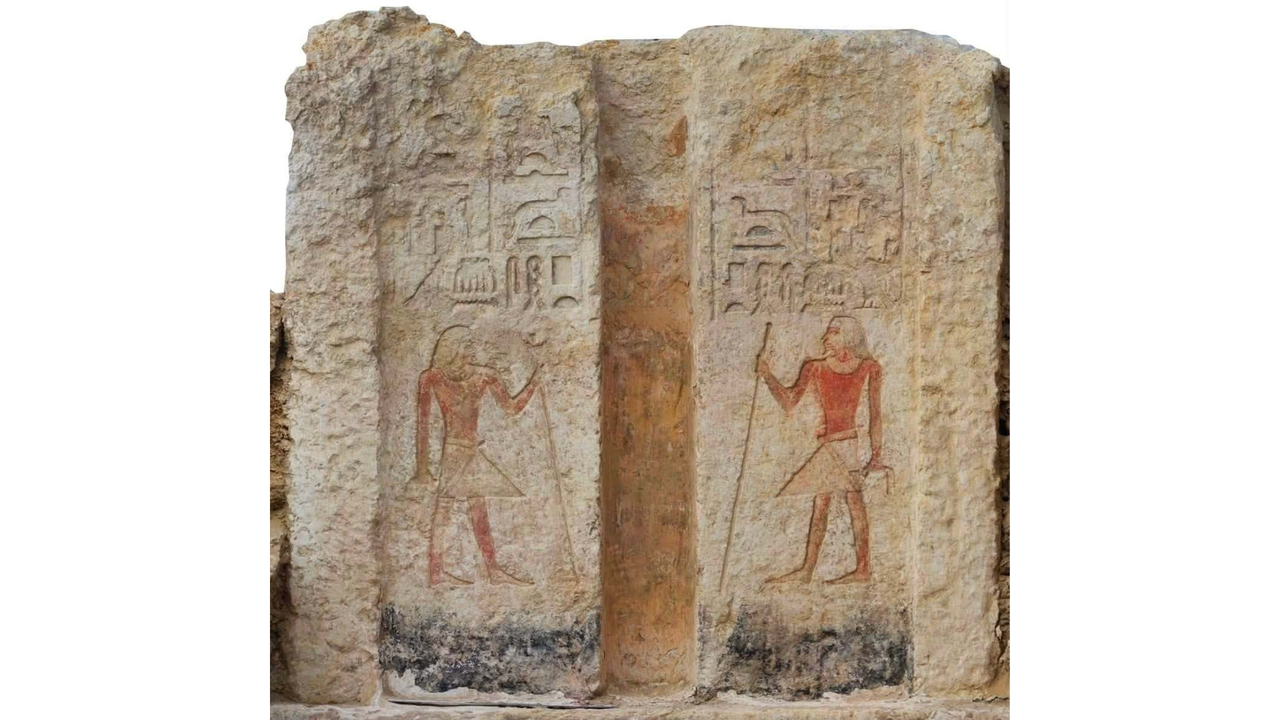
Ancient Egyptian tomb holding the king's 'keeper of secrets' unearthed at Saqqara
Key Points
Ancient Egyptian tomb holding the king's 'keeper of secrets' unearthed at Saqqara The tomb of a pyramid-age official has been found at Saqqara in Egypt. Archaeologists in Egypt have discovered an ancient tomb belonging to the "keeper of the secrets of royal decrees," they announced following an excavation at Saqqara. The decorated burial belongs to an official named Sekhentio-Ptah, who lived during the Old Kingdom (2649 to 2150 B.C.), a period that's famous for the building of the pyramids,...
Ancient Egyptian tomb holding the king's 'keeper of secrets' unearthed at Saqqara
The tomb of a pyramid-age official has been found at Saqqara in Egypt.
Archaeologists in Egypt have discovered an ancient tomb belonging to the "keeper of the secrets of royal decrees," they announced following an excavation at Saqqara.
The decorated burial belongs to an official named Sekhentio-Ptah, who lived during the Old Kingdom (2649 to 2150 B.C.), a period that's famous for the building of the pyramids, including those at Giza.
While the title "keeper of the secrets of royal decrees" may sound mysterious, it was likely a more bureaucratic position, said Ann Macy Roth, a clinical professor of Egyptology at New York University who was not involved with the excavation.
It "probably merely means that as someone in charge of royal documents and the people who write them, he has access to confidential information," Roth told Live Science in an email. "It's a common title among royal scribes."
The official Sekhentio-Ptah had a number of other titles, according to his tomb, including "Overseer of all the King's Works" and "Overseer of Royal Documents," representatives of Egypt's Ministry of Tourism and Antiquities wrote in a translated statement.
Within the tomb, archaeologists found an offering table, a purification basin and two false doors. The false door is a symbolic door, commonly found in ancient Egyptian tombs, that was believed to allow the soul to exit and enter the tomb at will. The design of the false doors places them in the late fifth or early sixth dynasty, around 4,350 years ago, Roth said.
More than 100 shabtis (also spelled ushabtis) were found in the tomb. Ancient Egyptians believed these figurines would act as servants for the deceased in the afterlife. The team also discovered a wooden statue of a falcon (possibly related to the falcon-headed god Horus) and the remains of cartonnage, a plastered material used on mummies. The mummy of Sekhentio-Ptah was not identified.
Get the world’s most fascinating discoveries delivered straight to your inbox.
Related stories
Looking at the photos and information the ministry released, Roth said it's likely this tomb was reused for later burials — something that was commonly done in ancient Egypt. She said the shabtis found in the tomb likely belong to later burials and the cartonnage is likely from mummies that were buried in the tomb at a later date.
The team discovered the tomb in the Bubasteion (also spelled Bubasteum) area of Saqqara, a place that was commonly used for cat burials in later times such as the late period (circa 664 to 332 B.C). The site was associated with Bastet, a cat-shaped goddess associated with fertility and protection. However, the statement didn't mention any cat burials found in this particular tomb.
Live Science reached out to the excavation team but did not hear back by the time of publication.
See how much you know about mummies with our mummy quiz.
Owen Jarus is a regular contributor to Live Science who writes about archaeology and humans' past. He has also written for The Independent (UK), The Canadian Press (CP) and The Associated Press (AP), among others. Owen has a bachelor of arts degree from the University of Toronto and a journalism degree from Ryerson University.
You must confirm your public display name before commenting
Please logout and then login again, you will then be prompted to enter your display name.
Ancient Egyptian (ORG)
Saqqara Ancient (LOCATION)
Egyptian (ORG)
Saqqara The (LOCATION)
Saqqara (LOCATION)
Egypt (LOCATION)
Sekhentio-Ptah (ORG)
the Old Kingdom (LOCATION)
B.C. (LOCATION)
Giza (LOCATION)
Ann Macy Roth (PERSON)
Egyptology (ORG)
New York University (ORG)
Roth (PERSON)
Live Science (ORG)