
Politics
Germany’s far-right AfD set for unprecedented election win: 3 scenarios for what happens next
Key Points
Germany’s far-right AfD set for unprecedented election win: 3 scenarios for what happens next Whether the pro-Russian AfD become the first far-right party to take control of a regional parliament in Germany since the Second World War or not, their victory creates a large poliital headache for the country’s leaders Chris Steveson and James C. Reynolds write - Bookmark - CommentsGo to comments The confirmed, full results in Germany's Saxony-Anhalt regional election are likely to be a major...
Germany’s far-right AfD set for unprecedented election win: 3 scenarios for what happens next
Whether the pro-Russian AfD become the first far-right party to take control of a regional parliament in Germany since the Second World War or not, their victory creates a large poliital headache for the country’s leaders Chris Steveson and James C. Reynolds write
- Bookmark
- CommentsGo to comments
The confirmed, full results in Germany's Saxony-Anhalt regional election are likely to be a major political headache for Chancellor Friedrich Merz, whose centre-right Christian Democrats (CDU) party have governed the eastern state for more than 20 years.
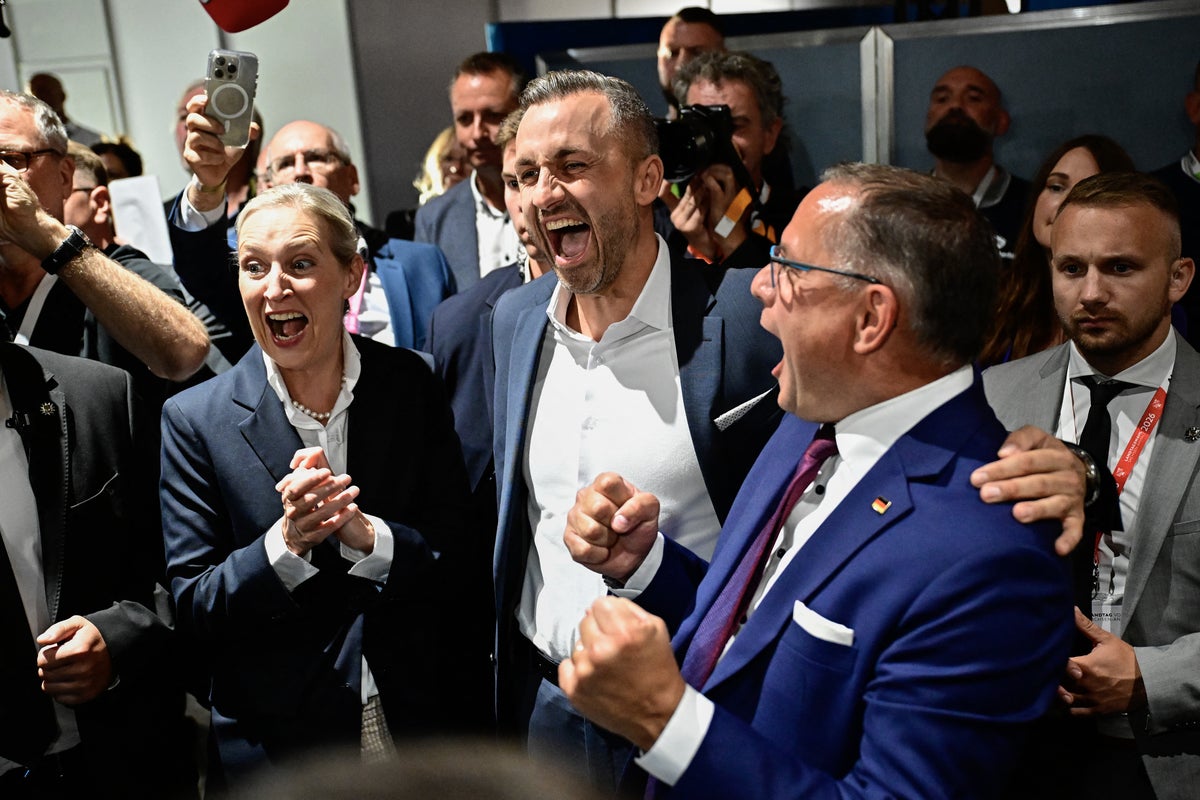
Sunday evening’s exit poll showing the far-right, pro-Russian, Alternative for Germany (AfD) potentially gaining 44.5 per cent of the vote is beyond the 40 per cent recent opinion polls had been showing and well in excess of the 20.8 per cent the party secured in 2021. Mr Merz's CDU fell to 18.5 per cent in the exit poll from 37.1 per cent in 2021. The CDU currently leads a coalition with the centre-left Social Democrats (SPD) and the free-market Free Democrats (FDP).
About 1.7 million people were eligible to vote in the east-central state of 2.1 million residents. Participation was at a record high of 76.5 pert cent
The AfD had been looking to secure an absolute majority of above 50 per cent, to ensure they could try and implement their own radical agenda.
So what happens now?
1. The AfD seize power
If the AfD were to take control of the regional parliament, they would be the first far-right party to have power in either a regional or the national parliament since the Second World War. If this were to happen, what is known in Germany as the "firewall" – where parties create coalitions to keep far-right parties from power – would be breached for the first time.
The AfD has been clear about what it would do if it were to take power. It seeks to restrict immigration, quit the Euro and restore ties with Russia as most of Europe rallies around Ukraine.
Based on the party’s “Vision 2026” election manifesto, victory in Saxony-Anhalt could invite sweeping reforms around state policy on migration, education, culture and the family.
Under Germany's federal system, state governments sit in the upper house of parliament, the Bundesrat, and also have wide powers in education, domestic security and culture.
An AfD-led state would launch a crackdown on migration with a task force set up to coordinate quicker deportations.
The children of refugees would be placed in separate classes at school to prevent what the party claims are “stresses” on the other children from being around different cultures.
Meanwhile children with disabilities would no longer be taught in the same classroom as those without, instead, being sent to new schools.
Schools would also be banned from flying rainbow flags, and the government would exhaust “all legal avenues” to limit Islamic expression.
The party has claimed greater acceptance of what it offensively labels as"sexual deviations and non-reproductive lifestyles" has contributed to sinking birth rates and promises to aggressively promote "traditional" family structures consisting of a mother, father and children. An AfD government would see major changes to the school curriculum around a “patriotic cultural policy”, extended to raising the German national flag daily and singing the national anthem at school celebrations.
It would also advocate for removing war refugee status for Ukrainians in Germany as long as the conflict remains concentrated in eastern Ukraine, arguing they should seek refuge in western Ukraine.
The current structure of the public broadcasting system would be dismantled and funding withdrawn for some cultural institutions.
In terms of domestic security in Saxony, the AfD in the state is assessed by Germany's domestic intelligence agency as a "far-right extremist" group, which would create concerns about the intelligence the AfD would be able to see if it was in charge of the regional parliament.
However, the AfD will likely need the support of another party, depending on how many smaller parties pass the five per cent threshold needed to get seats. In Saxony-Anhalt, all the parties except the small far-left BSW party have ruled out joining a coalition with the AfD.
If some smaller parties do not pass the threshold though, it would make the AfD's job easier as it would make the chance of a coalition against it less likely.
The party will talk to any sensible party with whom it can find common ground on policy positions, said AfD national co-leader Alice Weidel after the exit poll
2. The CDU pull together a coalition
The CDU has been hit hard, but may yet be able to pull together a "firewall coalition". That is what happened in the state of Thuringia in 2024, where the AfD gained more than 30 per cent of the vote, but not enough for an absolute majority.
However, American think tank the Brookings Institution believes this will be difficult. “The task of organizing a CDU-led governing majority faces almost insurmountable difficulties” it said in a recent briefing note, exacerbated by the CDU’s ruling out of any coalition with the far-left The Left party. The Left party has indicated it would be open to an arrangement formalising support for a CDU-led government over the AfD. But the CDU faces internal divisions over a possible alliance with the ideologically remote far-left.
Mr Merz said ahead of the election last Sunday that they would “assess the situation in light of the election results” and “do everything we can to prevent Saxony-Anhalt from falling into the hands of the radicals”.
State premier Sven Schulze congratulated the AfD in the wake of the exit poll and acknowledged the result showed it was the strongest party. If the AfD is unable to rule outright, it could trigger a protracted process of coalition building by mainstream parties who are determined to keep a party under investigation for right-wing extremism by Germany's domestic intelligence service out of power.
3. The German government takes a hit regardless
However the political wrangling in the wake of the Saxony result ends up, it is clear that the manner of the AfD's win is important for their national standing and a blow to Mr Merz's coalition government.
Nationwide, the AfD has swollen to become the most popular party, polling at 29 per cent, while Mr Merz has become the most unpopular chancellor since the founding of the Federal Republic, with 85 per cent of voters dissatisfied.
Lars Klingbeil, co-leader of Germany's centre-left SPD party and vice chancellor in Mr Merz's governing coalition, said after the exit poll that the result of the Saxony-Anhalt state election is a signal for Berlin politics. The result is a reason to reflect on the federal government’s policies, Mr Klingbeil told public broadcaster ZDF. “And rest assured, that is what we will do.”
Mr Merz has already sought to create a harder line on immigration, in a move designed to try and stem the rise of the AfD. There will no doubt be a greater push from the AfD to try and move the needle on national policy, while their pro-Russia stance could be an issue when it comes to European support for Ukraine, given the nation has previously been accused of moving cautiously when it comes to handing Ukraine weapons to fight off Russia's invasion.
Mr Merz will face an increasing level of political pressure about his own job and government, something the AfD will be all too happy to try and press home in both future regional elections and the wider national polls.
Join our commenting forum
Join thought-provoking conversations, follow other Independent readers and see their replies
Comments