
Education
Beyond STEM: Why Singapore tertiary institutions are putting more emphasis on arts and social sciences
Key Points
Beyond STEM: Why Singapore tertiary institutions are putting more emphasis on arts and social sciences As AI takes on more technical and routine tasks, educators are placing greater emphasis on creativity, critical thinking, communication, empathy and real-world problem solving. SINGAPORE: Programming a robot to perform a series of movements once meant spending time writing lines of code. Today, with artificial intelligence handling much of the technical work, students can get it done in...
Beyond STEM: Why Singapore tertiary institutions are putting more emphasis on arts and social sciences
As AI takes on more technical and routine tasks, educators are placing greater emphasis on creativity, critical thinking, communication, empathy and real-world problem solving.
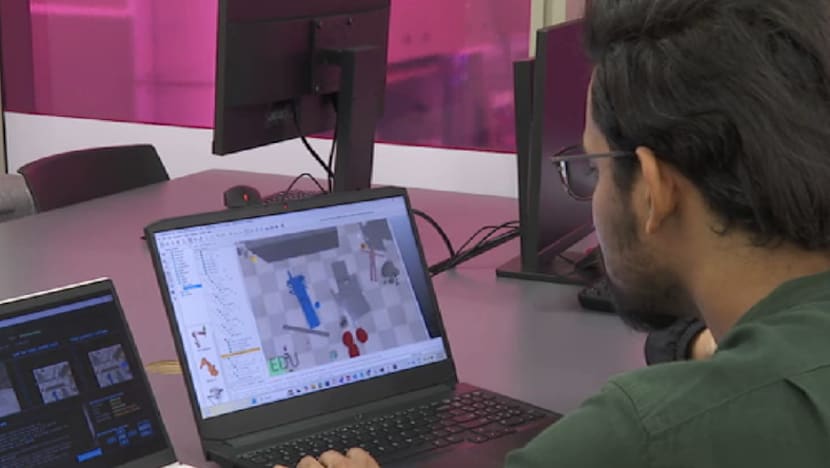
SINGAPORE: Programming a robot to perform a series of movements once meant spending time writing lines of code.
Today, with artificial intelligence handling much of the technical work, students can get it done in under a minute.
That leaves them with more time to think about what they want the technology to do, and to find solutions for different scenarios.
It is a small example of a broader shift taking place in tertiary education institutions here: from STEM – science, technology, engineering and mathematics – towards STEAM, which adds arts to the mix.
PSB Academy said demand for STEAM education has grown 47 per cent in the past two years, with student numbers rising from around 3,400 in 2023 to 5,000 last year.
Its CEO Derrick Chang said the demand is driven by students who want to expand their skill sets beyond their main subject of study.
He said technical students, for example, are looking to develop skills such as design thinking and communication skills, while non-technical students need to be comfortable using AI.
“Gone are the days where a technical person can just stay technical for a long time,” he said.
“As an engineer today and in the future, you need to be able to communicate your thinking, communicate your innovation.”
Noting that it was no longer “a single track”, Mr Chang said the ability to be multidisciplinary would continue to be critical to surviving in this new economy.
The private education institution is also building an Integrated STEAM Hub at Tai Seng, with larger, interdisciplinary learning spaces and high-tech facilities. The hub is expected to be ready in 2027.
FRAMING THE PROBLEM CORRECTLY
At the Singapore University of Technology and Design (SUTD), there is also a growing focus on combining technology with the humanities and social sciences.
The university said its refreshed curriculum is designed to attract students with strong interests in fields such as economics, business, psychology and philosophy, alongside those proficient in mathematics and the sciences.
Dr Grace Dixon, associate head of the programme, said these subjects should not be seen simply as “soft skills” added to a technology degree.
Instead, they help students understand the context and the problems they are trying to address before using design and AI capabilities to resolve them.
“It's not just about asking, 'can we do this', but 'should we do this', for whom and under what conditions?”
“If you frame the problem incorrectly, even an excellent technical solution may solve the wrong problem,” she added.
At the university, students and alumni will also get funding and support via a S$35 million (US$27.6 million) investment platform to pursue entrepreneurial projects.
At the Singapore campus of James Cook University, students are similarly being pushed to tackle real-world problems.
Its new barramundi hatchery facility lets students train in conditions that mirror the aquaculture industry, including learning how to respond when things do not go according to plan.
“We're really making sure that students are problem-focused, and that they've got practical skills, and that they're resilient,” said Professor Carole-Anne Upton, the university’s deputy vice-chancellor for Singapore.
“Resilience is quite a hard thing to teach, and we talk about resilience and agility as key skills for a changing workforce."
The ‘A’ IN STEAM
Other universities are taking the arts component of STEAM education more literally.
Inspired by its Arts Festival last year, Singapore Management University (SMU) is piloting a dance choreography course that explores Singapore’s culture and identity while developing creativity and empathy – skills it believes AI cannot yet replicate.
SMU’s professor of communication management (practice) Mark Chong said dance can become more than just a co-curricular activity when paired with intellectual inquiry.
“By marrying it with intellectual rigour, by using it as a platform to examine some of the cultural forces that shape the emergence of Singaporean identity … we can get students to think about not just learning dance techniques for the sake of learning the dance,” he said.
It can encourage them to ask larger questions about “what multiculturalism and national identity mean”, he added.
WHAT EMPLOYERS WANT IN THE AI ERA
The shift to adapt does not just apply to students preparing to enter the workforce.
At Kaplan, about six in 10 of its Singapore students are early or mid-career professionals.
As AI takes on more routine tasks across industries, employers are looking for a different mix of skills.
They are increasingly seeking people who can interpret information that AI gives them and turn it into decisions, said Mr Alex Chevrolle, managing director of Kaplan Singapore.
“They are looking for people that can … think about that information, analyse it, provide actionable insights, communicate those insights, advocate for them, and then collaborate with other colleagues around the business in order to execute on those insights,” he said.
A similar change is taking place at the Management Development Institute of Singapore (MDIS), where more than half its students are working adults.
A new campus next year will give students access to digital tools aimed at sparking creativity, while retaining the face-to-face learning that adult learners value.
The institute has also shifted away from exam-centred learning towards assignments based on actual business problems.
EHL Hospitality Business School, meanwhile, has seen courses taken up by working professionals rise by nearly 40 per cent year on year.
The school said adult learners are increasingly seeking practical training that can be immediately applied at work, including in people leadership, AI literacy and business transformation.
It is also seeing interest in learning that sits at the intersection of technology, business and human capabilities.
As technology continues to get smarter, educators say the premium is shifting to what people can bring to the equation – creativity, judgement and the ability to keep learning.