
Politics
CNA Explains: From Lake America to the Department of War, 5 name changes under Trump and why they matter
Key Points
CNA Explains: From Lake America to the Department of War, 5 Trump-era name changes and why they matter Presidential orders can change official US usage, but they cannot dictate what the rest of the world calls a place. Still, adoption by influential players such as Google and Apple could help new names gain wider acceptance. Open Google Maps in the United States today and you will find some familiar landmarks bearing unfamiliar names.
CNA Explains: From Lake America to the Department of War, 5 Trump-era name changes and why they matter
Presidential orders can change official US usage, but they cannot dictate what the rest of the world calls a place. Still, adoption by influential players such as Google and Apple could help new names gain wider acceptance.
SINGAPORE: Open Google Maps in the United States today and you will find some familiar landmarks bearing unfamiliar names.
The Gulf of Mexico appears as the Gulf of America. Lake Ontario is labelled Lake America. And North America's tallest mountain is once again Mount McKinley rather than Denali.
They are part of a series of name changes pursued by US President Donald Trump since he returned to the White House. His efforts have extended beyond geographical landmarks to government and cultural institutions.
The Trump administration, for instance, now uses "Department of War" as a secondary title for the Department of Defense and refers to Defense Secretary Pete Hegseth as "Secretary of War".
In the latest move on Sunday (Sep 6), Trump proposed renaming the state of New Mexico to "New America".
However, whether he can make these names stick varies.
Some changes apply only to the US federal government, while others require congressional approval, or involve places shared with other countries that have rejected the new names.
Although US president cannot dictate what private companies call these places, a few of his preferred names have already reached millions of people through Google and Apple, which altered their maps.
CNA takes a look at what Trump has renamed, why he is doing it and how far his power to make these changes extends.
LAKE ONTARIO
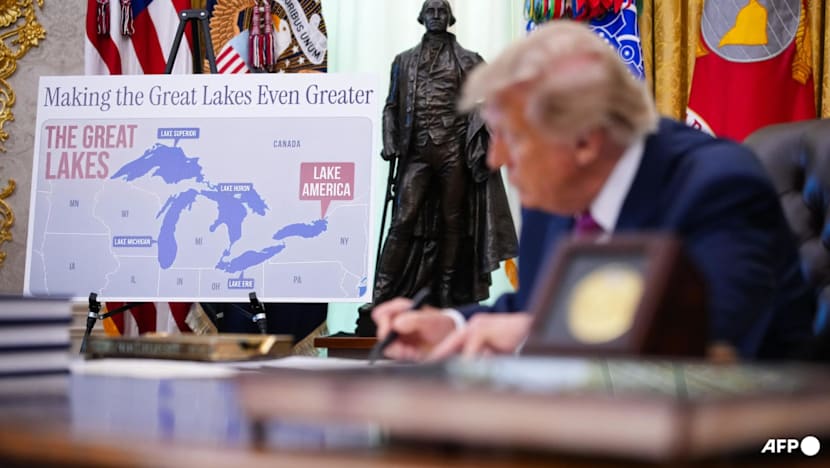
Trump issued an executive order renaming Lake Ontario as "Lake America" in late August, amid an escalating trade war with Canada.
The lake sits between Canada's Ontario province and the US state of New York, straddling the border between the two countries. It has been known as Lake Ontario for more than 400 years.
Trump justified the name change by arguing that the deepest part of the lake lies on the American side, meaning that the US "claims most of the lake's volume".
However, the order's reach is limited. Canada and New York have said they will keep calling it Lake Ontario.
Law professor Michael Dorf from Cornell University in New York told CNA that private companies are also under no legal obligation to adopt the new name.
The executive order determines what the US federal government calls the lake, but does not dictate what Canada, international bodies, private companies or individuals call it.
Prof Dorf also questioned whether the federal government followed the legally required process in implementing the change. He argued that the US Board on Geographic Names appeared either to have been bypassed or to have acted without following the process required under federal law.
Despite having no legal obligation to do so, Google and Apple changed their maps after Trump's order.
US users of both services see "Lake America", while those in Canada see "Lake Ontario". Users elsewhere see both names.
Both companies generally follow official government naming sources for their maps. Google, for example, has said that it updates place names when they are changed in official government sources.
However, the companies' decisions could have consequences beyond what appears on a map.
Professor Derek Alderman, a chancellor's professor at the University of Tennessee, said that it would be interesting to see how companies decide to respond to the name change, as their decisions could determine whether it becomes widely used and how long it survives, even after Trump's presidency.
Government orders alone do not give a new name its influence, he pointed out. It depends on how often the name is used by companies, communities and individuals in everyday life as well.
In that sense, the adoption of "Lake America" by influential companies such as Google and Apple can help legitimise and spread the name, Prof Alderman said.
Private companies, though, are caught between pressure from the government and their own users who might have strong opinions about retaining Lake Ontario's name.
Prof Alderman, who is also former president of the American Association of Geographers, said: "While companies may wish to avoid angering President Trump and his supporters ... other companies may realise a commercial advantage with keeping the name Lake Ontario and attracting customers who refuse to patronise a business using Lake America."
Some users have already pushed back. Prof Alderman pointed to renewed interest in MapQuest, which has said that it will not adopt "Lake America".
But he cautioned that it remains unclear whether this will translate into a lasting shift away from Google or Apple.
There may also be pressure from the administration itself.
Prof Dorf pointed to how the Trump administration restricted news agency The Associated Press' access to some White House events after the news organisation refused to use his new name for the Gulf of Mexico.
Apple and Alphabet, Google Maps’ parent company, "may have feared retribution from the vindictive president", he said.
As for why Trump is doing this, Prof Dorf said it was hard to tell because the US president often acts on impulse.
"He seems to think that the name change will give him leverage in trade negotiations with Canada, but he may also have acted simply out of anger."
The president might also be trying to draw attention from the bigger issues surrounding the dispute with Canada, which announced retaliatory tariffs on more than 700 American goods days before Trump announced the Lake Ontario name change.
"Many critics have suggested ... that the timing of the renaming of Lake Ontario was intended at least partly to distract attention from the economic and political fallout surrounding the administration's escalating trade conflict with Canada," Prof Alderman said.
However, he warned against dismissing these name changes merely as distractions or political stunts, arguing that they can have lasting cultural and political consequences.
Trump’s efforts amount to "inscribing an 'America First' nationalist ideology onto the landscape", Prof Alderman added.
This projection of US power diminishes geographical names that reflect connections with a wider world.
"The loss of 'Ontario' in 'Lake Ontario' and 'Mexico' in 'Gulf of Mexico' is about affirming a worldview in which bordering neighbour countries and regions seem to no longer matter, even though they certainly do," he pointed out.
The changes also allow Trump to demonstrate his ability to challenge established conventions, Prof Alderman said.
"The president sees the control of place names as a way of re-branding and redrawing the US map around his own worldview."
GULF OF MEXICO
At the start of his second term, Trump turned his attention to the Gulf of Mexico, announcing during his inauguration that it would be called the Gulf of America.
"America will reclaim its rightful place as the greatest, most powerful, most respected nation on Earth," he said.
The gulf is bordered by the US, Mexico and Cuba.
Even though Trump's announcement seemed to apply to the entire body of water, his executive order covers only the portion under US jurisdiction.
Google Maps, however, displays "Gulf of America" across the whole body of water for US users, which prompted a complaint from Mexico.
Prof Alderman said that the change projects a "problematic idea that America can claim and, in effect, own international bodies of water that don't belong to just one country."
Trump has since floated the possibility that he might rename oceans.
"We have a gulf and we have a lake. Now all we need is an ocean. So, maybe we'll have to change the name of the Atlantic and/or the Pacific. Maybe we'll change them both," he said in August.
MOUNT DENALI
At the start of his second term, Trump also changed the federal government's name for North America's tallest mountain, reverting it to Mount McKinley. Former US President Barack Obama had renamed it Denali in 2015.
Standing at more than 6,000m, the mountain is part of Denali National Park and Preserve in Alaska. It has been known by different names over its history.
The US National Park Service website states that the name "Mount McKinley" emerged during the Alaska gold rush, after a gold prospector who admired then-US president-elect William McKinley used it in an 1897 newspaper article.
McKinley had no direct connection to Alaska, but the name was popularised after his assassination in 1901 and became official 16 years later.
In 2015, the Obama administration officially changed the federal name to “Denali”, a move that Alaskans had championed for decades. The name comes from the region's Koyukon language and is commonly translated as "The Great One".
Trump ordered the mountain renamed to Mount McKinley shortly after returning to office, calling the previous name change "an affront to President McKinley’s life, his achievements and his sacrifice".
Prof Alderman said that the decision came as many nations and US states were working to preserve and amplify indigenous histories and connections with the landscape.
"President Trump's renaming decisions, like many of his policies, are motivated by an anti-DEI (diversity, equity, and inclusion) stance that narrowly defines who matters in America and its historical and geographic imagination," he added.
Alaskan lawmakers have urged Trump to retain Denali's name, arguing that the mountain is a cornerstone of the region's history and a tribute to its culture.
However, McKinley's great-great-nephew said that his ancestor deserved a mountain named after him and that having the entire park named Denali was an appropriate compromise.
KENNEDY CENTER
Another controversial rebranding involves the Kennedy Center, which Congress designated as a living memorial to former US President John F Kennedy in 1964.
The performing arts centre in Washington, DC, underwent a leadership overhaul last year after Trump removed its board members and replaced them with allies.
Months later, the White House announced that the new board planned to rename the institution the "Trump-Kennedy Center".
While the White House said the board's vote on the name change was unanimous, at least one board member disputed that account, news outlet BBC reported.
Ohio Democratic Representative Joyce Beatty said that she was muted during the call and prevented from speaking or voicing her opposition to the move.
Members of Kennedy's family slammed the decision, with his niece Maria Shriver saying it was "beyond comprehension".
"This is not dignified. This is not funny … It's downright weird. It's obsessive in a weird way," she wrote in a post on social media platform X.
Trump, who previously joked about a name change for the centre, said he was "surprised" and "honoured" by the decision.
In May, a court ordered Trump's name removed from the building after Beatty challenged the renaming in a law suit.
But the legal tussle continued. Last month, the centre's board voted to change the building's signage again, this time to read: "The John F Kennedy Memorial Center for the Performing Arts Renovated and Restored by President Donald J Trump".
A US court is now weighing that decision, as well as the board's proposal to rename the centre's grounds as the "President Donald J Trump Plaza".
SECRETARY OF DEFENSE
Trump marked his 200th executive order since returning to office with another push to revive an old name.
In September last year, he authorised "Department of War" as a secondary title for the Department of Defense.
The order also authorised Defence Secretary Pete Hegseth to use the secondary title "Secretary of War".
"I think it's a much more appropriate name, in light of where the world is right now," Trump said, adding that "it sends a message of victory", BBC reported.
The move revives the "Department of War" name used in the 1940s.
The Pentagon has acted on Trump's order, replacing some "Department of Defense" signs and changing its website domain and title.
However, only Congress can permanently change the department’s legal name.
The House approved the change in July as part of its version of the Fiscal Year 2027 National Defense Authorization Act, but the Senate has yet to do so.
CNA (LOCATION)
Lake America (LOCATION)
the Department of War (ORG)
Trump (ORG)
US (LOCATION)
Google (ORG)
Apple (ORG)
the United States (LOCATION)
The Gulf of Mexico (LOCATION)
the Gulf of America (LOCATION)
Lake Ontario (LOCATION)
North America's (LOCATION)
Mount McKinley (LOCATION)
Denali (ORG)
Donald Trump (PERSON)