
Health
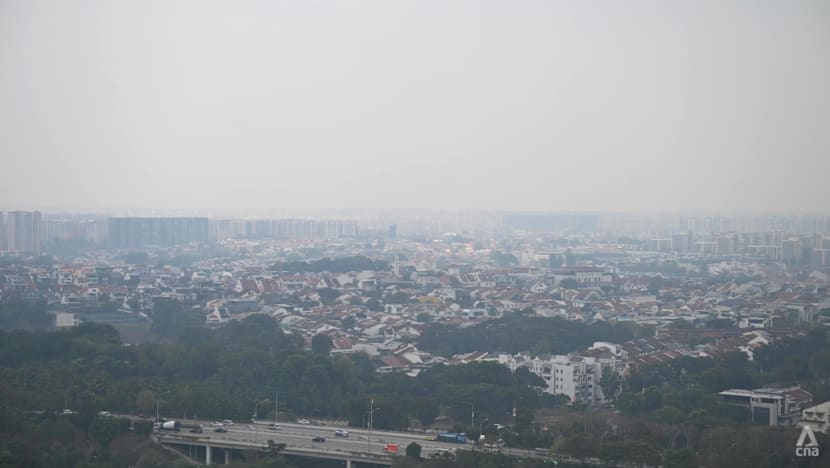
Air quality to remain in moderate to low unhealthy range on Tuesday: NEA
Key Points
Air quality to remain in moderate to low unhealthy range on Tuesday: NEA NEA said that moderate to dense smoke plumes from fires in southern and central Sumatra, as well as West Kalimantan, continued to drift towards Singapore. Air quality across Singapore remained in the moderate range on Monday (Sep 7), with the National Environment Agency (NEA) forecasting the 24-hour Pollutant Standards Index (PSI) for Tuesday to be in the moderate to low unhealthy range.
Air quality to remain in moderate to low unhealthy range on Tuesday: NEA
NEA said that moderate to dense smoke plumes from fires in southern and central Sumatra, as well as West Kalimantan, continued to drift towards Singapore.
SINGAPORE: Air quality across Singapore remained in the moderate range on Monday (Sep 7), with the National Environment Agency (NEA) forecasting the 24-hour Pollutant Standards Index (PSI) for Tuesday to be in the moderate to low unhealthy range.
The 24-hour PSI was between 63 and 85 as at 6pm on Monday.
In its health advisory, NEA said that if the air quality for the next day is moderate, all groups - healthy individuals, the elderly, pregnant women, children and those with chronic lung and heart disease - can continue with normal activities.
If the air quality is unhealthy, healthy individuals should reduce prolonged or strenuous outdoor physical exertion.
The elderly, pregnant women and children should minimise such activities, while those with chronic lung and heart disease should avoid them altogether, said NEA.
On Monday, NEA said that moderate to dense smoke plumes from fires in southern and central Sumatra, as well as West Kalimantan, continued to drift towards Singapore.
"Some showers are expected over parts of Kalimantan in the coming days. However, dry conditions are expected to persist over Singapore and southern and central Sumatra. If the fires continue, there remains a risk of smoke haze affecting Singapore."
NEA added that the health impact of haze is dependent on one's health status, the PSI level, and the length and intensity of outdoor activity.
It advised the public to check the 1-hour PM2.5 concentration readings for immediate outdoor activities, and use the 24-hour PSI forecast and its corresponding health advisories to plan next-day outdoor activities.
NEA began issuing daily haze advisories on Sep 4 after the 24-hour PSI in the central region crossed into the unhealthy band of 101 to 200 at 7am, marking the first time the PSI had breached the level since Oct 8, 2023. Air quality deteriorated steadily throughout the day, with the central, eastern and western regions all recording unhealthy PSI levels by midnight.
The 24-hour PSI is Singapore's indicator of daily air quality and forms the basis of NEA's daily health advisories. It is calculated using six air pollutants - PM2.5, PM10, ozone, sulphur dioxide, nitrogen dioxide and carbon monoxide.
The 1-hour PM2.5 reading, on the other hand, is the hourly average of the PM2.5 pollutant levels. PM2.5 is fine particulate matter with a diameter of 2.5 micrometres or shorter, and is the dominant pollutant during haze that causes harm to health.
While the 24-hour PSI is an average of the past 24 hours, the one-hour PM2.5 reading reflects the air quality at a single point in time.
A 24-hour PSI reading is considered "very unhealthy" when it is within the 201-300 range, and "hazardous" when it goes over 300.
In an earlier joint media release issued on behalf of agencies in the Haze Task Force (HTF), NEA said those in the task force have implemented their respective action plans and advisories to protect public health and well-being.
NEA's daily haze advisories will include the 24-hour PSI forecast, which can be used by the public to plan their activities and events for the next 24 hours.