
Technology
Hemmerle brings its unconventional high jewellery to Singapore
Key Points
Hemmerle brings its unconventional high jewellery to Singapore The Munich family jeweller is known for pairing exceptional gemstones with iron, aluminium, bronze and wood – and for questioning what makes a jewel precious. In the mid-1990s, Munich jeweller Stefan Hemmerle, then the third generation of his family to run the house, received an unusual commission. His client, an art collector who “detested flashy gems”, admired early 19th-century Berlin iron jewellery – neoclassical cast-iron...
Hemmerle brings its unconventional high jewellery to Singapore
The Munich family jeweller is known for pairing exceptional gemstones with iron, aluminium, bronze and wood – and for questioning what makes a jewel precious.
In the mid-1990s, Munich jeweller Stefan Hemmerle, then the third generation of his family to run the house, received an unusual commission. His client, an art collector who “detested flashy gems”, admired early 19th-century Berlin iron jewellery – neoclassical cast-iron ornaments worn by Germans who donated their gold to support the war effort against Napoleon.
Inspired by her preference for historic iron jewellery over traditional opulence, Stefan set a diamond in textured iron. The dark metal made the stone appear all the more brilliant while challenging one of jewellery’s longstanding assumptions: that a precious gemstone should be surrounded by equally precious materials. The ring would go on to set the family business on a new course.
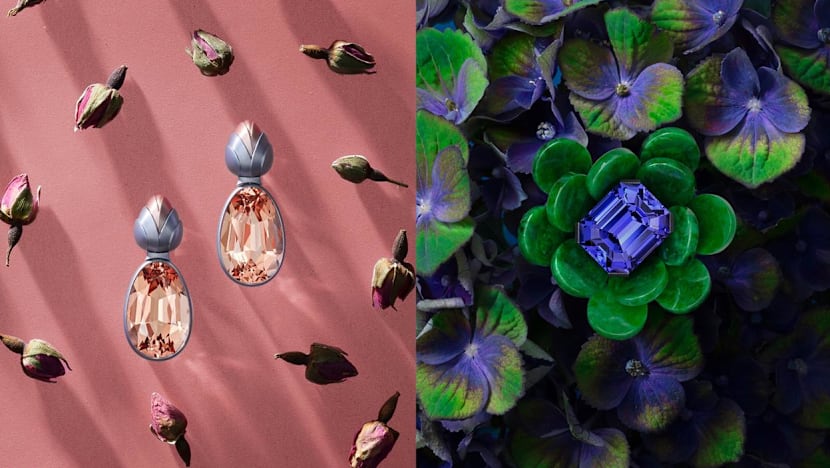
Today, Hemmerle is known for pairing exceptional gemstones with unconventional materials such as iron, bronze, aluminium, copper and wood. Emeralds are set against textured bronze, purple amethysts framed in violet aluminium and pink tourmalines paired with copper. Ancient Egyptian artefacts, 18th-century cameos, micromosaics and Japanese curios have also found their way into its creations.
From Sep 10 to Sep 12, a selection of Hemmerle’s one-of-a-kind jewels will be presented at an appointment-only trunk show at The Singapore Edition. The showcase is held in partnership with Revival Jewels, the Singapore jewellery business founded by Brenda Kang, which specialises in historic and contemporary pieces. Kang first presented Hemmerle in Singapore in 2021.
Ahead of their visit to Singapore, Christian Hemmerle – Stefan’s son and the fourth generation of his family to lead the house – and his wife, Yasmin, spoke to CNA Luxury by email about challenging conventional ideas of preciousness and preserving the family legacy.
For Hemmerle, a jewel’s value has never rested solely on the rarity or cost of its individual components.
“Preciousness is not something we view as inherent in a material alone, but rather, it emerges through a combination of materials, craftsmanship, creativity and emotional resonance. A diamond is certainly precious, but so too can be a piece of iron, wood, bronze or ancient artefact when it contributes something meaningful to a creation. We’ve always believed that beauty and significance cannot be measured solely through intrinsic value,” Christian explained.
Hemmerle’s use of unconventional materials was never intended as a prediction of where the luxury market might head.
“Our decisions have always been driven by aesthetics, craftsmanship and creative possibilities instead of economics. Perhaps what has changed is not our philosophy, but a wider appreciation that luxury can reside in creativity, originality and craftsmanship as much as in the intrinsic value of raw materials,” Yasmin added.
FROM ROYAL ORDERS TO RADICAL JEWELLERY
Hemmerle was established in Munich in 1893, when brothers Joseph and Anton Hemmerle took over a goldsmithing business specialising in medals and orders, with clients including the Bavarian royal family. In 1900, the house received a prize at the Paris Exposition Universelle for an enamel and gemstone bishop’s cross. Four years later, it opened a boutique on Maximilianstrasse. In 1905, Hemmerle began making the Bavarian Maximilian Order for Science and Art – a tradition it continues today.
These early commissions gave future generations a grounding in metalwork and goldsmithing. Hemmerle’s aesthetic later drew on German movements such as Bauhaus and Neue Sachlichkeit, with their emphasis on geometric clarity and the inherent character of materials.
In 1995, Stefan and his wife, Sylveli, took sole control of the business and began transforming its aesthetic. The diamond-and-iron commission provided the creative spark, opening the way for increasingly audacious combinations of materials, colours and textures. “It was not my intention to shock, though I did want to inspire,” Stefan once said.
The experiments gave rise to Hemmerle’s distinctive aesthetic of bold forms, architectural silhouettes, striking colour combinations and complex engineering. Signature pieces include the open-ended Harmony bangle, armour-like cuffs, mismatched earrings and necklaces with luxuriant tassels. Diamonds are sometimes set upside down, exposing their pointed pavilions to create reverse-pave surfaces.
Nature is another recurring source of inspiration, with flowers, fruit, vegetables, seeds, leaves and animals reimagined as sculptural jewels. The 2022 Infused Jewels collection, for example, translated botanicals used in herbal tea into earrings and brooches.
A MATERIAL WORLD
Hemmerle gives little weight to traditional hierarchies of value, applying the same level of craftsmanship to pebbles and moonstones as it does to diamonds and rubies.
“Materials are our starting point and drive our creativity. We experiment with the unconventional not just to be different, but to create a setting that enhances the natural beauty of materials through a unique use of colour and texture,” Christian explained.
Aluminium has proved both useful and challenging. Its lightness allows Hemmerle to create substantial jewels that remain comfortable to wear, while anodisation produces colours that cannot be achieved with gold or platinum. In some pieces, the metal is coloured to match the gemstone so closely that stone and setting appear to merge.
Working with aluminium also requires a different approach from traditional jewellery metals. Each component must be hand-sculpted and fully prepared before anodising, a process that can be difficult to control consistently. For some creations, the gemstones must be set beforehand, adding another layer of complexity.
“Every unconventional material presents its own challenges and part of Hemmerle’s identity has always been a willingness to engage with those difficulties. Innovation often begins where familiar solutions end,” Christian said.
Not every experiment succeeds. Some ideas prove technically impossible, while others fail to achieve the visual balance the family seeks. An abandoned technique may nevertheless return years later in another form. Nor is every intriguing material suitable for jewellery – it will not be used if it is unstable, cannot withstand wear or compromises the integrity of a piece.
TIME WITHOUT LIMITS
Every Hemmerle jewel is made at its Munich atelier, where crafts ranging from patina development and metalworking to stone-setting are carried out under one roof. Nothing is outsourced. Traditional skills passed down through generations sit alongside processes developed for individual designs, with some jewels taking more than 500 hours to complete.
The house has also revived techniques that had almost disappeared, including an early 19th-century Austrian method of knitting gemstone beads around silk. Each bead is carved, drilled and matched by hand before being worked into a flexible mesh used for bangles and long necklaces, sometimes finished with a signature tassel.
Hemmerle’s work is also held in major museum collections, including London’s Victoria and Albert Museum, New York’s Metropolitan Museum of Art and Cooper Hewitt, Smithsonian Design Museum, and Die Neue Sammlung in Munich.
For the family, craftsmanship is integral to a jewel’s identity – and one reason its value cannot simply be calculated from the price of its components.
“Collectors are increasingly interested in understanding what lies behind a piece and its story. They appreciate the rarity of exceptional materials, but are equally fascinated by the years of experimentation, craftsmanship and technical innovation that contribute to a creation,” Yasmin added.
PRESERVING VALUES, NOT FORMULAS
Christian and Yasmin joined Hemmerle in 2006 and now run the business with the support of his parents, Stefan and Sylveli. Remaining family-owned, they say, gives the house the freedom to work beyond the usual rhythms of the luxury industry – spending years perfecting a technique or searching for the right material, and setting aside ideas until the workshop finds a way to realise them.
“It gives us the freedom to think long-term,” Christian said. “Many of our most distinctive creations exist precisely because we’ve been able to follow curiosity wherever it leads.”
He described curiosity as one of the most important lessons inherited from his father, Stefan, who encouraged the couple to find inspiration in art, architecture, historic objects, nature and travel.
Carrying a family legacy forward, however, does not mean standing still.
“We preserve values rather than formulas. Craftsmanship, integrity, originality and curiosity are non-negotiables. Everything else should remain open to reinterpretation,” Christian said.
Many of Hemmerle’s signatures emerged because an earlier generation was willing to challenge convention. For Christian and Yasmin, retaining that openness is key to carrying the house forward.
A NEW HOME FOR HEMMERLE
That balance between continuity and reinvention can also be seen in Hemmerle’s new “home” on Munich’s Maximilianstrasse – the boutique and salon where the house receives clients. After 120 years at its former address, Hemmerle remained on the historic avenue, moving to the third floor of number 30.
Designed to feel more like a private residence than a conventional jewellery boutique, the space has softly lit rooms with curved walls, oak herringbone flooring, bespoke cabinetry and a travertine fireplace. Furniture by Pierre Chapo, Poul Kjaerholm, Vladimir Kagan, Jose Zanine Caldas and Tom Dixon sits alongside works by artists including Pierre Soulages and Piero Manzoni.
The mix echoes Hemmerle’s jewellery, bringing together different periods and disciplines through material, proportion and craftsmanship. Among the most personal details are the safe doors transferred from its former premises. Having protected generations of gemstones, jewels and archival pieces, they now preserve a tangible part of the house’s past in a new setting.
Only 15 to 20 jewels are shown at any one time, encouraging a slower, more personal viewing experience. Once the family has a sense of a visitor’s interests, additional pieces are brought out.
“We’ve always believed that collecting should be an act of self-discovery rather than simply acquisition,” Yasmin said.
COLLECTORS IN SINGAPORE AND ASIA
According to Christian and Yasmin, collectors in Singapore and across Southeast Asia often have interests spanning art, design, architecture, watches and jewellery. Many want to understand not only how a jewel was made, but why a particular material was chosen and what it brings to the finished piece.
Across Asia, the couple has also observed an appetite for exceptional gemstones and bold colour, alongside growing interest in unusual materials, historical artefacts and technical craftsmanship.
Yasmin believes Singapore collectors stand out for their appreciation of quality and substance. “They are well-informed, open to experimentation and highly appreciative of artistry and technical achievement,” she said. “This combination makes them particularly receptive to the ideas that have long guided Hemmerle.”
Hemmerle is also attracting younger collectors, although Christian and Yasmin see this as part of a broader shift rather than a clear generational divide.
“Clients today are drawn to originality and authenticity; they’re looking for objects that communicate personal taste rather than status, which aligns with our approach,” Yasmin said.
Many, she added, also want important jewels they can wear regularly rather than reserve for special occasions.
Some collectors encountering Hemmerle for the first time may question the value of a jewel made partly from an ordinary metal. But that question goes to the heart of what the house has explored since Stefan first set a diamond in iron. In Hemmerle’s hands, preciousness lies not only in the material itself, but in what craftsmanship, experimentation and design can make of it.