
Entertainment
AI can now help make entire films. What does that mean for Singapore’s film industry?
Key Points
AI can now help make entire films. What does that mean for Singapore’s film industry? As Singapore creators experiment with AI in filmmaking, questions are emerging over what it could mean for human creativity, jobs and authorship.
AI can now help make entire films. What does that mean for Singapore’s film industry?
As Singapore creators experiment with AI in filmmaking, questions are emerging over what it could mean for human creativity, jobs and authorship.
SINGAPORE: A two-and-a-half minute episode of Chinese AI-generated microdrama Master of Feng Shui amassed 100 million views within 12 hours of its debut, according to local media reports.
It is part of a growing wave of short-form dramas in China generated by artificial intelligence.
About 128,000 microdramas were released in the country in the first quarter of this year, of which more than 95 per cent were AI-generated, according to estimates published by China’s Netcasting Services Association.
According to digital content marketing company DataEye, the total output value of China's microdrama industry reached 100 billion yuan (US$14.35 billion) in 2025 – about twice the country's annual box office revenue.
But using AI to generate a short-form drama is one thing. What happens when it is used for longer productions – and to the people who traditionally make them?
In Singapore, filmmakers are already testing that question.
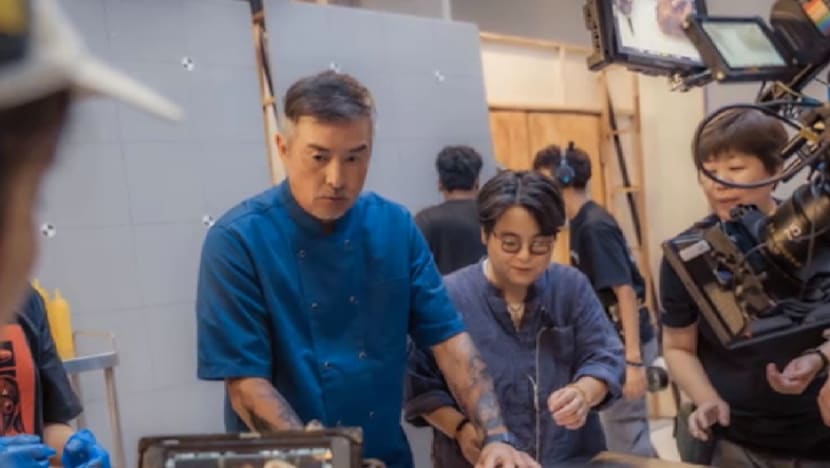
The country’s first AI-hybrid drama, Crooks, still has actors performing on live-action sets, while AI is used to help build the environments around them.
More than 50 crew members across production, technical and editing roles are being reskilled for the project.
B-01 Films founder and executive producer Boi Kwong, the showrunner of Crooks, said AI has shifted more work towards the post-production process.
“With AI hybrid building the environment, most skills or most requirements are transferred to the post-production. So more people that used to do visual effects now have to upskill themselves with knowledge of AI, and then adapt it to how we shoot,” Mr Kwong said.
He added that the shift could create more jobs in post-production.
AI could also make filmmaking more accessible and speed up the production process.
“First, it lowers the entry barrier to get into the creative industry for many creators, and secondly, that (production) is much faster and it's easy to modify,” said Mr Pax Chen, founder and CEO of FizzDragon, a Singapore-headquartered AI filmmaking and digital creator platform.
MAKING A FILM IS EASIER, BUT MAKING A GOOD ONE ISN’T
But even as AI makes filmmaking easier, it does not guarantee success with audiences.
Two AI-generated local films released over the National Day weekend divided viewers. Trace Project, for example, drew criticism over its characters, dialogue and inaccuracies – including a Singapore flag with six stars.
The response points to a gap between what AI makes possible and what audiences find convincing. It also raises the question of how much of the creative process should be handed over to machines.
Visual artist Debbie Ding, who is also assistant professor of practice in digital arts at the Singapore University of Technology and Design, sees value in tools that make the creative work more accessible.
But she cautioned against tools that take over the entire process.
“It's a black box that the artist doesn't know what's inside,” she said, adding that this can obscure the amount of “skill and experience” behind an artist’s work.
For all the advances in generative video, one major limitation remains: human performance.
“AI still cannot replicate actors' performance, actors' real emotion, and how the actors react to the scene, to the people … small nuances that actually bring the performance to life,” said Mr Kwong.
Those imperfections are part of what makes performances believable, said chairperson of The Actors’ Society Laura Kee.
“You don't want to see perfect expressions. You want to see the sweat on the brow of the actors. You want to hear them perhaps muffling or stumbling over one word or two,” said Ms Kee.
“When it's all dictated by generative AI, sometimes it's difficult to bring that imperfection and that humanness to performance.”
WHAT HAPPENS TO "CREATIVE FRICTION"
A production traditionally brings together directors, actors and other creatives with different ideas.
Automating more of that process could also remove some of the disagreements and negotiations that help shape a finished film product.
“What we're losing in this process is the kind of creative friction that enables a lot of interesting artistic work to emerge,” said assistant professor Pei Sze Chow, who specialises in digital culture and new media at Nanyang Technological University’s Wee Kim Wee School of Communication and Information.
She added that bringing together different creative perspectives can help produce a result that people feel confident about.
WHAT ABOUT AUTHORSHIP?
Generative AI also complicates another question: who is the author when a machine generates the images, music and performances?
Mr Justin Chan, founder of Designed for Good, a social initiative, said authorship ultimately requires creators to distinguish their work from that of others.
“I think what we call ''AI slop'' really is just aesthetic sameness,” said Mr Chan, who is also the founder of creative consultancy Fantastic Bureau.
“What worries me is that (creators) are going to generate a lot of things, but not really think through the process of design, who they are speaking to, what's the heart behind the message.”
The issue also raises concerns over ownership and control.
Unlike the United States, performers here lack a collective-bargaining framework for AI protection.
“We have no unions, so we have no bargaining power to protect actors, performers, and so it really depends on the individual actors' legal knowledge, their contract literacy, and their own ability to protect their rights now,” said Ms Kee.
More broadly, it remains unclear who gets to shape the stories audiences see when they are created using AI.
“Once you sort of devalue culture by outsourcing it to AI or outsourcing it to automation, then who's left to tell Singapore stories that will resonate with Singapore audiences?” asked Asst Prof Chow.
AI (ORG)
Singapore (LOCATION)
Chinese AI (ORG)
Feng Shui (PERSON)
China (LOCATION)
Netcasting Services Association (ORG)
DataEye (ORG)
Crooks (ORG)
Boi Kwong (PERSON)
Kwong (PERSON)
Mr Pax Chen (PERSON)
FizzDragon (ORG)
Trace Project (ORG)
Debbie Ding (PERSON)
the Singapore University of Technology and Design (ORG)