
Politics
9/11 unleashed two decades of war. Now Putin is exploiting the damage
Key Points
It’s unlikely that Osama bin Laden picked up the idea of a clash of civilizations from a Harvard professor’s essay in a 1993 edition of Foreign Affairs, but when Al Qaeda terrorists slammed two aircraft into New York’s Twin Towers and attacked the Pentagon eight minutes later - that’s what he got. The conflicts between cultures and religions that would replace the Cold War, as Prof Samuel Huntingdon predicted, have defined the last two decades and will dominate the world for the rest of this...
It’s unlikely that Osama bin Laden picked up the idea of a clash of civilizations from a Harvard professor’s essay in a 1993 edition of Foreign Affairs, but when Al Qaeda terrorists slammed two aircraft into New York’s Twin Towers and attacked the Pentagon eight minutes later - that’s what he got.
The conflicts between cultures and religions that would replace the Cold War, as Prof Samuel Huntingdon predicted, have defined the last two decades and will dominate the world for the rest of this century.
Ironically, this new chapter in history started as a war between east and west in the form of Islam vs the Christian world.
But now, the West is again under attack from a Cold War enemy that watched the US and its allies waste lakes of blood and trillions in treasure enfeebling themselves after 9/11.
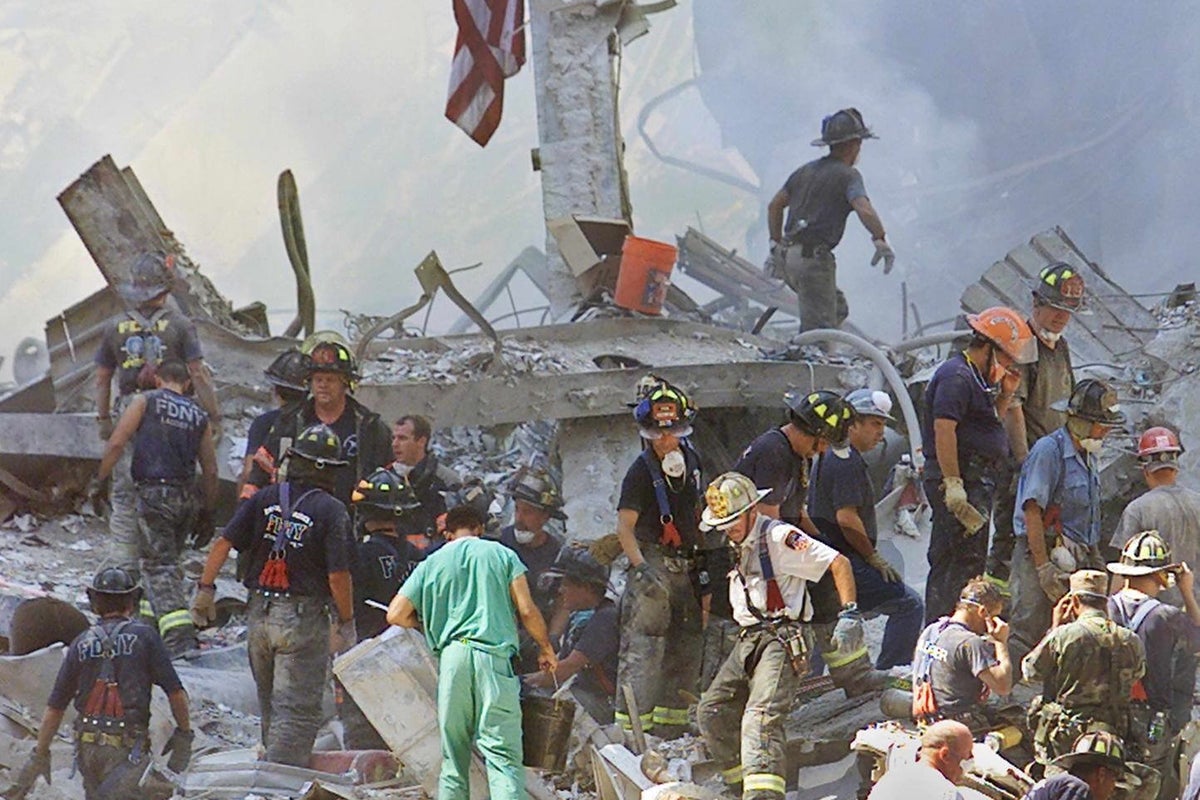
In the immediate aftermath, cooler heads in Washington might have been able to more deliberately and surgically exact revenge for the murder of 2,977 people on that day when, live on television, the world watched in horror as the towers came down.
Amid an act of war that turned out to have been launched, not by a state, but a fanatical group of mostly Saudi extremists led by the scion of a billionaire family hiding in Afghanistan, President George W Bush reacted as Osama bin Laden would have hoped.
The pain and the outrage, the fear and the amazement that the heart of the US government had been the target of mass murder, were so visceral that the US president invoked article 5 of the North Atlantic Treaty Organization’s charter for the first, and so far, only time in history.
An attack on one Nato nation was met by almost all the others, plus additional allies, joining a war to wipe out al Qaeda and topple the Taliban, Afghanistan’s ruling deeply conservative Islamists.
The Taliban had no interest in global terror then. They have none today either. But they had given bin Laden a safe haven for his plot against America and were guilty by association at least, if not actual accomplices.
By the end of that year, the Taliban had been felled. Bin Laden had been seen fleeing the caves of Tora Bora close to the borders with Pakistan, and a new military doctrine was being used by America and its allies.
This allowed for the killing of members of terrorist organizations in pre-emptive attacks. They didn’t need to be ticking bombs; they just had to be part of a movement that made them.
The massive reaction of the US and its allies to 9/11 created a new world disorder. Pre-emptive strikes were launched in Pakistan and elsewhere. Many civilians died in extrajudicial executions under the new doctrine.
But al Qaeda groupies and Islamists around the world were led to believe that America - an abomination in the eyes of bin Laden - could be humiliated and humbled.
From the sophisticated madrassas of Pakistan - with a Deobandi and Wahhabi version of Islam which argued for a seventh century literal and xenophobic interpretation of Islam - to north London mosques and online brain washing forums, young men were tempted to flock to al Qaeda’s black flag.
Reporting from Tora Bora at the end of 2001, I watched “daisy cutter” thermobaric bombs turn the sky magenta and felt the whomp of American explosive power like a chest punch five miles from detonation. It looked then that the al Qaeda brand had been obliterated.
But when the US invaded Iraq along with UK under Tony Blair, the black al Qaeda flag became a magnet.
The US and UK had lied the west to war. First, they said that Iraq was developing a nuclear weapon and, second, that Saddam Hussein was part of al Qaeda’s global agenda. Saddam’s regime had no nuclear programme and a scant understanding of Middle Eastern politics would have revealed that as a bloody and secular dictator, he was always an enemy of Islamic radicalism.
International law had long been seen as imperfect and usually employed by the strong to punish the weak. But there was a sense that the West, with the United Nations headquartered in New York, had been key in establishing global mechanisms designed to avoid war.
That went out of the window in Iraq where there was no mandate for an international military intervention.
Instead, people around the world saw Iraqis getting shot at road blocks by occupying American troops, US companies hoovering up contacts in Iraq funded by Iraqi oil revenues, and a system of near impunity for occupying forces to kill and maim as they fought against “insurgents” there.
These insurgents were old Baathist thugs left over from Saddam’s regime. Shi’a militia backed by Iran - and al Qaeda.
The clash of civilizations was now in full swing, fulled by western hypocrisy as well as growing systems to radicalize and terrorize Muslims.
During my time in Falluja, Iraq, I was abducted along with three colleagues in the early stages of that clash and taken away to be murdered. We were chased the wrong way up a motorway, cut off by armed men in a saloon car and escorted to their vehicle. Taken into the desert we were forced to our knees and prepared to die.
We survived by a fluke but had al Qaeda been in action, as it soon was, we could have suffered the televised fate of other hostages and been slaughtered on camera - dressed in orange overalls of the kind that Muslim prisoners were being made to wear in American prisons - without trial.
The so-called Islamic State emerged as a hybrid of Baathist tactics and radical ideology, employing ultra-violence to terrify a vast area of northern Iraq and Syria into submission.
The west, other allies in the Arab world and the new Iraqi government fought back after Isis formed a “caliphate” and had become a magnet for thousands of youth who now flocked to its banners to join the mass murder gangs and fantasies of a new world run on fundamentalist principles.
By the end of 2017, Iraq’s Mosul, where the Isis had claimed its caliphate, and then Raqqa were recaptured by Syrians, Iraqis, Kurds and Special Forces teams from the West. Isis was over.
But these wars of choice in Iraq and Afghanistan that had been seen by many in the west - as the late Sir Alex Younger put it - as “away games of football” entrenched the truth that in the west the lives of dark skinned people, especially Muslims, were less valued in the clash of civilizations that bin Laden ignited.
Islamic rage may yet return - partly driven by the actions of Israel in Gaza and the inactions of Israel’s allies to stop the slaughter there.
But another civilization identified by Prof Huntingdon has been plotting and planning. Vladimir Putin stayed away from Middle East conflicts, except to back Bashar al Assad in Syria in 2017.
But enraged by the expansion of Western democracy into eastern Europe, where states - once vassals of Moscow - have embraced freedom and the European Union, Putin invaded Ukraine in 2022, convinced that “the West” was plotting to annihilate Russia’s soul.
He would have done so anyway, but it helped that Iraq had been invaded without UN sanction and on baseless whims too.
The clash of civilizations that he has joined lately has already cost the US dearly. Brown University’s Costs of War project estimates that the US spent $4.37 trillion on its wars in Iraq, Afghanistan and Syria.
Hundreds of thousands of human lives have also been squandered - leaving the west spiritually and politically impoverished, deeply indebted and unable to meet new defence needs, and therefore vulnerable.
Putin has bin Laden to thank for that.
Join our commenting forum
Join thought-provoking conversations, follow other Independent readers and see their replies
Comments