
World News
US Embassy issues health alerts as Cuba’s multiple crises push islanders to breaking point
Key Points
US Embassy issues health alerts as Cuba’s multiple crises push islanders to breaking point Cuba’s crises worsened after U.S. President Donald Trump announced in late January that he would impose tariffs on any country that sells or provides oil to the Caribbean country - Bookmark Unbearably hot nights, rolling blackouts, persistent water shortages, failing housing, and unreliable communication networks are straining daily life across Cuba. For a population of roughly 10 million, the mental...
US Embassy issues health alerts as Cuba’s multiple crises push islanders to breaking point
Cuba’s crises worsened after U.S. President Donald Trump announced in late January that he would impose tariffs on any country that sells or provides oil to the Caribbean country
- Bookmark
Unbearably hot nights, rolling blackouts, persistent water shortages, failing housing, and unreliable communication networks are straining daily life across Cuba.
For a population of roughly 10 million, the mental burden is reaching a critical threshold as a U.S. energy embargo and deep economic woes offer no immediate prospect of relief.
"Before there was hope," Dr. Yomeidis Felicó Riverón said. "Right now, what people have lost is exactly that."
A primary care physician, Felicó Riverón has taken on an unexpected secondary role as residents attempt to navigate their challenging environment.
"They come and cry about their troubles, because they have no one else to vent to," she said of her patients. "We end up having to play psychologist."
Parents shield children from Cuba's realities
On a recent sunny afternoon, six girls and one boy gathered around a table while their parents sat in the background, attempting to fan away the suffocating heat.
The children were attending a free workshop on crafting gift bags and perfume, designed to offer a temporary respite from Cuba's realities.
"My son doesn’t know if there’s food or if there’s no food," Felicó Riverón said, noting that she conceals financial difficulties from him when she cannot afford things he asks for.
Instead, she shifts his focus: "Let’s go play, let’s go to the park. We’ll come back another day."
Dianne Tamayo was among the mothers present that day. The workshop served as an oasis for her and her daughter, allowing her to converse with others and temporarily forget household concerns.
"My husband is my rock," she said. "When I’m going crazy, my husband tells me, ‘Sit down, breathe … let’s put on some music.’"
He sometimes has to remind Tamayo that their daughter is coming home from school soon, and that they need to keep their troubles, anxieties and frustrations to themselves.
"I do the best I can with the tools I have, but there’s still a moment where I get overwhelmed," she said.
Tears fell as she confided that she doesn’t have anything in her life that relaxes her, and that she has never questioned how to release her feelings about life in Cuba.
"They are exterminating us," she said, "and we remain complacent."
U.S. Embassy issues health alerts
Difficulties on the island intensified after U.S. President Donald Trump announced in late January that he would impose tariffs on any country that sells or provides oil to the Caribbean country. Longtime U.S. sanctions also have taken their toll, Cuba's government said.
From March 2025 to the end of February, "the U.S. policy of economic strangulation" amounted to more than $8 billion, "a record figure," according to Cuban Foreign Affairs Minister Bruno Rodríguez.
Power cuts have grown more frequent this year, and daily outages now surpass 24 hours. Consequently, running water is often scarce, and small protests have erupted, despite the fear of being detained, as anger and frustration boil over.
The worsening situation prompted the U.S. Embassy to issue two public health alerts recently.
On Aug. 28, the embassy noted that "Cuba’s water supply infrastructure is increasingly unstable " and that there are "residential neighborhoods experiencing long periods without water from municipal or public sources."
On Friday, the embassy warned of an increase in gastrointestinal illnesses linked to the "degradation of the water and energy infrastructure. …. Recent cases have included E. coli, norovirus, Shigella, and other gastrointestinal pathogens."
Despite ongoing shortages of water and power, 81-year-old Havana resident Oscar Joaquín López said that he doesn’t dwell on what he lacks.
"Why?" López said. "Because it drives you crazy, and nobody is going to drive me crazy."
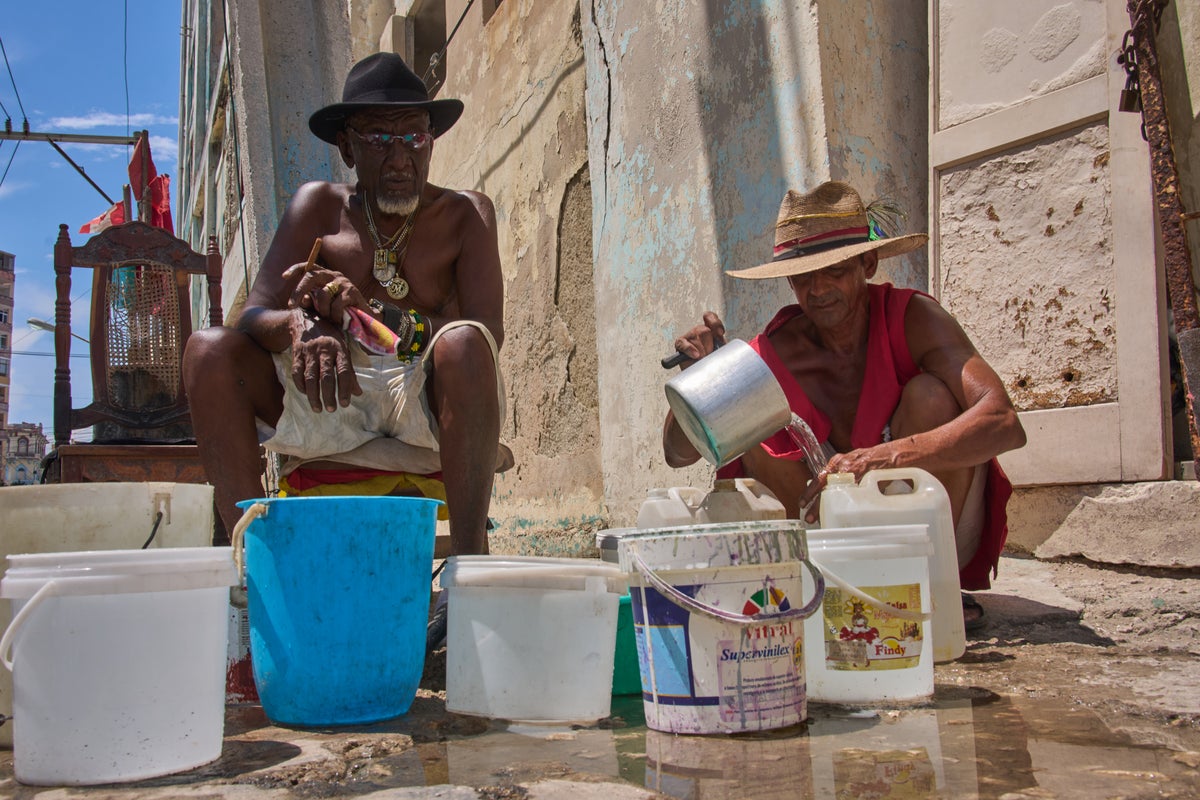
On a recent afternoon, he leaned against the doorframe of his home as he watched his 58-year-old roommate fill up nearly a dozen plastic containers with water that flowed from a pipe on the street. Having gone several days without water, they acted quickly.
With temperatures hovering above 90 F (32 C), López said that he sits in his doorframe until midnight to catch a breeze from the nearby ocean, a steel pipe nearby to ward off any intruders. After midnight, he goes to bed, hoping the wooden slat he wedged into his window will catch any wind, however slight.
Nearby, 62-year-old mason José Laó Faviel dug through overflowing garbage on the street, looking for food to feed his pig and her 10 piglets, because he had none to give them.
"What are you going to do?" he said. "We’re living through difficult times."
Minutes later, another man rifled through the same pile of garbage. After opening several bags, he found something to eat.
Cubans find solace in family
Sweat gathered around Armando Lafita’s brow as the 60-year-old pushed a cart through the crumbling buildings in Old Havana. Authorities have evacuated some residents in the area for safety reasons, but those with nowhere else to live now sleep on the street, ducking inside their building when they need something.
Lafita’s cart was filled with red roses and white ginger lilies, Cuba’s national flower. He sells them for 10 to 40 cents a bunch, but sometimes he goes home without a single sale.
"Everybody is fighting to survive here," he said. "It’s getting harder every day."
Like many Cubans, Lafita said the only thing that keeps him going is family: his 19-year-old son.
It’s the same reason that 70-year-old José Manuel Borroto Díaz and his 93-year-old mother, Teresita del Rosario González Ricardo, keep going: they have each other.
"Our situation is like something out of a movie, but we’re going to press on," said Borroto, a retired aviation official who was in Angola during Cuba’s military intervention in the 1970s.
Across the island, Cubans are pressing on even as the crises deepen, including 90-year-old Lázaro Alfonso Oviedo. He recently attended a weekly gathering to help raise the spirits of elderly people.
Oviedo danced and sang in a deep, robust voice "to forget for a little while the suffering the empire puts us through," he said, referring to the United States.
"We are not going to give up," he said as he praised Cubans' unwavering resilience. "We get it precisely from the spirit forged by the revolution itself — a revolution spanning more than 60 years."