
Technology
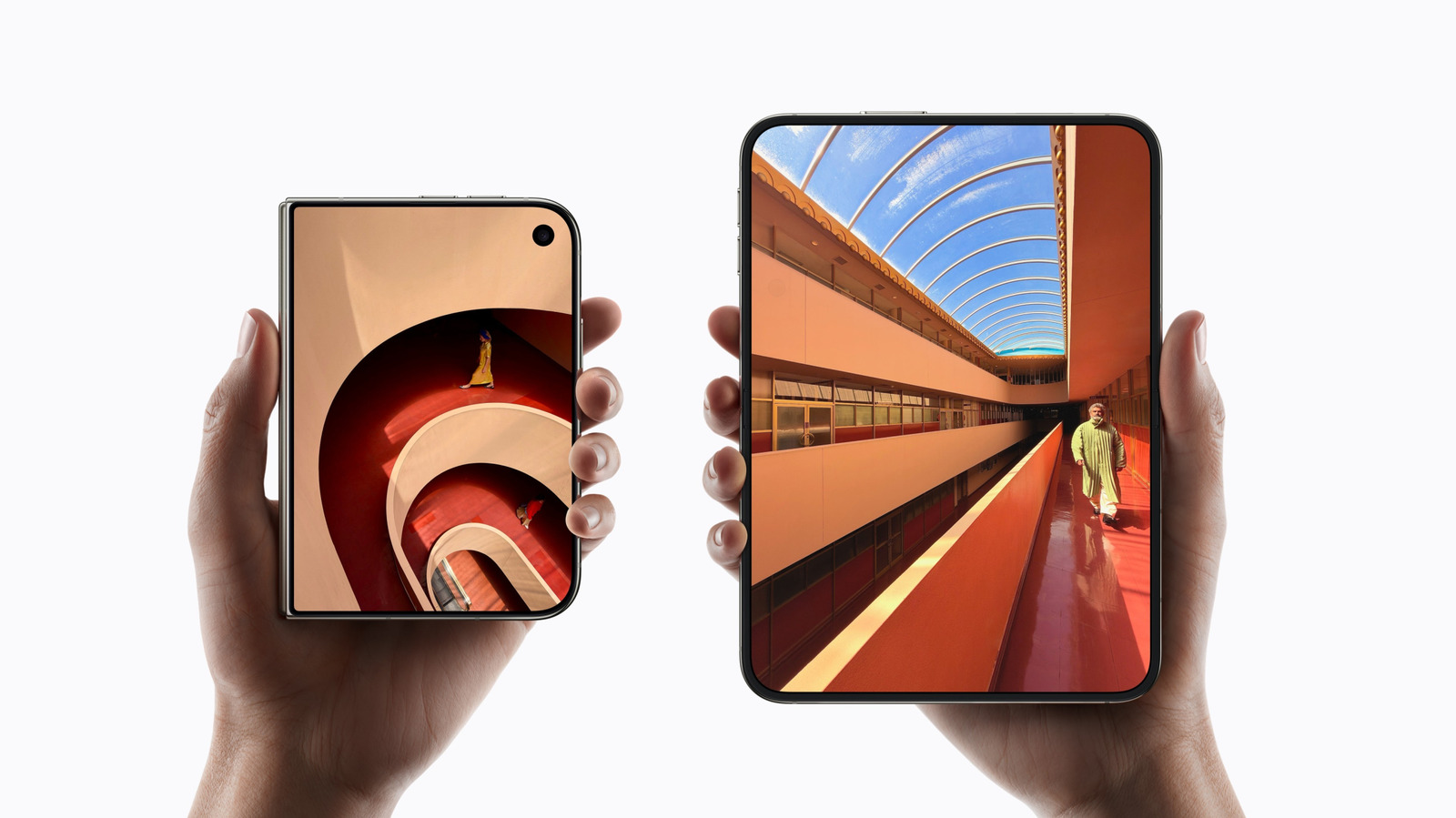
iPhone Duo vs Samsung Galaxy Z Fold 8: here's how they stack up
Key Points
iPhone Duo vs Samsung Galaxy Z Fold 8: here's how they stack up Apple's first foldable competes well with the Z Fold 8, at least in terms of specs. Apple's just-announced iPhone Duo represents its most radical reimagining of the smartphone, perhaps ever. With Samsung now on its eighth generation of foldable phones, and other competitors multiple generations into their own foldable lines, the iPhone Duo is the first Apple device with a screen that bends shut.
iPhone Duo vs Samsung Galaxy Z Fold 8: here's how they stack up
Apple's first foldable competes well with the Z Fold 8, at least in terms of specs.
Apple's just-announced iPhone Duo represents its most radical reimagining of the smartphone, perhaps ever. With Samsung now on its eighth generation of foldable phones, and other competitors multiple generations into their own foldable lines, the iPhone Duo is the first Apple device with a screen that bends shut.
Samsung, which manufactures parts for the iPhone and made that folding screen, preempted the Cupertino colossus by launching the Galaxy Z Fold 8 last month in August. While the Z Fold series has traditionally been a tall and skinny device that opens up into a nearly square display, the Z Fold 8 is instead short and squat, taking on a profile that has been called "passport-style." (The taller candy bar-style didn't go away, but was renamed the Z Fold 8 Ultra to justify a price increase.) That's not-so-coincidentally the same form factor Apple chose for its inaugural folding phone, which means the two devices are positioned in the market as direct competitors.
Samsung seems to have struck gold with the Galaxy Z Fold 8, its passport-style foldable. Yesterday, Samsung reported that the phone and its larger sibling, the Galaxy Z Fold 8 Ultra, are outselling last year's Fold 7 by 30 percent in the first month of their respective life cycles. Of course, the iPhone Duo is expected to be a juggernaut, and may make Samsung's numbers look downright cute when the dust settles. It's got a stacked spec sheet that takes clear aim at Samsung.
If you've decided this is the year you'll finally fold for a foldable, there's a solid chance these are the two smartphones you'll waffle between. So, here's how the two of them stack up in every way that matters. While we'll need time to test the iPhone Duo before rendering a final verdict on it, we held up its spec sheet side-by-side with the Samsung Galaxy Z Fold 8 to see how the two compare.
There's no clear winner between these dualing dual displays
The squat and slim Fold 8 has an inner display that unfolds to 7.6 inches with a resolution of 2,448 by 1,848 pixels; it runs at 120Hz. Apple has chosen the same 7.6-inch screen size with a slightly higher resolution of 1,878 by 2,670, also at 120Hz. Samsung's outer display is 5.5 inches, while Apple's is 5.4 and again has a slightly higher resolution.
Samsung manufactured the folding OLED screens for the iPhone Duo, and you might expect it to reserve some goodies for its own products. In Engadget's Fold 8 review, we gushed over the anti-reflective coating on both screens, which makes it far easier to use the phone in direct sunlight or harsh overhead lighting. Shockingly, that feature has made its way to the iPhone Duo. Apple may be calling it a "nano-texture finish," but it does the same thing. Apple claims its inner screen has 40 percent higher stiffness than other materials used in the industry. Both Samsung and Apple's latest foldables are also reinforced by a titanium plate under the folding layers.
Performance and cameras: iPhone takes the edge
The Fold 8 is powered by the Qualcomm Snapdragon 8 Elite Gen 5, which is built on a 3nm process. While it was extremely competitive against Apple's last generation A19 Pro silicon, the A20 Pro chip found in the iPhone Duo is built on a 2nm process and pushes ahead of Qualcomm's best mobile chip in both productivity and gaming tasks. Apple boasted 50 percent more memory bandwidth and a 40 percent faster GPU on the A20 Pro compared to the A19 Pro. You can expect Qualcomm to launch the Snapdragon 8 Elite Gen 6 in the near future, but it won't show up in new Android phones until later this year, likely appearing in next year's Galaxy phones. As for RAM, the Galaxy comes with 12GB unless you opt for the top-end 1TB storage model, in which case you'll get a whopping 16GB. Apple has not revealed the amount of RAM in the iPhone Duo. However, Apple is known for well-optimized software, and iOS has more aggressive RAM management than Samsung's take on Android.
Neither Apple nor Samsung have graced their passport-style foldables with serious camera firepower of the kind you'd find in their flagship slab-style phones. Both devices make do without a telephoto module, which means anyone who loves to take long-distance zoom shots should think twice before picking either phone up. However, the cameras on offer do differ. Whereas Samsung sticks two 50 megapixel shooters on the Fold 8, one wide and one ultrawide. Apple has equipped the iPhone Duo with both a wide and ultrawide 48 megapixel camera.
Selfie cameras are a different story. Samsung's middle child foldable has two 10 megapixel front-facing shooters, with the cover screen camera using a 24mm wide lens and the interior screen camera adopting an 18mm ultrawide. The logic seems to be that you can fit more content on the larger screen, and therefore you need a camera that can fit more in its frame. The iPhone Duo has a 12 MP cover camera and an under-display camera which Apple did not reveal the specs for; that one appears to be only aimed at using on FaceTime calls. Ultimately, the iPhone will probably take very iPhone-esque pictures, for better or worse.
Batteries, biometrics and multitasking: Samsung snatches the lead
With a larger screen when unfolded, you'd expect a larger battery to power it, but neither foldable follows that logic. The Fold 8 carries a 4,800 mAh cell with a top wired charging speed of 45W and just 20W wireless, even with a Qi2 compatible case for magnetic charging. The iPhone Duo doesn't have a listed battery capacity, with Apple only announcing that it will last for 31 hours of video playback on the inner display, or 44 on the outer. It will charge at 25W over MagSafe, at least.
Interestingly, the iPhone Duo carries a blast from Apple's past in the form of a fingerprint sensor mounted in the power button. It's the same solution Samsung implements on its own foldables. In both cases, the placement is due to the constraints of a folding form factor. There's no room for Apple's FaceID system in the iPhone Duo, and no room for Samsung's ultrasonic under-display fingerprint sensor on the Fold 8. iPhone users who've grown accustomed to FaceID may find this jarring, but we'll need hands-on testing to tell which fingerprint reader works best.
Apple has equipped the iPhone Duo with some snazzy-looking multitasking features, but Samsung has been honing the multitasking capabilities of its One UI Android skin for many years. Sure enough, Apple hasn't done quite as much in this department with iOS 27 on the iPhone Duo. It can run two apps side by side, resizing and reorienting the layout. You can even save a pair of apps to open side-by-side later, a feature cribbed right from Samsung.
Samsung devices, including the Fold 8, can run three apps side-by-side, with several more open simultaneously in windowed mode, up to five apps total in the latest One Ui software. You can drag photos and files from Samsung's Gallery and My Files apps into browsers or text fields in other apps, keep open apps tucked off to the side of the screen for quick access, or collapse them into bubbles. You can even get a desktop-like environment with better mouse and keyboard support by plugging the Fold 8 into an external monitor.
Durability and price: the iPhone can take a beating, but can your wallet?
Durability is always a concern with foldables, and though they've come a long way in that regard, they're still more destructible than normal, slab-style phones. The Fold 8 has an IP48 dust and water resistance rating, meaning you can take it out in the rain but not at the beach. The iPhone Duo outclasses Samsung here, with an IP68 rating that, combined with a titanium build, makes the iPhone a much better choice for durability, at least on paper.
Lastly, we have to talk about pricing. Both of these phones have a hefty price tag, especially considering how fragile they are compared to their slab-style counterparts. The iPhone Duo starts at $1,999 for the base 256GB configuration, and runs up to a staggering $3,199 for the top-end 2TB version. Samsung prices the Fold 8 at $1,900 for the entry level 256GB model and prices top out at $2,500 for 1TB with extra RAM. So, the Galaxy is slightly cheaper, which does help to balance against its less capable processor.
Verdict: Apple has a real crowd pleaser on its hands
When looking at both the Samsung Galaxy Z Fold 8 and iPhone Duo, the iPhone takes the clear win in terms of projected performance. While we'll need hands-on testing to confirm our suspicions, we know that its A20 Pro chip is significantly more performant than the A19 which was already neck-and-neck with the Galaxy Z Fold 8's Snapdragon 8 Elite Gen 5 processor. Apple excels at optimizing its software for its own silicon, so expect that to give the iPhone an even greater edge. However, the iPhone's stacked spec sheet comes at a higher cost.
Elsewhere, the comparison boils down to personal choice. If you're a multitasking maven, you may not get what you need from the iPhone's relatively modest software options, but if you don't want to treat your phone like a fragile baby bird, the iPhone can handle a bit more physical punishment. What Apple has done is build a foldable for iPhone users, with all the familiar trappings of iOS, and given it just enough of a competitive edge to tempt the fold-curious customer away from Samsung. While the Samsung Galaxy Fold 8 and 8 Ultra will likely remain the foldables of choice for enthusiasts, Apple has a real crowd pleaser on its hands.