
Politics
Political salary debate: PAP MPs, NMPs weigh in on pay structure, relay residents' concerns
Key Points
Political salary debate: PAP MPs, NMPs weigh in on pay structure, relay residents' concerns Nominated MPs suggested lowering the fixed component of a minister's salary and proposed longer-term goals for ministerial bonuses. Nominated Members of Parliament (NMPs) called for changes to the political salary framework's structure during a parliamentary debate on Thursday (Sep 10), as People's Action Party (PAP) MPs relayed residents' questions and concerns about the planned increase. The debate,...
Political salary debate: PAP MPs, NMPs weigh in on pay structure, relay residents' concerns
Nominated MPs suggested lowering the fixed component of a minister's salary and proposed longer-term goals for ministerial bonuses.
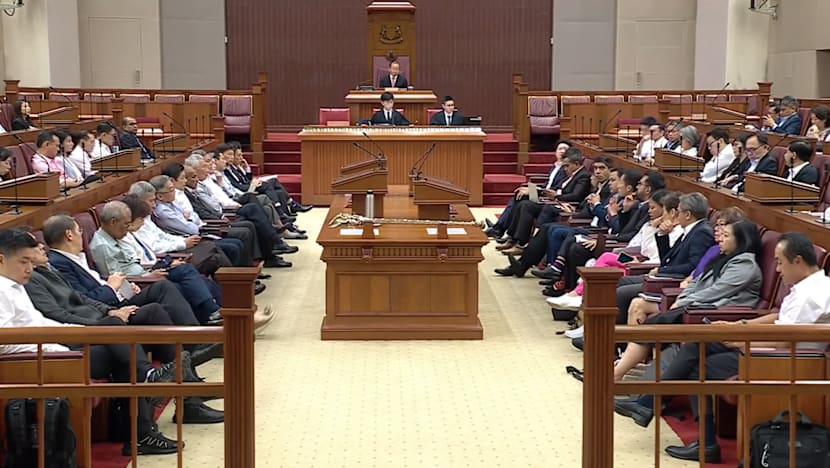
SINGAPORE: Nominated Members of Parliament (NMPs) called for changes to the political salary framework's structure during a parliamentary debate on Thursday (Sep 10), as People's Action Party (PAP) MPs relayed residents' questions and concerns about the planned increase.
The debate, which lasted over four hours, saw four PAP MPs speak alongside Workers' Party chief Pritam Singh, five NMPs and Minister for Trade and Industry (Energy and Industry) Tan See Leng.
Among the NMPs' proposals were lowering a minister's fixed salary component and adding longer-term goals to ministerial bonuses.
Prime Minister Lawrence Wong announced on Tuesday that political office holders will get a salary increase of up to 9 per cent, the first revision since 2011. The variable component of a minister's pay will make up more than a third of total annual remuneration.
NMP Azhar Othman suggested raising the variable component to 55 per cent of a minister's annual pay, with a fixed component of 45 per cent.
He said the 55 per cent should be "explicitly, transparently, and heavily" weighted toward national performance metrics that directly affect real median income growth, unemployment rates and housing affordability.
“Under such a model, if the nation thrives, our leaders thrive with it, justly so. But if the nation faces headwinds, our leaders share in the national sacrifice,” he said.
NMP Kenneth Goh proposed adding longer-term goals to a minister's key performance indicators.
He said the current indicators determining the national bonus – the unemployment rate of citizens, real income growth for citizens in the 50th and 20th percentile and real GDP growth rate – "largely tell us how Singapore is performing now".
“I ask whether the government would consider assessing our progress on indicators that reflect Singapore's capacity to thrive over the medium and long term,” said Assoc Prof Goh.
“Some of our most difficult challenges unfold over much longer horizons: demographic sustainability, social mobility, climate adaptation, social cohesion.”
He suggested developing a "long-term national stewardship scorecard" alongside the national bonus framework, assessing three- to five-year progress towards long-horizon outcomes and milestones.
“The broader question is whether our framework should assess not only how well Singapore performs today, but whether today's leaders leave Singapore stronger for tomorrow.”
Is the right benchmark being used for ministerial pay? NMP Kenneth Goh posed this question in parliament on Thursday (Sep 10). Simply being highly paid does not make a private sector role comparable to that of a minister, he said. So, instead of starting with Singapore’s top earners, he suggested identifying roles with similar levels of skill, judgement, complexity and responsibility, and examining what they pay. Future reviews could test the current benchmark against this alternative comparison group. Noting that private sector incomes can fluctuate, while some professions have relatively short periods of peak earnings, he proposed looking at average earnings over three to five years. Once a credible benchmark is established, the political service discount could be replaced with a “compensating premium” that recognises the burdens of political office. Assoc Prof Goh also called for the inclusion of indicators that assess whether political leaders are leaving Singapore stronger for the future. He spoke in parliament on Thursday (Sep 10).
POLITICAL SERVICE DISCOUNT
Assoc Prof Goh also recommended replacing the "political service discount" with "an adjustment that reflects the distinctive burden of political office".
Currently, to reflect the ethos of public service, benchmarks for new ministers are set at a 40 per cent "discount" off what top Singaporean earners get, including chief executives and professionals from a range of fields.
With the changes, a maximum 9 per cent adjustment will see a political appointment holder with a salary of S$1.1 million adjusted to about S$1.2 million. In 2026, the benchmark of the median top 1,000 earners is S$3.1 million, making S$1.2 million an effective discount of over 60 per cent.
Assoc Prof Goh said that a minister’s “willingness to give more should not itself become a reason to pay them less”.
“There's a difference between someone willingly accepting sacrifice because of a sense of service and designing a compensation system that requires financial sacrifice as evidence of that service,” he said.
Political office imposes burdens many comparable leadership roles do not, he said, such as intense public scrutiny, loss of privacy, reputational risk and the possibility that family members are drawn into unwanted public attention.
“In labour markets, unusually demanding or unattractive features of a job can justify a compensating premium, so why should political office automatically require a discount?” he asked.
QUALITY OF LIFE INDICATOR
Coordinating Minister for Public Services Chan Chun Sing said on Tuesday that the government agreed with the review committee to explore including a quality of life measure in the national bonus framework, as part of the variable pay component.
NMP Kenneth Poon said that while the existing national bonus indicators provide a "strong picture of economic progress", the committee's quality of life recommendation "gives us an opportunity to complement this with a clearer conception of social progress".
He recommended four areas for determining quality of life: whether Singaporeans have enough to meet their essential needs, whether they can obtain essential services when they need them, whether Singaporeans feel that they belong and whether Singaporeans themselves feel that their lives are going well.
NMP Haresh Singaraju asked when considerations for a quality of life measure will be published and presented to parliament.
“Singapore doing well is not the same as Singaporeans living well. Political pay rests mostly on the first. I ask the government to start measuring the second,” he said.
The reaction on the ground is not a comfortable one. Feedback from workers in the land transport sector on the salary adjustments revolved around the timing and the realities. MP Yeo Wan Ling shared these observations in parliament on Thursday (Sep 10), saying they must be taken seriously. She stressed the need to explain plainly how the benchmark works - as a reference point within a salary structure. She also pointed out that if political remuneration is tied to Singapore's progress, then the progress of workers must be part of that picture. She also agreed with workers that political service must ultimately be motivated by a desire to serve. Ms Yeo said it is right to scrutinise the numbers but Singaporeans should not lose sight of the need for the framework to enable capable people to step forward to serve.
RESIDENTS QUESTIONED TIMING, QUANTUM
PAP MPs backed the move but relayed residents' concerns.
MP Yeo Wan Ling (PAP-Punggol) said workers in the land transport sector had asked her: "Aren't we supposed to share the good times and the difficult times together? Why choose this time?"
While Singapore's economic numbers may look healthy, she said, workers told her it is "not necessarily how the economy feels to them on the ground".
“Some could understand salaries being reviewed and adjusted, but felt that 9 per cent was too high, instinctively comparing it with their own annual agreements, which are considerably lower,” said Ms Yeo.
Some had also asked why there were "so many years" between adjustments, she added.
Ms Yeo said the 9 per cent may look like a large figure, but the increment had to account for about 15 years without adjustments, while workers generally see progression in wages "year after year".
It was right to scrutinise the numbers and benchmarks underpinning the wage framework, she said, but "we should not lose sight of why we have this framework in the first place: to enable capable people to step forward to serve".
MP Mariam Jaafar (PAP-Sembawang) recounted a resident who runs a coffee shop telling her: "That kind of money, even if I work for 20 years, I can't get a whiff of it."
"She wasn't angry, she was simply stating candidly just how far that amount was from her reality," Ms Mariam said.
She said she would not tell Singaporeans struggling with the cost of living, housing, healthcare and school fees, or mature workers and young people anxious about job security and the impact of AI, that a "seven-figure number should not make them uncomfortable". But that discomfort "cannot be the end of the conversation", she added.
“We must also consider some other harder questions: If not this, then what is the alternative? And if not now, then when?”
How Singapore's leaders respond to crisis is one of the most direct tests of leadership over the past few decades, said MP Liang Eng Hwa. Speaking in parliament on Thursday (Sep 10), he highlighted examples of their ability to steer Singapore out of rough waters and execute long-term plans while preparing for adversity. He pointed out that the team will face many tests again and stressed that as a small country, the margin for error is far smaller. Singapore “cannot compromise on the quality of leadership”, he said. Ministerial salaries have remained unchanged for 15 years and it is time for adjustment, he added. Mr Liang noted that many people still face a “psychological hurdle” in accepting that the salaries of political appointment holders should be linked to the market. But for Singapore to continue to have an outstanding political leadership team, it must establish a reasonable and sustainable system that encourages capable people of integrity and a strong sense of mission to serve the country, he said.
PAY SHOULD NOT BE AN OBSTACLE
MP Liang Eng Hwa (PAP-Bukit Panjang) said a spirit of service and reasonable remuneration "are not mutually contradictory concepts".
“The key is to find a key balance between the spirit of dedication inherent in public service and the need to attract and retain outstanding people – a balance that the society can accept and the country can sustain over the long term,” he said.
“In my view, the existing ministerial salary framework is the balance we seek.”
NMP Terence Ho used the analogy of Singapore’s efforts to raise its total fertility rate.
“For people to start and grow families, they must want children and see parenthood as meaningful. Yet, for many couples, the cost of raising children is an issue, and more generous financial support could, for some, tilt the balance in favour of starting a family or having another child,” he said.
“Likewise, pay cannot and should not be the principal motivation for someone to seek political office. Yet, for some, the financial sacrifice on top of other sacrifices may be what tilts the balance one way or the other.”
MP Christopher De Souza (PAP-Holland-Bukit Timah) said that in other countries, some politicians see public office as a chance to earn more after they step down.
“The public will inevitably wonder whether today's decisions are made solely in the national interests, or whether tomorrow's opportunities are also at the back of the minds of their leaders,” he said.
Singapore, in contrast, compensates its leaders transparently through a clean wage, one "sufficient to ensure that they are not incentivised to look elsewhere to make up the difference", he said.
In a Facebook post on Thursday, Senior Minister Lee Hsien Loong said he was glad there was "substantial consensus" supporting the government's move on both sides of the house.
“By keeping civil service and political salaries realistic, we have been able to build a high-quality civil service, and assemble a strong and capable team of ministers to serve Singapore well,” he said.
If public sector salaries are allowed to “fall out of line”, the quality of the administration and political leadership will “slowly but inexorably” decline, he added.
“I urge Singaporeans to continue supporting realistic and practical policies that will keep Singapore exceptional for many years to come.”