
Politics
Commentary: Ministers can be paid more, but link their salary to performance
Key Points
Commentary: Ministers can be paid more, but link their salary to performance Linking pay to performance will become more important if the current difficulty with getting top people in the private and public sector continues, says veteran newspaper editor Han Fook Kwang. The debate over ministerial salaries in parliament last week can sound like a broken record player, repeatedly playing the same line in a song. I heard no new arguments for or against.
Commentary: Ministers can be paid more, but link their salary to performance
Linking pay to performance will become more important if the current difficulty with getting top people in the private and public sector continues, says veteran newspaper editor Han Fook Kwang.
SINGAPORE: The debate over ministerial salaries in parliament last week can sound like a broken record player, repeatedly playing the same line in a song.
I heard no new arguments for or against.
It isn’t surprising since this discussion is more than 30 years old, starting when a White Paper on the issue was introduced in parliament and debated in 1994. It is an unusually long time for the merits or otherwise of a policy to be still so actively in play even as the world, and Singapore, have changed substantially.
All the usual questions have been asked and re-asked over the last three decades: Will increased pay actually result in quality candidates stepping forward? Will it not entice the wrong people, motivated by money? Isn’t a million dollars a year more than enough when Singapore ministers are already the best paid in the world?
But there is something new every time these questions are raised: New data points emerge from the accumulated experience of implementing the pay formula which should help answer some of these questions.
We now know more about the outcome of this controversial policy than we ever did.
With 30 odd years behind it, what have been the results and how have they measured against the objectives?
That is the best way to assess whether supporters or critics were right in their arguments, and that is what every new debate on this old issue should revolve around.
Alas, I did not hear much of it in this round.
So, has it worked to attract capable people to enter politics?
By its own admission, the ruling party has found it increasingly difficult to do so, especially from those in the private sector.
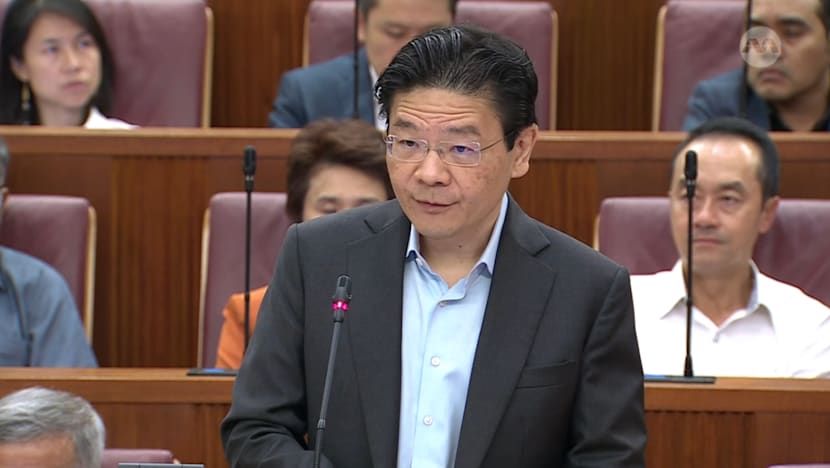
Prime Minister Lawrence Wong in his speech on Thursday (Sep 10) admitted as much, recounting how he approached several chief executive officers and senior business leaders who could have made a real contribution and were earning several times a minister’s salary. None were prepared to make the move into politics.
Even senior permanent secretaries were not keen. Of the several whom the prime minister asked, not a single one stepped forward.
STILL A POLITICAL HOT POTATO
I wrote in a commentary last month that the prime minister’s hands were tied in the recent changes to the Cabinet line-up because he had too few candidates to choose from.
He had inherited the problem which stemmed from the previous two general elections in 2015 and 2020 when the pipeline for minister-calibre material slowed down considerably.
You could argue that it was precisely why ministerial salaries, which had not been changed since 2011, needed adjustment.
This brings me to the second point which is that what the last 30 years have shown is that no prime minister has wanted to tackle the issue if they could help it. It was a political hot potato and it still is, very much so.
When I first heard that there might be revisions to these salaries, I thought that Mr Wong had finally decided to take the political bull by the horn and make a decisive change to help solve the talent shortage problem.
I suppose he tried, but the increases he announced were somewhat incremental and unlikely to move the needle much.
Even though the so-called MR-4 benchmark for junior ministers will go up from S$1.1 million to S$1.8 million, the actual salaries will increase more gradually, moving up to S$1.2 million in October and to an expected maximum of S$1.35 million by the end of this government’s term in 2030.
The new salary of S$1.2 million translates to over 60 per cent discount from the formula to accommodate a public service element, much higher than the 40 per cent that the review committee had recommended.
In effect, the prime minister was even more cautious than the committee and clearly had one eye on ground sentiment over an issue that still rankles many.
Having decided he had to make some adjustments, the prime minister opted for the least politically objectionable way.
To be fair, he said that the People’s Action Party (PAP) did not believe in using higher pay to draw people into politics.
Rather it was to ensure they did not have to make too great a financial sacrifice on top of all the other drawbacks that a political life demanded, including loss of privacy and being publicly scrutinised 24/7.
“Entering politics would already involve considerable disruption and sacrifice. We should not require them to completely upend the financial responsibilities that they have legitimately taken up for their families,” he said.
This is fair enough but his incremental approach also reduces the impact of the pay increase.
Will any one of the CEOs or permanent secretaries whom he had approached now say yes with these latest adjustments?
I have my doubts.
A RESET NEEDED TOO?
In a way, it is like Singapore’s birth rate problem, when no amount of baby bonuses has moved the fertility needle which instead has plummeted to record levels.
Will the number of minister-level candidates too fall below the replacement rate?
Perhaps the issue needs a reset in the same way the government says it is tackling the baby problem.
What should it start with?
The Sep 10 parliamentary debate hinted at one possible way which is about linking pay to performance.
I believe it is absolutely the right thing to do.
There are already targets which the government has set that determine to some extent the final pay: gross domestic product growth rate, the unemployment rate, income growth for the 50th percentile (the middle group of income earners), and for the 20th percentile consisting of those at the bottom.
Nominated Member of Parliament (NMP) Haresh Singaraju asked about setting quality of life indicators based on how well Singaporeans live, instead of focusing on how the country was performing economically.
NMP Kenneth Goh proposed longer-term targets such as “demographic sustainability, social mobility, climate adaptation and social cohesion” and suggested a three- to five-year timeframe for these key performance indicators (KPIs).
These suggestions are worth considering, as the government looks into the review committee’s recommendation of a quality of life measure be included in the national bonus framework.
Indeed, I believe that the public will pay greater attention in the future to individual minister’s performance as their salaries increase over the years.
There is nothing wrong with this demand and the government should respond to it by devising meaningful performance indicators and implementing it in a transparent and rigorous way.
Mr Wong himself acknowledged this saying: “So beyond what we have already shared, I will consider whether more information can be disclosed,” he said. “But we should also be careful not to turn ministerial assessment into a public popularity contest – and then start comparing and ranking individuals year by year.
“That is not going to be productive, and that's not how I want the Cabinet to operate.”
In fact, revamping the targets is an opportunity to reset.
If ever it decides to act decisively to up ministerial salaries that might produce concrete results, and not do so incrementally, it should accompany the move with an equally bold plan to tie these increases to a more challenging set of KPIs that is directly related to a minister’s performance.
This should be paid as a variable bonus.
Linking pay to performance will become more important if the current difficulty with getting top people in the private and public sector continues.
If the ruling party ends up missing out on the best candidates, the quality of leadership will suffer and there will be questions raised about whether those who answer the call deserve their remuneration.
Linking pay with performance is the best way to answer detractors.
Han Fook Kwang was a veteran newspaper editor and is Senior Fellow at the S Rajaratnam School of International Studies, Nanyang Technological University.