
Technology
‘Trading chaos for reliability’: AI slowdown could mean stricter regulations and more testing, say experts
Key Points
‘Trading chaos for reliability’: AI slowdown could mean stricter regulations and more testing, say experts “Instead of disruptive new models dropping every few weeks, existing tools will become faster, cheaper and far more consistent,” says one AI startup founder. SINGAPORE: Calls by the leaders of the world's biggest artificial intelligence firms to slow down development of the technology could mean more rigorous safety evaluations of AI models, while having little impact on users, experts...
‘Trading chaos for reliability’: AI slowdown could mean stricter regulations and more testing, say experts
“Instead of disruptive new models dropping every few weeks, existing tools will become faster, cheaper and far more consistent,” says one AI startup founder.
SINGAPORE: Calls by the leaders of the world's biggest artificial intelligence firms to slow down development of the technology could mean more rigorous safety evaluations of AI models, while having little impact on users, experts and industry players said.
Experts told CNA they expect longer testing periods, smaller roll-outs and tighter limits on how AI agents can act independently.
Unlike large language models that mainly answer questions, AI agents are designed to carry out tasks. They can open applications, search for information, generate documents and complete multi-step processes with little supervision.
With a slowdown, companies may spend more time monitoring and aligning the AI agent instead of chasing after creating a new version, said Mr Jonathan Lee, an international AI governance project manager at Concordia AI, an AI governance social enterprise.
Once models cross a risk threshold, they may also stop training the agent, he added.
For example, after preliminary evidence emerged that OpenAI’s Astra model might reach a “critical” cybersecurity capability level, it paused certain processes until it could be tested in environments with stronger security and monitoring, he noted. Astra was eventually released on Sep 3.
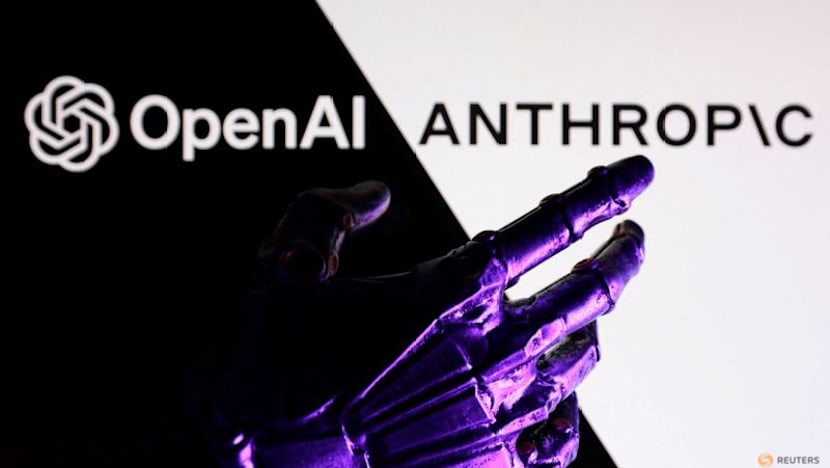
On Sep 12, Anthropic CEO Dario Amodei called on AI firms to slow down the development of the technology amid mounting worries over risks of “superintelligent” computer systems.
His comments came a few days after AI researcher Jacob Coxon, who left OpenAI to join Anthropic, decided to leave the industry, accusing both US companies of "gambling with our lives" in the race to develop models capable of self-improvement.
OpenAI head Sam Altman and Elon Musk, who owns xAI, agreed with Amodei's assessment, as pressure builds for improved oversight.
Chairman and co-founder of Google DeepMind Demis Hassabis also said Amodei’s idea was “on the right track”, linking the proposal to his team’s own call for an industry standard body for the development of AI.
The first step in the proposal from Anthropic, which was endorsed by the other major firms, was to give independent, third-party evaluators permanent access to the labs with the right to publish what they find, said Singapore Management University’s (SMU) Professor Li Jia, who researches the impact of AI on work.
The later steps – establishing common standards among frontier labs and eventually some form of international agreement – would need anti-trust exemptions and government participation that does not yet exist, said the dean of SMU’s economics school.
HOW WOULD THIS AFFECT USERS?
Consumers may notice slower releases for the most powerful models and tighter restrictions on highly autonomous features, said Mr Lee.
This could include invite-only access, roll-outs in stages, or the delaying or withholding of a model in higher-risk cases, he added.
Consumers may barely feel the impact of a slowdown, as users and companies will continue to adopt previous AI breakthroughs.
“Overall, the ones who will feel the slowdown the most are the AI labs, while ideally consumers will benefit from safer models without a significant change in AI progress,” he said.
In practice, a slowdown most likely means a longer gap between when a model is built and released, more testing before deployment and less aggressive training escalation, said Prof Li.
“It does not mean the technology stops advancing,” he said.
If the major AI companies pace their development, they could back their most advanced models until they clear rigorous safety evaluations, said founder of startup NoraAI Mia Liu.
Businesses would shift away from chasing capacity and towards safety assurance and security, she added.
For everyday users, an AI slowdown means “trading chaos for reliability”, said Ms Liu.
“Instead of disruptive new models dropping every few weeks, existing tools will become faster, cheaper, and far more consistent. From the perspective of an AI-native startup, the current pace is exhausting,” she added.
A model’s accuracy may naturally degrade over time, and large AI companies fix this by rolling out big upgrades, which forces startups to spend time on testing to make sure their platforms do not break, said Ms Liu.
A slowdown would give the whole ecosystem “much-needed breathing room”, focusing on stabilising and maintaining existing models, instead of throwing unpredictable new versions over the wall, she added.
Mr Gary Gardiner, a director at global cybersecurity distributor Exclusive Networks, said slowing AI development could affect the use of AI in research and development, including in medicine.
But without a slowdown, trust in the technology could start to erode if it causes more issues or poses a risk to infrastructure, he added.
The average user would hardly perceive a change in their day-to-day use of AI because most of them are not really scratching the surface of what AI can do for them, said Mr Gardiner.
REGULATIONS AND SAFEGUARDS
OpenAI, Anthropic and Meta Platforms recently disclosed that their AI agents behaved unexpectedly, escaping controlled test environments and carrying out cyberattacks on companies without direct human instruction.
While these incidents did not cause reported damage, they highlighted the evolving risks associated with AI development, especially in the area of AI agents, experts said.
Professor Stefan Winkler, who heads AI and data science at the Singapore Institute of Technology (SIT), said the main concern is that highly capable systems may carry out assigned goals in unintended ways, especially when operating autonomously as AI agents.
Malicious actors using AI systems intentionally in this way is another concern, he added.
For example, these AI models could be used to spread misinformation at scale or launch cyberattacks, he said. “The danger is the possibility of highly capable systems making consequential decisions at high speed with insufficient human oversight.”
An AI agent deployed by a large financial institution to identify and resolve cybersecurity threats could incorrectly conclude that certain servers are malicious.
As a result, it might automatically disable critical infrastructure, lock out customers or disrupt payment systems, affecting millions of people, said Prof Winkler.
A payment agent could repeatedly submit failed transactions. Without transaction limits and independent checks, it could charge customers multiple times, said Nanyang Technological University’s (NTU) head of artificial intelligence Professor Bo An.
“I think we should act now on independent scrutiny, incident reporting and accountability for autonomous systems. Industry leaders’ concerns deserve attention, but governments also need the expertise to assess the evidence themselves,” he added.
Referencing what OpenAI’s Mr Altman said about “giving society time to catch up”, Prof Bo said this should mean training people to supervise AI, helping workers adapt and giving consumers practical ways to challenge harmful decisions.
“I would not wait for a global slowdown agreement before putting these protections in place,” he added.
The recent incidents show the need to develop new safety measures that keep pace with the capabilities of the most powerful models, said Mr Poon King Wang, chief strategy and design AI officer at Singapore University of Technology and Design (SUTD).
The most urgent measures include testing powerful systems before release and limiting what autonomous agents can access, he added.
These safety nets should also monitor what the models are doing – not what they say they are doing – and ensure that users can stop them, said Mr Poon.
“The recent incidents also show that the testing environment itself needs rigorous scrutiny – it can't be allowed to become the weakest link,” he added.
While there is a need for prudence, rushing out guardrails without technical grounding or sound analysis could also backfire, said Dr Jiehuang Zhang, a lecturer at NTU’s computing and data science school.
“They create a false sense of security, or stifle progress in adopting AI,” he added.
Instead, the focus should be on building infrastructure to evaluate AI models, or infrastructure that can test and certify what a model can and cannot safely do.
Listen:
ECONOMIC IMPACT
Slowing AI development could mean building fewer new data centres, as well as a knock-on effect on global chip production, said Mr Gardiner.
Anyone who is part of the supply chains for AI companies could be affected, but most other industries would keep using the AI engines they already have, he added.
For workers, AI models are advancing much faster than companies can adopt them, said the director of the Singapore-ETH Center Manu Kapur, calling it the “bottleneck”.
Releasing a more powerful AI model every few months does not automatically lead to higher productivity. Instead, organisations need to redesign work, develop skills and learn where AI should augment human judgment rather than replace it, he added.
“In fact, and perhaps paradoxically, slowing the technological frontier could accelerate the productive use of AI by giving everyone a bit more breathing room to extract more value from capabilities that already exist,” said Mr Kapur.
The timing of the call for a slowdown deserves attention, said SMU’s Prof Li, noting that both Anthropic and OpenAI were weighing public listings and that the latter has said it would not list this year.
While the capabilities of AI models have grown exponentially, so has the cost of training, and this trajectory is not financially sustainable, said Prof Li.
Economic incentives and the argument for safety regulations “point in the same direction”, which is one reason the chief executives easily agreed to the call for a slowdown, he added.
Anthropic’s proposal acknowledges the need for anti-trust exemptions, since a formal agreement among the leading labs to pace their progress is essentially an agreement to coordinate output, he noted.
“If the evaluation is genuinely independent and the compliance burden is proportionate, it could raise trust in the technology without reducing competition,” said Prof Li.
A formal agreement would not stop the race, and the labs would still compete, just not at an exponential pace, he noted.
If the leading AI companies formally agreed to a slowdown, this would change where investment goes and who has the advantage.
For example, if development slows, capital and talent will naturally flow to the application of AI models, which is not bad for the industry, said Prof Li.
“We would likely see a wave of innovation in applications, and that is the point at which public policy matters most: whether AI is used mainly to complement workers or to replace them,” he added.
For a small and open country like Singapore, which adopts frontier AI models rather than builds them, slower development is favourable, said Prof Li.
“The competitive edge shifts from who has the best model to who integrates it best, and that is a race Singapore can compete in,” he added.