
Science
Bangkok’s historic Custom House reborn as The Langham’s newest luxury hotel
Key Points
Bangkok’s historic Custom House reborn as The Langham’s newest luxury hotel The 1888 riverside landmark has been lifted, restored and reimagined as a 75-room hotel, with its heritage buildings reserved for restaurants, bars and public spaces. When CNA Luxury met Nick Downing, general manager of The Langham, Custom House, Bangkok, he was both energised and exhausted. With the opening just months away, his hard hat suggested he remained very much in work mode.
Bangkok’s historic Custom House reborn as The Langham’s newest luxury hotel
The 1888 riverside landmark has been lifted, restored and reimagined as a 75-room hotel, with its heritage buildings reserved for restaurants, bars and public spaces.
When CNA Luxury met Nick Downing, general manager of The Langham, Custom House, Bangkok, he was both energised and exhausted. With the opening just months away, his hard hat suggested he remained very much in work mode. Yet his enthusiasm was obvious, with simple questions prompting excursions through nearly 140 years of Bangkok history.
Behind him, one of the city’s great architectural survivors is nearing the end of an extraordinary transformation. Built in 1888, Bangkok’s former Custom House spent decades deteriorating on the banks of the Chao Phraya. Parts had collapsed. Floorboards were missing. Most remarkably, the central building had sunk below river level.
When it opens on Dec 20, 2026, the reborn complex will be home to one of Bangkok’s most anticipated new luxury hotels. There will be just 60 rooms and 15 suites, alongside Chuan Spa, restaurants involving some of the biggest names on Bangkok’s food scene, and Crowntail, a riverside bar with its own pier. T’ang Court, the three-Michelin-starred Cantonese restaurant at The Langham, Hong Kong, will also make its Bangkok debut here.
But first, there was the small matter of rescuing the building.
“One of the very first decisions was: how do we rectify that?” said Downing. “How do we give the building its prominence back to the river again?”
The answer was to lift it. As roads, developments and flood defences rose around the site, engineers constructed new foundations, positioned 412 individual jacks beneath the Custom House and, over 18 months, painstakingly raised the structure by hand, two to five millimetres at a time.
For Smith Obayawat, founder and principal of Bangkok-based architecture practice The Office of Bangkok Architects (OBA), the feat was part of a broader challenge: preserving one of the capital’s most important landmarks while giving it a viable future.
Designed by Italian architect Joachim Grassi and opened during the reign of King Rama V, the Custom House was conceived as a gateway to Siam at a time when the Chao Phraya was Bangkok’s principal connection with the outside world.
Its fortunes declined as its original function disappeared. It was put to other uses, most recently as a fire station, before being abandoned for about a decade. Downing remembers venturing inside around 15 years ago.
“There were firemen sleeping in the rooms,” he recalled. “There had been about 20 different types of wallpaper that had gone up over the decades. Floorboards were missing.”
By the time restoration began, parts of the main building had collapsed. Yet much of the structure across all three heritage buildings remained intact.
Preserving as much as possible became the guiding principle. Surviving original elements were retained, while historical records, photographs, archaeological findings and physical evidence helped determine what had been lost or altered. Much of the original timber structure survives, strengthened only where necessary.
“The philosophy was very clear: authenticity first,” said Obayawat. “We haven’t recreated the Custom House. We’ve preserved the real thing and prepared it for its next chapter.”
The work also yielded surprises. Archaeological investigations uncovered evidence of an earlier structure associated with the collection of taxes and duties, suggesting that the riverfront had served a customs function before the present complex was built.
Then there was the clock. High within the main building, the remnants of a mechanical clock were found bearing the name of its maker, allowing its origins to be traced to Milan. Its surviving components are now being transformed by an Italian artist into an artwork for the hotel – a reminder of the Custom House’s role as a place where an increasingly outward-looking Siam met the world.
Raising the central building also created a new lower level, dubbed the Gallery. Here, glass flooring will reveal sections of the old foundations, while ceramics, bottles and other artefacts unearthed during excavation will be displayed.
“It’s a bit like Indiana Jones,” said Downing. “You sort of go in and out of the different rooms.”
Perhaps the most consequential conservation decision, however, concerned what not to put inside the old buildings.
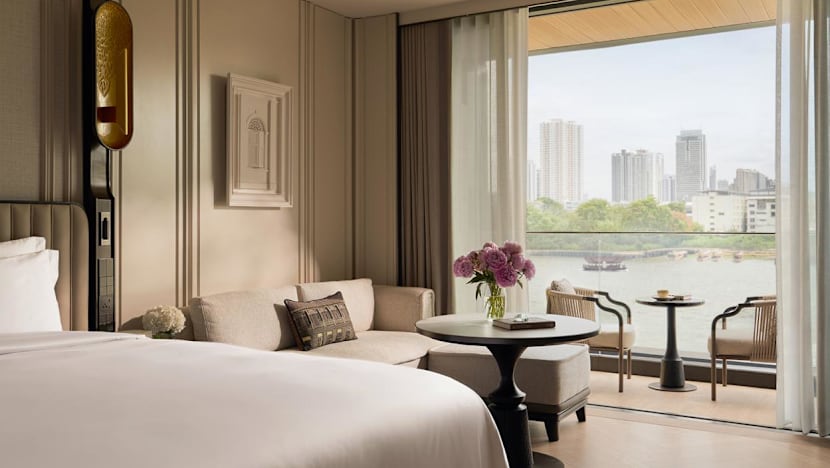
Rather than dividing the Custom House into guestrooms and suites, all 60 rooms and 15 suites occupy a newly constructed wing alongside it. The three heritage buildings will instead form the hotel’s social heart, housing restaurants, bars and event spaces.
That separation reduced the need to carve up the historic interiors or force the infrastructure of a contemporary hotel into a 19th-century shell. Air-conditioning, lighting, kitchens and other modern services have been integrated around the surviving fabric as discreetly as possible.
“The technology should support the experience, but you shouldn’t necessarily notice it,” said Obayawat.
The original grand staircase is being restored, while historic roof beams remain visible in the ballroom. New glass lifts, by contrast, have been placed in a contemporary structure beside the Custom House rather than disguised as original features.
That distinction between preservation and imitation also shaped the new accommodation wing.
Obayawat characterises the relationship between old and new as one between “grandfather” and “grandson” – members of the same family, but belonging to different generations. Accordingly, the new structure does not attempt to mimic the neo-Palladian architecture beside it.
Its curved form responds to the Chao Phraya, while faceted glass catches shifting light and reflections from the water. Its scale and sightlines were calibrated so the Custom House remains the architectural protagonist. The connection between the structures swoops down towards the heritage buildings, a gesture Downing describes as the grandson bowing to his grandfather.
“There was a very conscious decision about not copying the original, because if you had done that, it would have devalued the original buildings,” said Downing. “If you can copy it, what’s the point?”
Inside the new wing, the references are more subtle. Brushed-metal bathtubs evoke the gilded objects and coinage of the Rama V era, while geometric details draw on rhombus patterns found in Thai architecture and decorative arts. Bespoke textiles incorporate details from the Custom House facade.
If the guestrooms promise a quieter retreat, the heritage buildings are being primed to supply the buzz. T’ang Court will occupy the former post and telegraph office building, bringing the three-Michelin-starred Cantonese pedigree of its Hong Kong sibling to Bangkok. Other restaurants will involve some of the city’s best-known culinary names, including a two-Michelin-starred chef and a prominent Thai chef whose identities remain under wraps.
Downing is particularly animated about Crowntail, named after a variety of Siamese fighting fish. Positioned on the Chao Phraya with its own pier, the bar is intended to be a destination in itself – a place for cocktails and sunsets with the river virtually at arm’s reach.
Together, these spaces create what Downing describes as almost “two hotels in one”. Guests can retreat to the privacy of the contemporary accommodation wing or cross into a livelier world of restaurants, bars and gathering spaces within buildings that have occupied the riverfront for well over a century.
Chuan Spa adds another layer of retreat, drawing on Traditional Chinese Medicine, while private boats will offer another way to explore the Chao Phraya and its temples, markets and historic neighbourhoods. Chauffeured Bentleys will be available for journeys further afield.
It’s an ambitious proposition for an intimate hotel. The complex occupies 170 metres of river frontage in Bang Rak yet contains just 75 guestrooms. Downing says around US$250 million (S$316.82 million) has been invested in the project – a level of investment he concedes “almost defied logic”.
Crucially, much of what has been created will not be reserved for those staying at the hotel. The restaurants, bars, ballroom, Gallery and other public spaces will allow Bangkokians to once again experience a landmark that spent decades deteriorating behind closed doors.
“We want Bangkok to come into these buildings,” Downing said.
Almost 140 years after the Custom House first greeted ships, trade and travellers arriving along the Chao Phraya, its purpose has changed beyond recognition. But after one of the most complex heritage restorations Bangkok has witnessed, its doors are preparing to open again.
Bangkok (LOCATION)
Custom House (ORG)
Langham (ORG)
CNA Luxury (ORG)
Nick Downing (PERSON)
the Chao Phraya (ORG)
Chuan Spa (PERSON)
T’ang Court (ORG)
Cantonese (ORG)
Hong Kong (LOCATION)
Downing (PERSON)
the Custom House (ORG)
Smith Obayawat (LOCATION)
The Office of Bangkok Architects (ORG)
OBA (PERSON)