
Politics
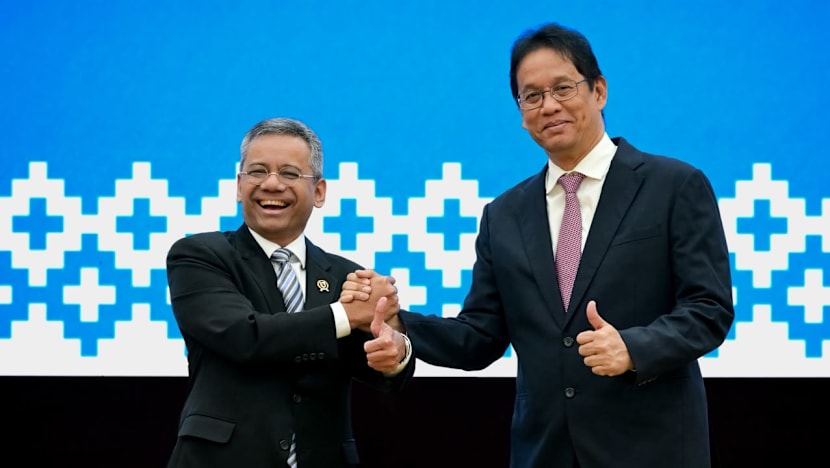
What led to Purbaya’s sacking as Indonesia’s finance minister – and the challenges facing successor Suahasil
Key Points
analysis Asia What led to Purbaya’s sacking as Indonesia’s finance minister – and the challenges facing successor Suahasil Analysts say the appointment of Suahasil Nazara signals that President Prabowo Subianto wants to achieve ambitious economic growth targets in a more careful and prudent way, adding that the new minister will have to balance this goal with fiscal discipline. A widespread restructuring inside Indonesia’s finance ministry, and a public disagreement with sovereign wealth...
analysis Asia
What led to Purbaya’s sacking as Indonesia’s finance minister – and the challenges facing successor Suahasil
Analysts say the appointment of Suahasil Nazara signals that President Prabowo Subianto wants to achieve ambitious economic growth targets in a more careful and prudent way, adding that the new minister will have to balance this goal with fiscal discipline.
JAKARTA: A widespread restructuring inside Indonesia’s finance ministry, and a public disagreement with sovereign wealth fund Danantara over the use of its profits were the latest possible reasons prompting President Prabowo Subianto to sack Purbaya Yudhi Sadewa as finance minister after months of growing calls for his removal, said analysts.
They also said Suahasil Nazara’s appointment as Indonesia’s new finance minister on Monday (Sep 14) could bring greater internal stability and better inter-agency cooperation, given his experience as an insider in the ministry and his comparatively more subdued leadership style.
Still, the observers warned that a daunting list of challenges awaits Suahasil.
The reshuffle caught many by surprise, including Suahasil.
“I was informed about the process this morning and told to prepare for the inauguration this afternoon.” he told reporters after his swearing-in ceremony on Monday.
Meanwhile, Purbaya was still attending a parliamentary hearing as finance minister on Monday morning before leaving abruptly.
“I got a call from Prasetyo Hadi, the State Secretary,” Purbaya said on Tuesday about why he left the hearing.
He found out only later on Monday that he was being replaced.
“Last night, I still had a lot on my mind, so I had some trouble sleeping,” Purbaya said on Tuesday after a handover ceremony at the Finance Ministry’s office where he passed the baton to his successor.
“But I’m sure tomorrow I’ll be at ease. All good.”
Suahasil is Prabowo’s third finance minister since the president took office in October 2024. Purbaya was appointed just over a year ago on Sep 8, 2025, replacing longtime finance minister Sri Mulyani Indrawati, who served under three presidents.
Suahasil is no newcomer to the Ministry of Finance. He previously headed the ministry’s Fiscal Policy Agency from 2016 to 2019 and served as Deputy Finance Minister from 2019 until his appointment as minister.
Experts believe that Suahasil will adopt a more cautious approach as minister compared to Purbaya, viewed widely as a polarising figure who attracted both praise and criticism for his brash and unfiltered style.
“He (Suahasil) understands the state budget, taxation, financing, subsidies, and fiscal governance from the inside,” Achmad Nur Hidayat, an economist and public policy analyst from Jakarta’s National Development University, told CNA.
CHANGING OF THE GUARD
Purbaya's time in office was marked by a number of economic shocks, including a weakened rupiah currency and a fiscal deficit that the government said in July could widen to 2.85 per cent of gross domestic product this year, bigger than the 2.68 per cent it originally predicted.
The new estimate is close to the legislated deficit ceiling of 3 per cent of GDP.
Two ratings agencies, Moody’s and Fitch, downgraded Indonesia's credit rating outlook from stable to negative this year, citing policy uncertainty and fiscal spending plans, battering sentiment on Southeast Asia’s biggest economy.
This sparked rumours that Purbaya’s days may be numbered.
In recent months, Purbaya, who was previously a low-profile technocrat best known for leading a deposit insurance agency, has had to deny speculation that he was resigning from office.
Experts said Purbaya’s brash comments and policies meant that questions continued to linger over how long he could last.
In April, Purbaya had floated the idea of imposing a levy on ships passing through the Malacca Strait, as part of a push to maximise the country’s strategic position along global trade and energy routes.
A day later, Indonesia’s foreign minister Sugiono said the country would not do so as this would not be consistent with international law.
Last week, Purbaya conducted a massive restructuring inside the Finance Ministry, which saw hundreds of officials reassigned to new positions, including some 50 director-level officials.
Quoting anonymous sources from inside the ministry, several media outlets reported that many finance ministry officials were not happy with the massive reassignment.
“Purbaya’s actions have caused a huge rift inside the Finance Ministry. This move may be one of the reasons why he was sacked,” Bhima Yudhistira, executive director of the Jakarta-based think-tank, Centre for Economics and Law Studies (CELIOS), told CNA.
The move was just one of several shake-ups and restructuring done during Purbaya’s tenure.
Quoting an anonymous source, Suara news portal reported that Purbaya has been trying to replace “Sri Mulyani’s people” ever since he became minister.
The most senior ranking were Febrio Nathan Kacaribu and Luky Alfirman who were removed in April from their positions as director-general of economic and fiscal strategies and director-general of state budget, respectively.
Both men were appointed to their positions by Sri Mulyani in May 2025, just months before Purbaya became minister.
Suahasil had served as Sri Mulyani’s deputy minister for five years, and kept his position following Purbaya’s appointment.
Bhima said another possible reason could be Purbaya’s recent standoff with officials from sovereign wealth fund Danantara Indonesia.
In early September, Purbaya told the media that Danantara would transfer 120 trillion rupiah (US$6.8 billion) of its profits to the government to help meet this year's fiscal deficit target.
Danantara officials later said no such plan was discussed.
“Then there was the issue of delayed tax refunds, which made a lot of businesses unhappy,” Bhima said.
He was referring to Purbaya’s decision in February to put tax refund applications through a lengthier verification process, believing that it would save the country billions of dollars.
“So Purbaya’s approach to internal coordination, including his communication style, became increasingly problematic over time. He was overconfident. That was ultimately what led to his removal in the reshuffle,” Bhima said.
Agung Baskoro, a political analyst at Jakarta-based think-tank Trias Politika Institute, said that relationships between the Finance Ministry and other government institutions deteriorated under Purbaya.
The reshuffle, he told CNA, could be aimed at “maintaining harmony between the central and regional governments, as well as working relations between the Ministry of Finance and other ministries that are stakeholders of the Finance Ministry”.
Speaking to reporters on Tuesday, Purbaya admitted that his dismissal was “partly” the result of his decision to reassign hundreds of ministry officials.
He declined to say what the other reasons for his dismissals were, saying instead: “It’s the president’s prerogative.”
CNA has reached out to Purbaya for comment but has not received a response.
Deni Friawan, an economics researcher at Jakarta-based think-tank Centre for Strategic and International Studies (CSIS), said that despite the changing of the guard, Prabowo will likely maintain his ambitious target of 8 per cent economic growth by the end of his presidential term in 2029.
“I think the Prabowo administration is sending a signal, or a message, to the market and businesses: ‘Yes, I have ambitious economic growth targets’. That was why, for example, Purbaya, who was very aggressive, was appointed previously,” Deni told CNA.
“But the message today is that the government not only wants to maintain that ambition, but also wants to achieve it in a careful, prudent and measured way.”
CONTINUITY, BUT WITH A DIFFERENT STYLE
Suahasil is a long-time economist and technocrat who has served as deputy minister under Prabowo and his predecessor Joko Widodo.
Suahasil also has a long academic career at the University of Indonesia, where he began teaching in 1999. He headed the university’s Demographic Institute from 2005 to 2008 and became a professor of economics in 2009.
The 55-year-old holds an economics degree from the University of Indonesia, a master’s degree from Cornell University and a PhD in economics from the University of Illinois at Urbana-Champaign.
Deni from CSIS said Suahasil’s long experience as an economist and policymaker would make him a more measured communicator than Purbaya, who had become known for his “cowboy” style.
“Your words have to be measured and carefully considered. When you hold such a position, even a cough can draw a reaction from the market, let alone something you actually say,” said Deni.
“Suahasil is accustomed to this, and he understands that everything he says can have major consequences for the market, or even for people’s livelihoods. So he will certainly be careful.”
Agung of Trias Politika Institute said this shift in public communication should be clearly evident during Suahasil’s first 100 days at the helm of the Finance Ministry.
Agung said Suahasil should communicate as transparently, calmly and steadily as possible.
“If a policy is not yet clear, there is nothing wrong with saying ‘no comment’ for the time being. A finance minister saying ‘no comment’ does not mean he knows nothing. On the contrary, that can actually help maintain market stability,” Agung said.
Wijayanto Samirin, an economist from Jakarta’s Paramadina University, said Suahasil could bring stability inside the finance ministry and forge better relationships with other institutions.
“One of the things that has frequently made the economic situation worse has been Purbaya’s communication style,” Wijayanto told CNA.
“As finance minister, (Purbaya) should serve as a key point of coordination and communication across institutions and ministries, particularly on fiscal matters. And yet Purbaya turned out to be difficult to work with: both internally, with his own team, and across ministries and other government institutions.”
In an interview after his inauguration on Monday, Suahasil described the change in leadership at the Finance Ministry as a “continuation, not a change”, but said the ministry would carry on its work “in a better way”.
He also said Prabowo had tasked him with maintaining a credible state budget and trustworthy public communication, while ensuring that the budget supports the government’s priority programmes.
“In general, the President directed us to continue safeguarding the country’s finances, maintaining their health and preserving their credibility going forward,” Suahasil said.
TOUGH ROAD AHEAD
One of Suahasil’s pledges was to keep the budget deficit below 3 per cent of the country’s GDP.
However, CELIOS economist Nailul Huda said keeping the fiscal deficit below 3 per cent depends on whether the government is willing to discontinue priority programmes that place a burden on the budget, such as the Free Nutritious Meals programme.
The National Nutrition Agency has a 240.2 trillion rupiah budget ceiling for 2027, equivalent to about 5.9 per cent of the government’s proposed total spending.
Of that, 232.5 trillion rupiah is earmarked for the free meals programme, which is expected to reach about 72.46 million people.
Nailul said Suahasil’s task is to restore rationality to the state budget by being willing to reject unjustified spending increases next year.
“The public will naturally expect Suahasil to distinguish himself from Purbaya rather than simply continue what Purbaya did. His immediate task is to reject unjustified budget increases sought by ministries and government agencies as the 2027 budget is being finalised,” Nailul said.
Similarly, Achmad of National Development University said Suahasil must be willing to scrutinise and correct the large budgets allocated to Prabowo’s flagship programmes, which he said consume a significant share of the state budget.
To finance these programmes, Jakarta has slashed funds allocated to help provinces and districts pay for their programmes and expenses from 919 trillion rupiah last year to 693 trillion this year.
The decision has disrupted basic public services in some areas and led to the postponement of strategic infrastructure projects.
Jakarta is also considering imposing new taxes as well as raising and expanding existing ones.
“These programmes have resulted in the finance ministry increasing tax pressure on those who are already compliant, cutting subsidies for ordinary people or squeezing regional government spending,” Achmad said.
“A finance minister is not merely a treasurer tasked with finding money to pay for every political promise made by the government. A finance minister must have the courage to say no (to costly programmes) when the necessary funding is unavailable.”
Purbaya (ORG)
Indonesia (LOCATION)
Suahasil (PERSON)
Asia (LOCATION)
Suahasil Analysts (PERSON)
Suahasil Nazara (PERSON)
Prabowo Subianto (PERSON)
JAKARTA (LOCATION)
Danantara (LOCATION)
Yudhi Sadewa (PERSON)
Suahasil Nazara’s (PERSON)
Prasetyo Hadi (PERSON)
State (ORG)
the Finance Ministry’s (ORG)
Prabowo (ORG)