
Science
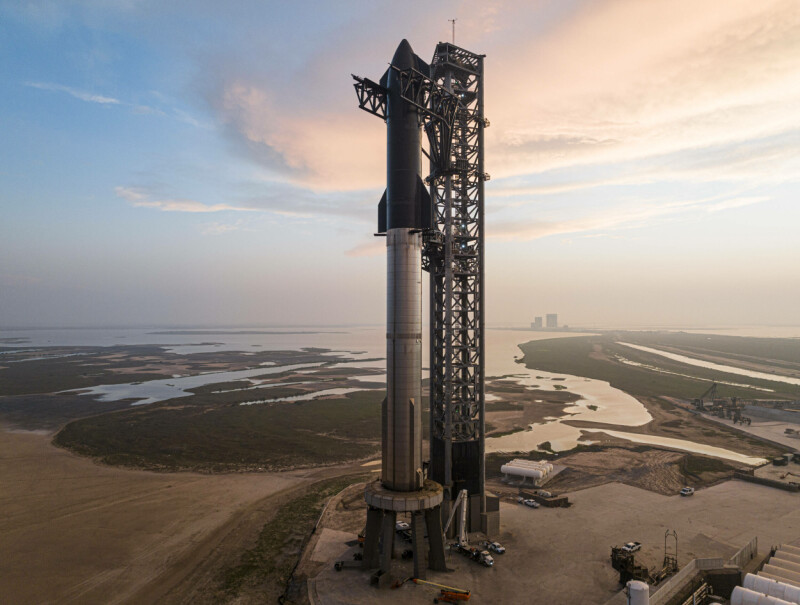
SpaceX aims Starship for orbit on September 22
Key Points
SpaceX is aiming for a September 22 launch of its monstrous Starship rocket on a 10-hour mission to deliver 26 Starlink V3 satellites into orbit. The flight, set to launch at 1215 UTC if all goes to plan and the authorities give the green light, will be the first time Starship has gone into orbit, and the mission is planned to fly at an altitude of approximately 275 km. The mission aims for six orbits, followed by a deorbit burn using a single Raptor engine while.
SpaceX is aiming for a September 22 launch of its monstrous Starship rocket on a 10-hour mission to deliver 26 Starlink V3 satellites into orbit. The flight, set to launch at 1215 UTC if all goes to plan and the authorities give the green light, will be the first time Starship has gone into orbit, and the mission is planned to fly at an altitude of approximately 275 km. The mission aims for six orbits, followed by a deorbit burn using a single Raptor engine while. The engineers are then planning a splashdown in the Pacific Ocean west of Chile. The Super Heavy Booster will be ditched in the Gulf of Mexico, hopefully under better control this time. On flight 13, the booster made a "hard splashdown," as SpaceX delicately put it, after only eight of the planned 13 engines reignited. The booster used all 33 engines for its boostback burn, but according to SpaceX, "the three center engines showed signs of ice clogging which triggered an early end to the maneuver." In true iterative style, SpaceX tweaked the hardware to improve filtering and updated the software to "enhance relight reliability." SpaceX has also changed Starship's heatshield, including adding curved tiles to reduce heating in tile gaps and "additional retention mechanisms added to tiles in areas deemed to be at highest risk of falling off during ascent." It is also reusing a pair of tiles recovered from the previous flight test. If Starship is to become truly reusable, these tiles will need to fly over and over again. Getting to orbit is by no means guaranteed. The SpaceX team will only command a final burn to enter orbit if there is sufficient hardware redundancy to perform a deorbit burn when the time comes. After all, nobody wants something the size of Starship making an uncontrolled reentry after its orbit eventually decays. Starship has had an eventful test program. Some missions were spectacularly successful, and several boosters returned to be caught by arms on the launch tower. Others were impressive failures. The vehicle is critical to SpaceX's future; it can loft far greater payloads than the company's workhorse Falcon 9 and is an essential part of NASA's Artemis program. For Artemis III, planned for 2027, SpaceX is expected to launch a Starship equipped with the docking apparatus planned for the lunar variant. Reaching orbit is therefore a critical step. ®