
Science
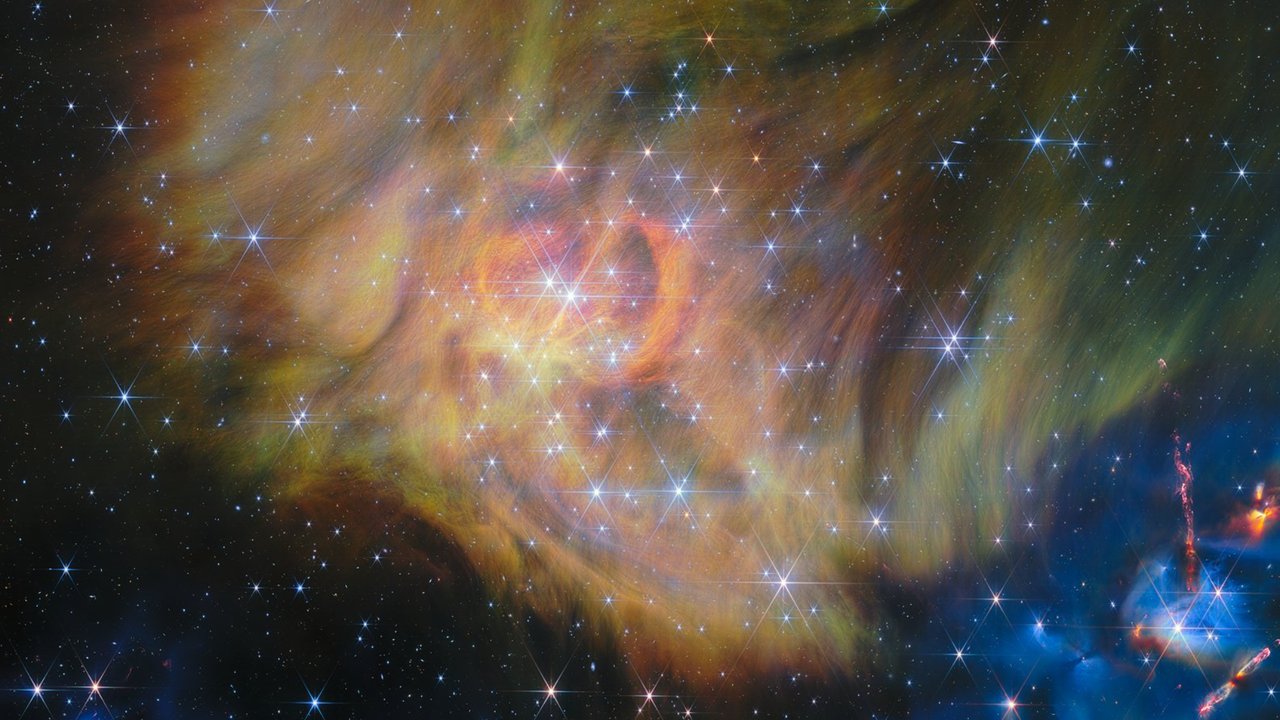
Colossal cosmic cloud revealed in insane new image from the James Webb Space Telescope | Space photo of the day for Sept. 16, 2026
Key Points
Colossal cosmic cloud revealed in insane new image from the James Webb Space Telescope | Space photo of the day for Sept. 16, 2026 James Webb Space Telescope spies colossal cosmic cloud | Space photo of the day for Sept. 16, 2026 An ethereal and magnificent display of gas and dust stretches across the cosmos in a spectacular new image captured by NASA's James Webb Space Telescope. Glowing wisps of translucent gas and dust paint a striking image of the star-forming region IC 348 in this new...
Colossal cosmic cloud revealed in insane new image from the James Webb Space Telescope | Space photo of the day for Sept. 16, 2026
James Webb Space Telescope spies colossal cosmic cloud | Space photo of the day for Sept. 16, 2026
An ethereal and magnificent display of gas and dust stretches across the cosmos in a spectacular new image captured by NASA's James Webb Space Telescope.
What is it?
Glowing wisps of translucent gas and dust paint a striking image of the star-forming region IC 348 in this new JWST snapshot. In the image, you can see IC 348, a region found about 1,000 light-years away.
In this vast expanse of gas and dust, cold molecular hydrogen gas collapses to create new stars. And this image has no shortage of suns, with twinkling stars speckling the entire cosmic landscape, diffraction spikes and all.
But while this is a star-forming region, objects are found here as well. This image was captured as part of a scientific search for brown dwarfs, which are objects that form like stars but aren't massive enough to kickstart hydrogen fusion in their cores.
Why is it incredible?
Brown dwarfs are one of the great mysteries of our universe. Not as massive as the least massive stars, but more massive than the biggest planets, brown dwarfs are strange objects stuck in the middle.
Brown dwarfs do emit some light and heat, which helps scientists to find them, though doing so can be tricky, as they're much cooler than stars and not that bright (at least in visible light). However, despite being dim, they give off infrared radiation, allowing them to be spotted by infrared instruments aboard space telescopes like JWST.
This incredible new image is part of an observing program that aims to use JWST to find and study the smallest brown dwarfs. In 2022, researchers looking at IC 348 found brown dwarfs just a few times more massive than Jupiter, so they were on the very small end. Researchers hope to find even smaller brown dwarfs to help them better understand how these strange objects form and vary across space.
You must confirm your public display name before commenting
Please logout and then login again, you will then be prompted to enter your display name.
Chelsea Gohd served as a Senior Writer for Space.com from 2018 to 2022 before returning in 2026, covering everything from climate change to planetary science and human spaceflight in both articles and on-camera in videos. With a M.S. in Biology, Chelsea has written and worked for institutions including NASA JPL, the American Museum of Natural History, Scientific American, Discover Magazine Blog, Astronomy Magazine, and Live Science. When not writing, editing or filming something space-y, Gohd is writing music and performing as Foxanne, even launching a song to space in 2021 with Inspiration4. You can follow her online @chelsea.gohd and @foxanne.music
the James Webb Space Telescope (ORG)
James Webb Space Telescope (PERSON)
NASA (ORG)
JWST (ORG)
suns (ORG)
Brown (PERSON)
Jupiter (LOCATION)
Chelsea Gohd (PERSON)
Space.com (ORG)
M.S. (LOCATION)
Biology (LOCATION)
Chelsea (ORG)
JPL (ORG)
the American Museum of Natural History (ORG)
Scientific American (PERSON)