
Science
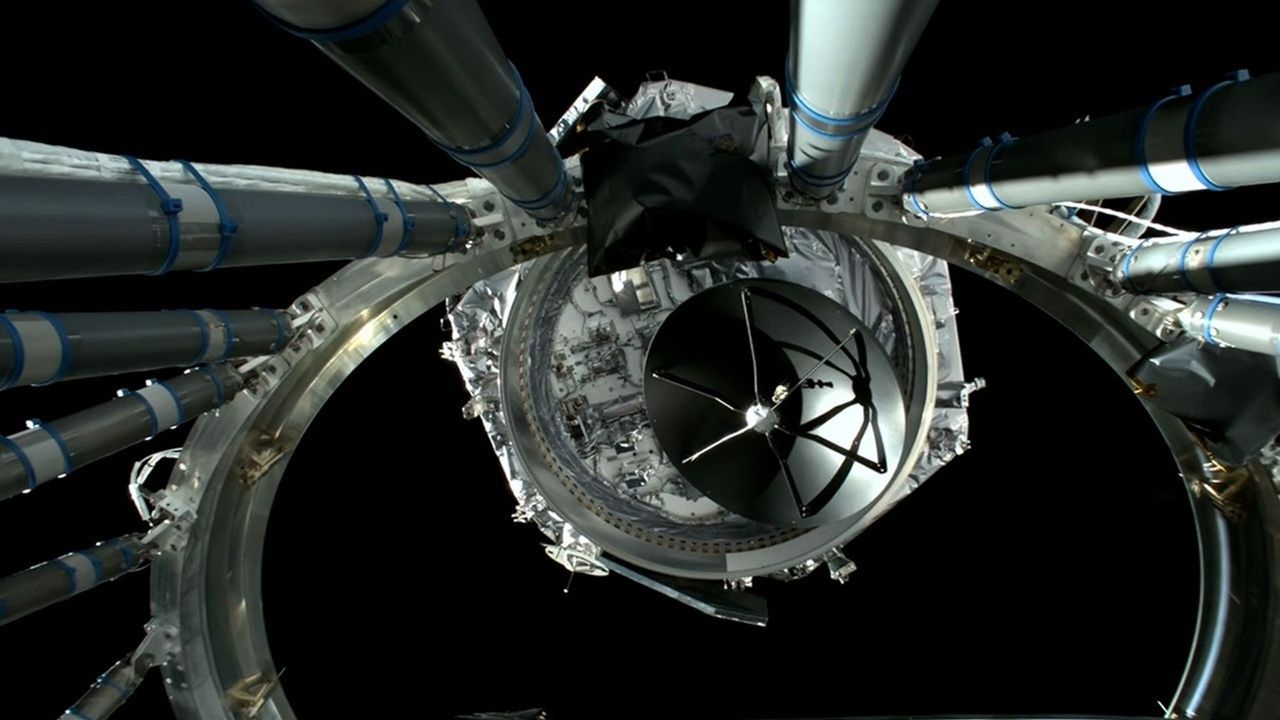
Roman Space Telescope starts waking up as NASA powers on instruments for the 1st time
Key Points
Roman Space Telescope starts waking up as NASA powers on instruments for the 1st time Roman is still traveling to its final destination in space and slowly powering all its devices. As the newest heavy hitter in orbital observatories continues the journey to its final destination, NASA has begun the process of switching the spacecraft on. The Nancy Grace Roman Space Telescope launched on Aug. 30, and is on a three-month long trek to Lagrange point two (L2).
Roman Space Telescope starts waking up as NASA powers on instruments for the 1st time
Roman is still traveling to its final destination in space and slowly powering all its devices.
As the newest heavy hitter in orbital observatories continues the journey to its final destination, NASA has begun the process of switching the spacecraft on.
The Nancy Grace Roman Space Telescope launched on Aug. 30, and is on a three-month long trek to Lagrange point two (L2). L2 is a relatively idle orbital sweet spot almost a million miles from Earth that will allow Roman to remain on the planet's night side and keep the bright sun to its back. It's an optimal location for the telescope to operate its two primary instruments, the Wide Field Instrument (WFI) and its Coronagraph Instrument.
Neither are ready to begin collecting science, and will undergo another month or so of calibrations and tests before Roman can begin its mission, but initial downlinks from the telescope indicate nominal readings on its components as NASA teams continue its commissioning. "This is a huge milestone for the team at Goddard, our industry teams at BAE Systems, Inc. and Teledyne, and our science centers," said Josh Schlieder, the Wide Field Instrument scientist at NASA's Goddard Space Flight Center, in a statement.
The WFI is a 300-megapixel infrared camera designed to survey enormous swaths of the sky. Scientists plan to use the imager to take fast snapshots of the cosmos, study dark energy, and map the distribution of matter throughout the universe. It uses 18 infrared detectors that NASA says combine for a sensing area about the size of a laptop; by comparison, a typical digital camera imaging sensor covers about the size of a postage stamp.
Before engineers could switch on the WFI, they spent about 10 days allowing the instrument to dry out and shed contaminants that may have accumulated prior to launch. The WFI was kept at a relatively warm (for space) -85 degrees Fahrenheit (-65 Celsius). On Friday (Sept. 11), Roman teams turned off the instrument's heater to allow it to cool to around -225 Fahrenheit (-143 Celsius), at which point it was cold enough to activate its infrared detectors. The detectors continued cooling afterward toward their eventual operating temperature of about -300 F (-183 C).
Following the successful activation of its infrared sensors, engineers moved on to calibrate the WFI's element wheel, which filters individual wavelengths for detection using a system of prisms and other optic mechanisms. And, on the morning of Sept. 13, Roman teams confirmed the focus components were functioning nominally.
Roman's coronagraph also completed its first major steps toward operation. The instrument is controlled by the Coronagraph Commanding Center at Caltech/IPAC in Pasadena, California, where operators were able to verify that they could remotely operate the instrument’s electronic and mechanical systems. The coronagraph functions using a series of mirrors, masks and sensors to block the light of a distant star in order to detect the much fainter light of planets in that star’s orbit.
Tests on the coronagraph also included warming the device to 72 degrees Fahrenheit (22 Celsius) — nominal for operating conditions in controlled environments on Earth, but quite warm compared to the WFI’s -300 F (-183 C) operating temperature. The extra heat allows the Coronagraph to maintain conditions similar to those inside NASA test chambers so engineers can more easily simulate tests on Roman's deformable mirrors.
"Now that this test is complete, we've been decontaminating: sitting idle with our detectors warm so anything that’s stuck to the surface, such as water or trace chemicals, will tend to leave it,” said Eric Cady, an optical engineer leading commissioning efforts for the Roman Coronagraph at NASA's Jet Propulsion Laboratory.
Decontamination procedures on Roman's coronagraph will continue for 30 days, along with periodic checks and other minor calibrations. That will occupy a portion of the observatory's remaining journey to L2, which is expected to last about 12 more weeks. NASA says Roman remains on track to release its first science images in early 2027. And, thanks to the precision of Roman's SpaceX Falcon Heavy launch vehicle and fuel savings during Roman's early trajectory corrections, the telescope is expected to have enough propellant to operate for the next 22 years.
You must confirm your public display name before commenting
Please logout and then login again, you will then be prompted to enter your display name.
Josh Dinner is Space.com's Spaceflight Staff Writer. He is a writer and photographer with a passion for science and space exploration, and has been working the space beat since 2016. Josh has covered the evolution of NASA's Artemis program and humanity's return to the moon, commercial spaceflight partnerships and crewed missions from the Space Coast, NASA science missions and more. He also enjoys building 1:144-scale model rockets and spacecraft. Find some of Josh's launch photography on Instagram, and follow him on X, where he mostly posts in haiku.
Roman Space Telescope (LOCATION)
NASA (ORG)
Roman (PERSON)
The Nancy Grace Roman Space Telescope (ORG)
Lagrange (LOCATION)
L2 (ORG)
Earth (LOCATION)
the Wide Field Instrument (ORG)
WFI (ORG)
Coronagraph Instrument (ORG)
Goddard (ORG)
BAE Systems, Inc. (ORG)
Teledyne (ORG)
Josh Schlieder (PERSON)
Goddard Space Flight Center (ORG)