
Weather
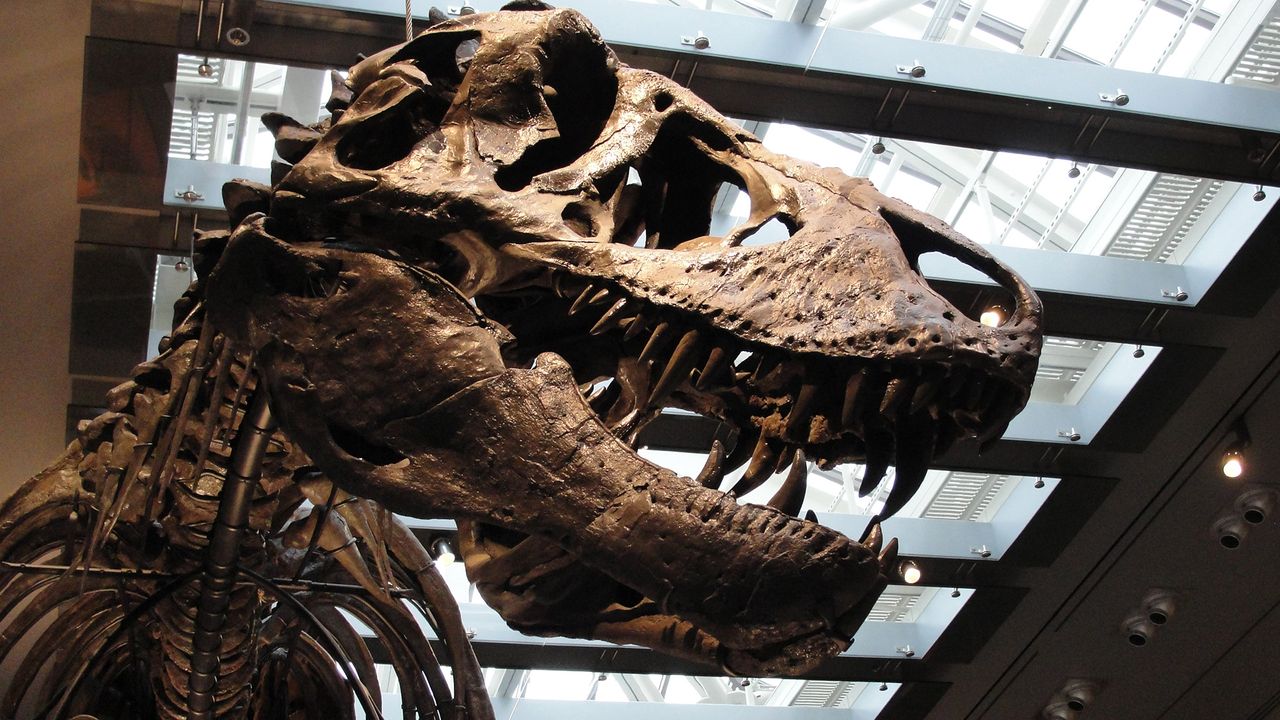
Scientists finally figured out the temperature of T. rex's blood — and it was as hot as ours
Key Points
Scientists finally figured out the temperature of T. rex's blood — and it was as hot as ours Tooth analysis has revealed that the king of the dinosaurs was as warm-blooded as a human or an elephant Tyrannosaurus rex was a hottie with a body temperature similar to our own, according to a new analysis of their teeth. The finding supports the idea that T. rex was a fast, energetic predator and scavenger, not an animal that basked in the sun to gain energy like most modern-day reptiles. T. rex,...
Scientists finally figured out the temperature of T. rex's blood — and it was as hot as ours
Tooth analysis has revealed that the king of the dinosaurs was as warm-blooded as a human or an elephant
Tyrannosaurus rex was a hottie with a body temperature similar to our own, according to a new analysis of their teeth.
The finding supports the idea that T. rex was a fast, energetic predator and scavenger, not an animal that basked in the sun to gain energy like most modern-day reptiles.
T. rex, which lived between about 68 million and 66 million years ago, at the end of the Cretaceous period (143.1 million to 66 million years ago), was one of the largest carnivorous dinosaurs that ever lived.
Previous studies have already suggested that T. rex and its relatives were warm blooded, but now scientists have estimated the dinosaur's body temperature for the first time by studying different isotopes, or forms, of the same chemical elements in the enamel of three T. rex teeth from specimens found in the Hell Creek Formation in Montana.
Rare, heavy isotopes of carbon and oxygen bond together differently in growing tooth enamel depending on the temperature. The number of bonds formed between these rare isotopes is greater at cooler temperatures than it is at warmer temperatures, which means warm-blooded, or endothermic animals, that can regulate their own body temperature, have fewer of these chemical bonds in their teeth than cold-blooded, or ectothermic, animals, which rely on their environment for warmth.
By measuring the bonds in carbon dioxide (CO2) given off when dissolving small samples from the T. rex teeth, Randon Flores, a geologist at the University of California, Los Angeles (UCLA), and his colleagues could estimate where on the scale of animal body temperatures T. rex sat.
They put the T. rex body temperature at 97.3 degrees Fahrenheit (36.3 degrees Celsius), comparable to that of a human or an elephant. Modern, cold-blooded reptiles tend to have lower body temperatures of about 82-86 F (28-30 C), while most birds — descendants from T. rex's branch of dinosaurs — tend to be much warmer at 104-109 F (40-43 C). Therefore, these findings, published Wednesday (Sept. 16) in the journal Science Advances, show how much this relative of modern birds had already diverged from cold-blooded dinosaurs like Triceratops and Stegosaurus.
Get the world’s most fascinating discoveries delivered straight to your inbox.
"The temperature is about what I would have guessed — higher than a reptile or a slow mammal like a sloth, but lower than an avian," study co-author Robert Eagle, a geobiologist at UCLA, said in a statement.
Related stories
- 'Another dinosaur has entered the luxury collectibles market': Gus the T. rex just sold for $50 million. Here's what its loss means to science.
- Fossils of iconic long-necked dinosaur Diplodocus found in Europe for first time — and it may have traveled there via land bridge
- Did fungi give mammals an evolutionary edge after the dinosaur-killing asteroid hit? New evidence revives a provocative hypothesis
These findings have implications for how and where the T. rex might have lived. A warm-blooded T. rex would have been an energetic, active animal, chasing or scavenging food to fuel its fast metabolism rather than basking in the sun to gain energy, wrote the authors.
It also means that during the Cretaceous period, one of the warmest periods in Earth’s history, about 11-25 F (6-14 C) warmer than today, T. rex would have been able to survive in most of the North American continent, from what is now Mexico up to chilly climates where cold-blooded reptiles wouldn’t have survived. This helps explain why a tyrannosaur fossil has been found in the Kikak-Tegoseak Quarry in Alaska, although there is no trace of other reptiles like lizards, turtles or crocodiles from that period in the region.
The ability for T. rex to inhabit cooler, high latitudes also aligns with recent evidence that tyrannosaurs crossed the Bering Land Bridge between Asia and North America, write the authors.
Flores, R. J., Eagle, R. A., Trayler, R. B., Conte, G. L., Kim, S. L., Chiarenza, A. A., Farnsworth, A., Valdes, P. J., Chiappe, L., & Tripat, A. (2026). The body temperature of Tyrannosaurus rex. Science Advances, 12. http://www.science.org/doi/10.1126/sciadv.aeb7653
How much do you know about the king of the dinosaurs? Test your knowledge with our T. rex quiz!
Chris Simms is a freelance journalist who previously worked at New Scientist for more than 10 years, in roles including chief subeditor and assistant news editor. He was also a senior subeditor at Nature and has a degree in zoology from Queen Mary University of London. In recent years, he has written numerous articles for New Scientist and in 2018 was shortlisted for Best Newcomer at the Association of British Science Writers awards.
You must confirm your public display name before commenting
Please logout and then login again, you will then be prompted to enter your display name.