
Science
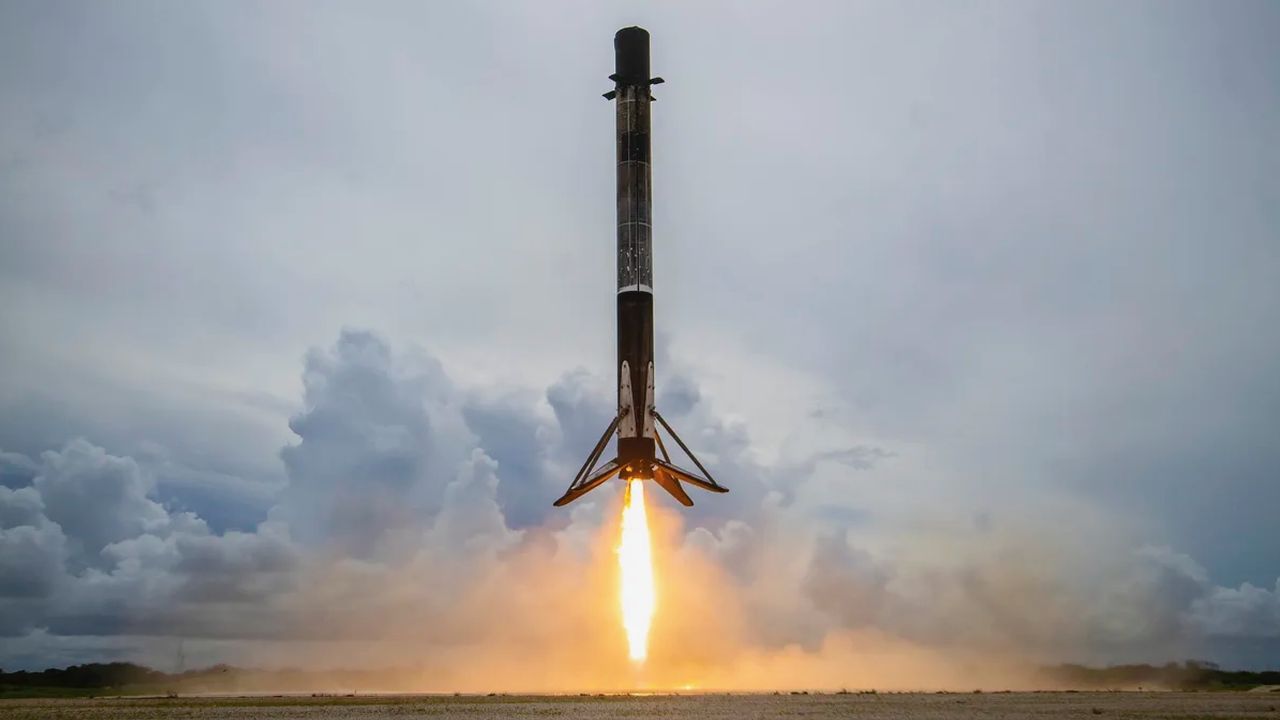
SpaceX Falcon 9 rocket-landing team gets 1st-ever Neil Armstrong Space Prize
Key Points
SpaceX Falcon 9 rocket-landing team gets 1st-ever Neil Armstrong Space Prize The winners of the first-ever Neil Armstrong Space Prize just got their hardware. Those awardees — the people who developed and mastered the famous landing capability of SpaceX's Falcon 9 rocket — were announced in April.
SpaceX Falcon 9 rocket-landing team gets 1st-ever Neil Armstrong Space Prize
The winners of the first-ever Neil Armstrong Space Prize just got their hardware.
Those awardees — the people who developed and mastered the famous landing capability of SpaceX's Falcon 9 rocket — were announced in April. But they didn't actually receive the prize until Tuesday night (Sept. 15), when it was bestowed during a ceremony at the Cosmos Club in Washington, D.C.
And it was richly deserved, according to Purdue University, which created the international award and named it after perhaps its most famous alumnus. (Purdue is known as the "cradle of astronauts," because 30 of its graduates have flown in space or been selected as NASA astronaut candidates.)
"Neil Armstrong's achievement rested on extraordinary engineering, teamwork and the courage to attempt what had never been done before," Mark Lundstrom, the John A. Edwardson Dean of the College of Engineering at Purdue, said in a statement on Tuesday.
"The Falcon 9 Booster Landing Team carries that spirit forward," he added. "By making rocket reuse practical at unprecedented scale, they changed the economics of spaceflight and opened new possibilities for science, exploration and commerce. It is especially fitting that they are the first recipients of the Neil Armstrong Space Prize."
Purdue wants the annual prize to become a sort of Nobel for space science and exploration. The inaugural honorees are five SpaceX employees, who represent the much larger Falcon 9 landing team:
- Lars Blackmore, senior principal Mars landing engineer
- Shana Diez, senior director of Starship reliability
- Jon Edwards, senior vice president of Falcon & Dragon projects
- Yoshiaki Kuwata, principal guidance, navigation and control engineer
- Eduardo Velazquez, director of Crew Starship engineering
The two-stage Falcon 9 debuted in June 2010. The rocket was always envisioned to have a reusable first stage, though making that happen took a while.
"On a simple hand calc, I thought, 'Oh, this would work,'" said Kuwata, who joined SpaceX in 2012.
"But then the difficult part is going from this hand calculation to the reality, and there are a lot of nuances that we learned on the way," he told Space.com. "And on paper, I think it would have been done in like six months. But it took like three, four years to actually get it to work."
The milestone moment occurred on Dec. 21, 2015, on the 20th Falcon 9 flight to date: The rocket's first stage came back to Earth for its first-ever vertical touchdown, landing at Florida's Cape Canaveral Air Force Station (now known as Cape Canaveral Space Force Station) after sending 11 satellites to orbit for the company Orbcomm.
The Falcon 9 ticked another big box on April 8, 2016, acing a touchdown on a SpaceX "drone ship" stationed in the Atlantic Ocean.
These eye-popping sights have now become commonplace; to date, SpaceX has landed boosters more than 650 times during orbital missions. And these rockets don't stay on the ground for long. Six different Falcon 9 first stages now have more than 30 launches and landings under their belt, led by Booster 1067, which has flown a whopping 37 times.
Such extensive reuse has helped make the Falcon 9 the dominant rocket flying today. In 2025, the vehicle flew 165 missions — about half of the global total — and all of them were successful.
This success has inspired copycats. For example, two different Chinese rockets have landed successfully in the past few months, one of which employs foldable landing legs just like a Falcon 9 first stage.
But the imitation doesn't bother Velazquez.
"I think this is great," he told Space.com. "I mean, we didn't start from scratch, right? If you look at a cross section of our engines and the engines from the '60s, they're all very similar. So we're all kind of cribbing from the same place. But the fact that we are able to advance the bar so that everybody else is landing first stages is just great. I think we all move forward together, and we need more entrants in the field to really have a big kind of spacefaring economy and civilization."
SpaceX is planning to sunset the Falcon 9 in the relatively near future in favor of Starship, the fully reusable megarocket it's developing to help humanity settle the moon and Mars, among other exploration tasks.
Starship has flown 13 test flights to date, all of them suborbital. SpaceX has already successfully recovered the giant vehicle's Super Heavy first stage on three occasions, catching the booster with the "chopstick" arms of the launch tower at its Starbase site in South Texas.
Such success follows quite naturally from the experience the company built up with the Falcon 9 (and its cousin the Falcon Heavy). But landing and reflying Starship's upper stage, known as Ship, is a different animal. (Falcon upper stages are expendable.)
"The bigger step change for Starship is the stage two — Ship upper stage — reusability," Kuwata said.
"In Monte Carlo simulations, [Ship landings] work well," he added. "And then we kind of demonstrated that pinpoint landing, precision landing, on the ocean many times. But I feel we will find out more things along the way by trying many times."
"Yeah, the 'trying many times' I think is kind of key," Velazquez said. "And I think we're getting pretty close to to catching a Ship."
You must confirm your public display name before commenting
Please logout and then login again, you will then be prompted to enter your display name.
Michael Wall is the Spaceflight and Tech Editor for Space.com and joined the team in 2010. He primarily covers human and robotic spaceflight, military space, and exoplanets, but has been known to dabble in the space art beat. His book about the search for alien life, "Out There," was published on Nov. 13, 2018. Before becoming a science writer, Michael worked as a herpetologist and wildlife biologist. He has a Ph.D. in evolutionary biology from the University of Sydney, Australia, a bachelor's degree from the University of Arizona, and a graduate certificate in science writing from the University of California, Santa Cruz. To find out what his latest project is, you can follow Michael on Twitter.
SpaceX Falcon 9 (ORG)
Neil Armstrong Space Prize (ORG)
Falcon (ORG)
SpaceX (ORG)
the Cosmos Club (ORG)
Washington (LOCATION)
D.C. (LOCATION)
Purdue University (ORG)
Purdue (ORG)
NASA (ORG)
Neil Armstrong's (PERSON)
Mark Lundstrom (PERSON)
John A. Edwardson Dean (PERSON)
the College of Engineering (ORG)
the Neil Armstrong Space Prize (ORG)