
Science
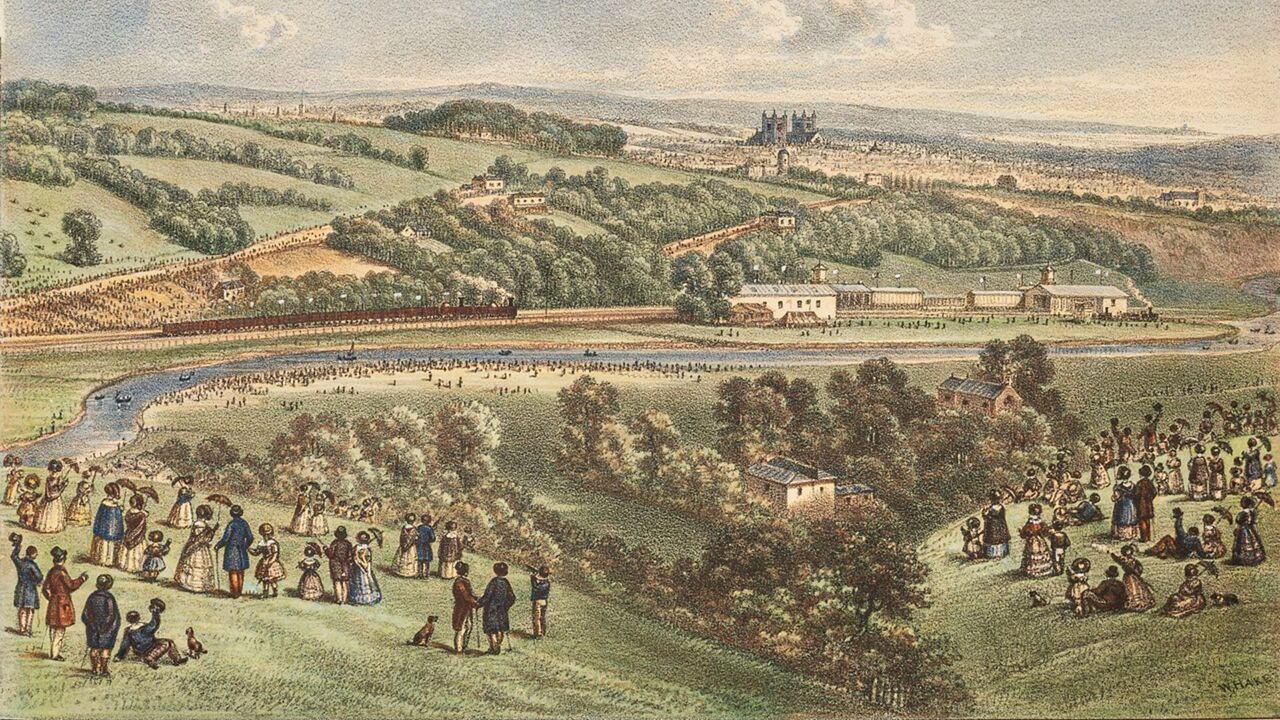
Space weather caused a 16-minute train delay in 1848: 'Our research has a hint of a detective story'
Key Points
Space weather caused a 16-minute train delay in 1848: 'Our research has a hint of a detective story' "The Exeter train delay is a fascinating story because it sits right at the point where emerging technologies first began to encounter the realities of the space environment." Detective work by a team of space-weather experts has discovered the truth about a historical event that had been thought to be the first-ever case of technological disruption by geomagnetic activity from the sun, but...
Space weather caused a 16-minute train delay in 1848: 'Our research has a hint of a detective story'
"The Exeter train delay is a fascinating story because it sits right at the point where emerging technologies first began to encounter the realities of the space environment."
Detective work by a team of space-weather experts has discovered the truth about a historical event that had been thought to be the first-ever case of technological disruption by geomagnetic activity from the sun, but has now been shown to have taken place seven years later.
From it being too hot or too wet to leaves on the track or cows on the line, there's a fine tradition of what the British public consider to be flimsy excuses for delays on the trains. Yet an 1871 edition of the journal Nature describes a very different event that caused a train departing Exeter, in Devon on the south-west coast of the U.K., to be delayed by 16 minutes: a solar storm that flooded the railway signals' electrical telegraph network with current.
"The Exeter train delay is a fascinating story because it sits right at the point where emerging technologies first began to encounter the realities of the space environment," said Jim Wild, who is a professor of space physics at Lancaster University and also the President of the Royal Astronomical Society, in a statement.
The event has frequently been cited as the first example of a solar storm disrupting technology on Earth, but when a team led by Wild went back through historical records to investigate further, they found that things didn't add up.
The original report in Nature stated that the electrical disturbance occurred at 10:05pm local time on Oct. 18, 1841. However, Wild's team found that particular train line didn't open until 1846.
So, they delved deeper into the history books to figure out the truth.
"Our research has a hint of a detective story — piecing together a wide range of archived records to better understand a historically severe space-weather event," said team-member Mike Hapgood, a space weather expert at RAL Space, which is the UK's National Space Laboratory, in Oxfordshire.
Combining data from railway timetables, old newspapers, plus historic reports of solar observations and the northern lights and digitized geomagnetic data, Wild and Hapgood's team were able to conclude that the most likely date for the train delay was Oct. 18, 1848, which coincided with a strong solar storm that hit Earth.
This revised date knocks it off top spot in the chronological list of such events. The first recorded disruption to electrical technologies is now a disturbance on the Midland railway network, which had lines covering much of the U.K., in March 1847.
"Although this means it is not the earliest recorded space weather impact, it remains one of the first clear examples of solar activity disrupting critical infrastructure," Wild said. "It also demonstrates the value of combining scientific records with contemporary newspaper reports and archival documents when reconstructing historic space weather events."
The case reminds us that space weather has been a hazard to technology and modern systems for a long time, and isn't just a recent problem.
"Society has been experiencing the effects of space weather on technology for almost as long as electrical technologies have existed," said Wild.
The most dramatic example is the aforementioned Carrington event of 1859, representing the most significant solar storm on record as it caused telegraph poles to spark and battery power supplies to be disrupted. By this point, telegraph operators had grown used to electrical disturbances associated with auroral activity, but even the Carrington storm shocked them — quite literally in some cases, as extra current ran down the telegraph lines — with its ferocity. Should a similar event occur today, it would cause huge black outs, knock out power grids, disrupt communications and fry satellites.
"While today's space weather [monitoring] capabilities are far more advanced than anything available in the 1800s, the modern technologies we depend on are also much more vulnerable to solar storms," said Hapgood.
The current solar cycle 25 peaked in Oct. 2024 and we are just beginning to come out of an extended period of maximum activity. However, it remains to be seen how the rest of this cycle will play out before reaching solar minimum in about 2030. We've already seen severe geomagnetic storms caused by space weather in May 2024 — will we experience another powerful storm before the decade is out?
You must confirm your public display name before commenting
Please logout and then login again, you will then be prompted to enter your display name.
Keith Cooper is a freelance science journalist and editor in the United Kingdom, and has a degree in physics and astrophysics from the University of Manchester. He's the author of "The Contact Paradox: Challenging Our Assumptions in the Search for Extraterrestrial Intelligence" (Bloomsbury Sigma, 2020) and has written articles on astronomy, space, physics and astrobiology for a multitude of magazines and websites.