
Health
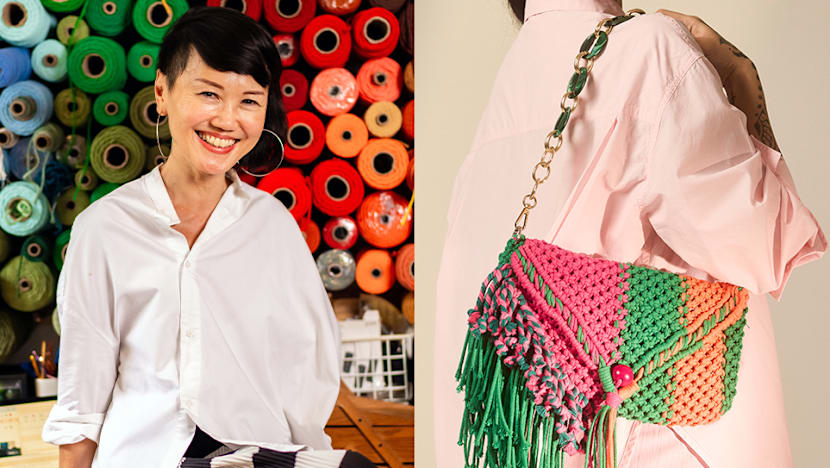
She failed arts and crafts in school. Now, she makes one-of-a-kind macrame bags while helping others
Key Points
She failed arts and crafts in school. Now, she makes one-of-a-kind macrame bags while helping others She once thought she was hopeless at crafts. In her 50s, Lu-lyn Chang found calm, creativity and a new purpose through macrame and Bound Designs.
She failed arts and crafts in school. Now, she makes one-of-a-kind macrame bags while helping others
She once thought she was hopeless at crafts. In her 50s, Lu-lyn Chang found calm, creativity and a new purpose through macrame and Bound Designs.
Looking at the intricate macrame bags that Lu-lyn Chang makes by hand for her accessories brand, Bound Designs, it’s hard to believe she once considered herself completely hopeless at arts and crafts.
“I failed the subject terribly in school and cannot sew or fold a paper aeroplane to save my life,” she told CNA Lifestyle, in an email interview.
Chang, now in her 50s, discovered an unexpected knack for macrame much later in life, after turning to the craft of knot-tying to cope with her anxiety during the COVID-19 pandemic.
“That was a difficult time for me. It threw so many things out of my control and worrying thoughts occupied my mind. I was constantly thinking about my mum and children catching COVID, and so forth,” she recalled.
Desperate to keep herself occupied, she tried yoga, baking, gardening, meditation and crocheting. Nothing quite worked.
Then she chanced upon a YouTube tutorial on how to make a macrame plant potholder.
“Somehow, I got hooked. The repetitive, rhythmic pattern of knot-tying calmed my mind. The focus on creating the rows of knots did something to align my mind, breath and movement,” she said.
Unlike the other activities she had tried, the sense of calm lingered. “I couldn’t wait to get back to it.”
FROM A HOBBY TO A BUSINESS
It didn’t take long before plant holders gave way to something considerably more ambitious.
Chang had little interest in making the table runners and cushion covers commonly associated with macrame. Looking at the weave one day, she wondered if she could turn it into something she would actually use: a bag.
“So I researched materials and made a simple clutch bag in black. After that, I couldn’t stop,” she said.
She experimented with different colours, knots and materials, gradually developing bags that looked increasingly unlike the traditional macrame pieces that had first introduced her to the craft.
“The more bags I made, the better I got. I showed my girlfriends a few of my creations, and they all ooh-ed and ah-ed, so I ended up making a ton of bags for them,” she recalled with a laugh.
What began as something to occupy an anxious mind was slowly becoming something else.
Eventually, Chang launched Bound Designs, although she doesn’t describe the decision as some grand entrepreneurial epiphany.
“I don’t know if I was inspired to start Bound so much as just taking what, to me, was one logical step after the next,” she said.
Today, Bound Designs' handmade bags start from S$269, while accessories start from S$79.
It is not Chang’s first brush with entrepreneurship. She is also the co-founder of a digital marketing agency she started with two partners in 2000. After selling a majority stake in the business to a UK media company in 2018, she stepped back from a full-time role, giving her more time to pursue other interests.
Bound, however, is a very different kind of business – one Chang is deliberately happy to keep small.
NOT YOUR GRANDMA’S MACRAME
Forget the beige, bohemian macrame of the 1970s.
Chang’s bags are bold, contemporary and often deliberately unruly, with oversized tassels, unexpected textures and dramatic silhouettes that make them difficult to ignore.
That is precisely the point.
“I love movement in bags, so the tassels are definitely a key design element. But I can, at times, move completely away from tassels and design something simple and quiet,” she said.
“I design from the heart and make what I like.”
That instinctive approach also means plenty of experimentation – and failure. Behind every finished Bound bag, Chang said, are numerous prototypes that never make it out into the world.
She imagines her pieces on confident women with a wild, creative streak, and says those are often exactly the customers who find her.
“My regular clients don’t care that they are lawyers or bankers who carry bags with gigantic tassels into meetings and town halls. They are confident expressing who they are,” she said.
There is a certain irony in the fact that Chang, who spent decades in marketing, has built a label that resists some of the usual instincts of a growing consumer brand.
She has little interest in churning out identical versions of a bestseller. Bound remains intentionally small, allowing her to work according to her own creative rhythm. Every bag is a one-off design.
Even when customers ask her to recreate a sold piece, she won’t make an exact copy.
“I always tell clients I will make the bag, but it will be the same, yet different,” she explained.
She might alter the knot pattern or introduce a subtle variation in colour. “It is important for me to make a bag that is unique for that client and that client alone.”
Her materials are equally unpredictable. She has worked with raffia, wool, jute, rattan, recycled sari fabric and denim cords, and inspiration can come from just about anywhere.
“Just the other day, I was having breakfast with my husband and saw a rooster with the most fabulous fiery orange, red and black feathers,” she said with a laugh.
“You’ll be seeing a Bound Designs bag in those shades with feather tassels soon.”
KNOTTING WITH A DIFFERENT PURPOSE
But macrame has given Chang something beyond a creative outlet or a business.
The same repetitive act of knotting that once helped quiet her own anxious mind has become a way for her to connect with others.
She remembers watching a CNA documentary about inmates in Changi Prison and hearing about the anxiety some experienced while incarcerated, particularly when they were powerless to deal with family problems outside.
It struck a nerve.
“Wow, that resonated with me. During COVID, I felt locked up and anxious about everything – I couldn’t sleep,” she recalled.
A chance introduction by a friend eventually brought her to the women’s wing at Changi Prison, where she taught a small group of five inmates how to knot and weave.
“We talked and learnt each other’s stories during my time there,” she said. “After that stint, I became motivated to work with marginalised segments of our society.”
Chang has since become a partner trainer with SG Enable, working on projects involving persons with intellectual disabilities and autistic individuals.
For these collaborations, she teaches participants the craft before engaging and paying them to produce bags, wall art and other pieces for Bound and commercial projects.
In a sense, macrame has come full circle for Chang: something she discovered because she needed to steady herself has become something she can now share with others.
And perhaps the biggest thing the craft has unravelled is an assumption Chang had carried about herself for much of her life – that creativity simply wasn't something she possessed.
She hopes her story might encourage others to question similar narratives they have built around themselves and what they believe they can or cannot do.
“I had always pictured myself retired, travelling and eating my way around the world, by the time I hit my 50s,” she said.
Instead, she finds herself designing fashion accessories, experimenting with knots and materials, and collaborating with communities and businesses in ways she could scarcely have imagined when she first clicked on that YouTube tutorial.
“But here I am, on this path of self-discovery, creating fashion accessories and working with different communities and businesses whenever I can to give back to society,” she said.
“It fuels my creative streak and fulfils me in a way that makes this phase of my life really exciting.”
For someone who once believed she couldn't even fold a paper aeroplane, it has turned out to be quite the second act.