
Politics
Companies should be more transparent with workers about AI plans: Jasmin Lau
Key Points
Companies should be more transparent with workers about AI plans: Jasmin Lau Employers should not take "a quiet workforce for an agreeable workforce", says the senior minister of state for digital development and information. Companies should be more transparent with employees about how artificial intelligence could affect jobs, Senior Minister of State for Digital Development and Information Jasmin Lau said on Thursday (Sep 17). Speaking at the launch of SG AI Exchange, Ms Lau, who is also...
Companies should be more transparent with workers about AI plans: Jasmin Lau
Employers should not take "a quiet workforce for an agreeable workforce", says the senior minister of state for digital development and information.
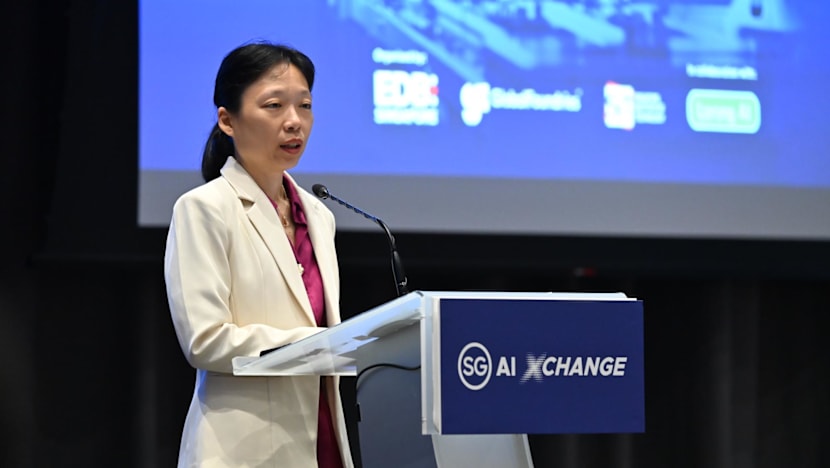
SINGAPORE: Companies should be more transparent with employees about how artificial intelligence could affect jobs, Senior Minister of State for Digital Development and Information Jasmin Lau said on Thursday (Sep 17).
Speaking at the launch of SG AI Exchange, Ms Lau, who is also acting manpower minister, urged employers not to take "a quiet workforce for an agreeable workforce".
"The fact that they are quiet and not pushing back yet doesn't always mean that they are happy with where things are going," she said.
"They want to know what their business leaders are really thinking, whether you are already planning retrenchments and slowdown in hiring."
Ms Lau urged companies to "be a lot more transparent" with their workforce. Where automation is planned, employers should tell employees what could happen and what retraining may be required.
Firms should also be open when a weaker business outlook is behind changes to their workforce, as employees may mistakenly link such transformation with AI.
"We think that a lot more communication and transparency will help keep our workers and our companies together, and we hope that you play a part in it," Ms Lau said.
"SOME GROUNDSWELL" OF ANTI-AI SENTIMENT
Ms Lau also highlighted unease about AI among certain groups, noting that there is “some groundswell of workers and younger students who are somewhat anti-AI”.
“They fear how it will be taking away many of their jobs and aspirations,” she said.
Some also associate AI with environmental damage.
“These sentiments are not meant to be ignored," Ms Lau said.
"They are real sentiments and emotions, and there is a lot more we then need to do to ensure that we hold the Singapore society together, regardless whether you are an employer, a business leader, a worker, or a student who is generally anxious about the world that you are in today," she added.
Acknowledging that views differ on how AI should or should not be used and the pace of its adoption, Ms Lau said that the government recognises that "the world is changing" and wants AI to be adopted widely enough in Singapore to create "real value for our companies and good jobs for our workers".
She added that Singapore is “not blind in our pursuit for AI” and that the technology will be used "for good".
“We will do so if it means giving our workers better jobs, and we will do so if it means providing better services for our people.”
Earlier this year, Singapore set up a National AI Council chaired by Prime Minister Lawrence Wong. Ms Lau said the country now has close to 100 AI Centres of Excellence across sectors ranging from finance to manufacturing.
"Within manufacturing alone, we are seeing companies in semiconductors, medtech, mobility, energy, and chemicals building up their AI capabilities," she added.
Singapore is also seeing growing investment from AI companies. Anthropic will open an office in Singapore in October, with the AI firm saying on Wednesday it will be hiring for a "range of roles".
Ms Lau noted Google Cloud opened its Singapore Engineering Centre this week, while Databricks has announced new initiatives to build AI skills locally, including pledging to invest more than US$350 million in Singapore over the next three years.
She said Singapore aims to be a place where companies can safely build, deploy and scale AI, while helping workers adapt and benefit from the changes brought about by the technology.