
Science
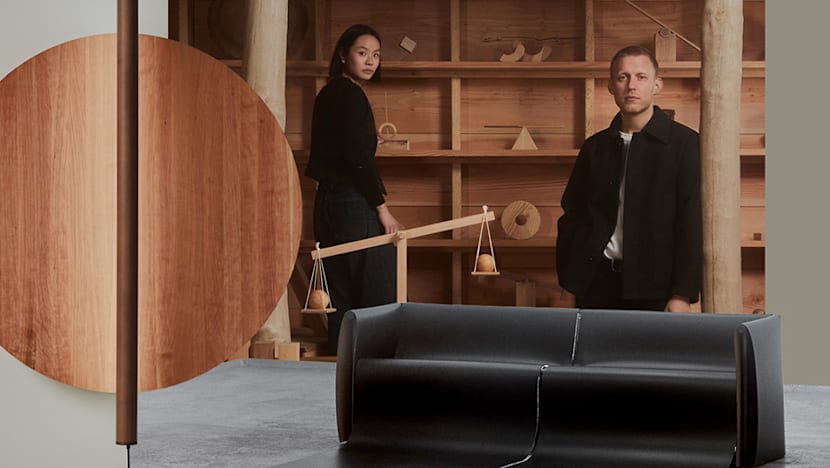
Singaporean designer Jade Chan is making her mark in Copenhagen with Christian+Jade
Key Points
Singaporean designer Jade Chan is making her mark in Copenhagen with Christian+Jade With Danish partner Christian Hammer Juhl, Chan has built a design practice shaped by craft, material experimentation and an instinct for making by hand. The matt smoothness of Christian+Jade’s Reflecting Flame wall candleholder gives its edges a crisp definition. At its centre, however, the aluminium is contoured and coarse, its hand-hammered surface brought into relief by flickering candlelight.
Singaporean designer Jade Chan is making her mark in Copenhagen with Christian+Jade
With Danish partner Christian Hammer Juhl, Chan has built a design practice shaped by craft, material experimentation and an instinct for making by hand.
The matt smoothness of Christian+Jade’s Reflecting Flame wall candleholder gives its edges a crisp definition. At its centre, however, the aluminium is contoured and coarse, its hand-hammered surface brought into relief by flickering candlelight. Elsewhere, linoleum – a material more commonly associated with flooring – takes on an unexpectedly fabric-like quality when draped over a desk, chair and sofa for Beginnings & Endings, presented at Copenhagen’s 3 Days of Design from Jun 10 to Jun 12.
Behind the Copenhagen-based studio are Singaporean designer Jade Chan and her Danish partner, Christian Hammer Juhl, whose work explores the tensions between material, craft and function.
Chan said the pair were drawn to the quiet poetry that could emerge from tensions within a single material – between, for example, the hammered and untouched areas of a single sheet of aluminium. “Rather than controlling the material completely, we tried to let its properties guide the design and determine how each project would take shape,” she said.
Chan established Christian+Jade in 2002 with her Danish partner, Christian Hammer Juhl, after the pair graduated from Design Academy Eindhoven in the Netherlands in 2018 and later based their practice in Copenhagen. Since then, their material-led approach to design, craft and storytelling has attracted international attention. In 2024, they were named among Maison&Objet’s Rising Talents and included in the Dwell 24, the magazine’s annual list of emerging designers. The studio subsequently received a three-year working grant from the Danish Arts Foundation.
In late 2024, Christian+Jade created The Age of Wood, the inaugural Survey exhibition at Karimoku Research Center in Tokyo. Exploring humanity’s relationship with wood and the passage of time, the exhibition included a library of 63 wood species, a folding screen and a kinetic sculpture in which a pendulum gradually scratched marks into walnut.
GROWING UP WITH CRAFT
Chan credited her DIY-loving father and crafty mother with introducing her to designs and making from an early age.“She had a constant rotation of craft projects that she encouraged me to join in,” Chan said, recalling Sundays spent painting and making things together. “I think this made the act of making and creating come naturally to me. It has remained an important part of how I think, solve problems or even relax today – be it by winding down with a needle and thread, cooking up a meal or building a new storage system to make better use of our tiny home,” she said. “The first instinct will always be to use my hands.”
Not surprisingly, she ended up studying Visual Arts at SOTA (School of the Arts, Singapore). Even then, Chan struggled to find her personal expression until the school started teaching design. “Something clicked. I was drawn to the idea that function, needs, behaviours, rituals and materials should be the starting point in itself. That way of thinking felt more intuitive to me,” She reflected.
Hammer Juhl, by contrast, grew up in a small town in Denmark. A creative career was not an obvious path during his childhood, which he spent playing sports and computer games and exploring his neighbourhood. Design was nevertheless part of everyday life at home, where he grew up surrounded by mid-century Danish furniture.
“My parents believed it was important as part of a cultural education to know the names of the architects and the stories behind the pieces we lived with,” he shared. His grandfather, a furniture designer and maker, was another major influence. “He was like a Gyro Gearloose character, who was always inventing, experimenting and finding creative solutions. I loved visiting his home,” said Hammer Juhl. Among his grandfather’s inventions was a cabinet with a rotating carousel for his pipes. He also installed a telephone system connecting the rooms – even the toilets – “so my grandmother could call him when lunch was ready”, Hammer Juhl recalled.
MAKING AND THINKING
At Design Academy Eindhoven, the couple’s hands-on interest in craft gained a stronger conceptual foundation. Chan recalled courses organised around themes such as “Man and Identity”, “Man and Well-Being” and “Man and Communication”. “That approach made more sense to me, that design could depart from a real need or context rather than working mainly towards the end goal of a piece of clothing or furniture,” she said.
The school also encouraged independence, which meant “experimenting, learning things in unconventional ways and getting things wrong – which is also often where the most interesting discoveries happen,” said Chan. She and Hammer Juhl first worked together during a design residency at Cranbrook Academy of Art in Michigan.
“We spent a month there, living in the incredibly inspiring home of Danish-American sculptor Anders Ruhwald, and immersing ourselves in the history of the school. It carries the legacy of figures such as Charles and Ray Eames, who designed the iconic Eames chairs, and is also home to Saarinen House designed by Eliel Saarinen, so there was an extraordinary amount to absorb,” said Hammer Juhl.
Their first works together emerged after meeting a retired metalworker in Detroit who had made aircraft and automotive parts for General Motors. “We had always thought of automobile production as something highly industrialised, so it was fascinating to discover how much of his work was rooted in craft,” said Chan, recalling how the craftsman “shaped each piece by hand, hammering the metal himself and even making his own tools.” The pair learnt about different alloys and how to make moulds and form aluminium, experiments that eventually led to the Smoke Cloud Chandelier and Reflecting Flame wall candleholder.
HOME IN COPENHAGEN
In 2022, Hammer Juhl and Chan bought a 68-sq-m home in Copenhagen’s historic centre, in a building dating to the 1600s. “We introduced natural wood throughout to soften the interior, and bring a sense of warmth and tactility,” said Chan. Their home reflects the same pared-back, tactile sensibility found in their work.
“We enjoy finding expressions that feel deceptively simple and almost ‘obvious’, as if the material made the decision for us. We are drawn to objects that have a story, that have been made with care, and that become more beautiful with age and use,” said Chan. They prefer living with fewer possessions rather than filling their home “for the sake of having them”, she added, with each object having “a purpose, a personal connection or something about it that we genuinely value”.
Several former university classmates who started studios around the same time also live on their small Copenhagen street. “Today, we share a large workshop with studios and offices, and over the years, we’ve built a close-knit community,” said Hammer Juhl.
Working in Denmark has also shaped Chan’s perspective, particularly in a country where design and craftsmanship have a long-established place in everyday life. “It feels like a real privilege to work as a designer in a country with such a long history and appreciation for design, material and craftsmanship. There is a genuine understanding not only of its cultural value, but also the time, skill and labour that goes into it,” Chan observed.
MAKING A MARK
Public support for the arts has also helped foster an environment where designers can pursue more experimental work, Chan said, citing the Danish Arts Foundation as one example. “Their support for works that are exploratory, experimental and open-ended has allowed us and many other creatives to have the freedom to take risks and pursue works that are creatively driven and would otherwise be difficult in purely commercial terms,” she said.
Christian+Jade’s profile in Copenhagen has continued to grow. This year, Chan and Hammer Juhl were appointed curators of The Mindcraft Exhibition 2026, which runs from Sep 23 to Sep 27 at Charlottenborg in Copenhagen. The annual exhibition presents experimental work by contemporary designers and makers from Denmark.
Christian+Jade is also developing a new body of work for a solo exhibition at Etage Projects’ new gallery in Maloja, in Switzerland’s Engadin region, next year. The couple recently completed a summer residency there. “We found ourselves inspired by everything from the local building culture, to the water and healing traditions, to the grass, harvest and haying season, and much more,” shared Chan.
Despite the studio’s growing international reach, Chan’s dream project remains closer to home: She hopes to work in Southeast Asia with local craftspeople, exploring the region’s materials, cultures and traditions. “For a long time, I didn’t quite know what I could bring to a project like that. It has taken time for us to understand the identity of our practice, our way of thinking and making, and the kinds of projects we want to pursue. That has started to take on more clarity, so this is a dream project that I am starting to feel ready to take on.”
Singaporean (ORG)
Jade Chan (PERSON)
Copenhagen (LOCATION)
Danish (ORG)
Christian Hammer Juhl (PERSON)
Chan (PERSON)
matt (PERSON)
Beginnings & Endings (ORG)
Design Academy Eindhoven (ORG)
Netherlands (LOCATION)
the Danish Arts Foundation (ORG)
Karimoku Research Center (ORG)
Tokyo (LOCATION)
DIY (ORG)
Visual Arts (ORG)