
Business & Finance
What would EU ‘associate’ status mean for Canada?
Key Points
What would EU ‘associate’ status mean for Canada? To soften the blow from its trade standoff with the US, Canada needs to boost economic ties with other parts of the world. Prime Minister Mark Carney has made it clear he wants a closer relationship with the European Union.
What would EU ‘associate’ status mean for Canada?
To soften the blow from its trade standoff with the US, Canada needs to boost economic ties with other parts of the world.
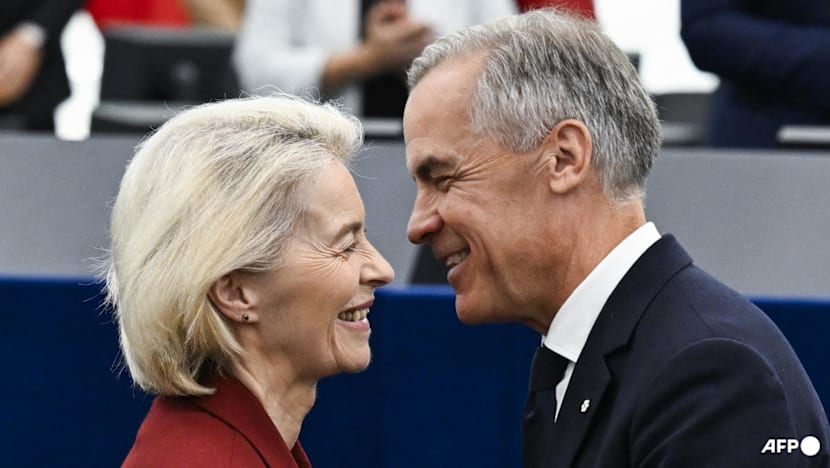
Prime Minister Mark Carney has made it clear he wants a closer relationship with the European Union. European Commission President Ursula von der Leyen’s offer to make Canada an “associate member” of the world’s most powerful trading bloc during her annual speech to the European Parliament on Sep 16 went further than many had expected.
Such a status could draw Canada deeper into Europe’s markets and strategic industries. But the relationship would be a new one, created bespoke to meet a unique moment, and the EU has yet to define what it means.
What would being an associate EU member look like?
The idea is a partnership that falls short of full membership while still offering some of its benefits. Canada’s location makes it legally impossible to aim for full membership, which requires countries to belong to the European continent. Norway, Iceland and Liechtenstein offer one possible model. As members of the European Economic Area (EEA), those countries need to follow the rules of the EU single market to trade with the bloc yet have no role in running its institutions or voice in making its laws.
What they do get is the ability to sell goods and services and move capital into the EU without encountering many tariffs or other trade barriers.
The chair of the European Parliament’s trade committee, Bernd Lange, said an extended relationship with Canada could be similar to the EU-Swiss model, only with greater political engagement.
“With Switzerland we have around 100 different agreements, quite close, but the Swiss are not integrated into the political decision-making process,” Lange said. He suggested that Canada could be given some say in EU decision-making, without having full voting rights.
What difference would it make for Canada?
Both von der Leyen and Carney have identified manufacturing, technology, defence, energy and the Arctic as areas for deeper cooperation. Carney told Bloomberg in an interview that he hopes for movement in the areas of travel rights and education.
Canada has already become the only non-EU country to participate in SAFE, the bloc’s €150 billion (US$173 billion) defence-procurement loan program.
In terms of trade, it may be hard to deepen a relationship that’s already quite close. Trade between Canada and the EU is already governed by CETA, a wide-ranging trade deal sealed a decade ago that eliminated duties on almost all goods and gave the EU greater access to Canada’s services markets.
Although CETA has provisionally entered into force, 10 EU countries have yet to ratify it — an indication, perhaps, of hesitation on the part of some EU countries about embracing further integration with Canada.
Is this virtually a done deal?
The idea of moving closer to the EU has broad backing in Canada. In an Abacus Data survey of Canadians conducted in early September, 80 per cent supported closer cooperation with the EU on issues such as foreign policy, defence and economic opportunities, up six percentage points since February. Support for full EU membership was weaker, at 49 per cent.
For some members of the EU, the idea of Canada joining, even as an associate member, may be difficult to swallow.
Nine countries are officially in the queue to join the bloc, and any move that could be seen as granting Canada preferential treatment may encounter some resistance. Would-be member Ukraine has rejected the notion of a “membership light” for itself that was proposed by German Chancellor Friedrich Merz.
Nonetheless, the EU could do with a boost. Earlier this month, Iceland voted not to reopen accession talks with the EU, one reason being that it already enjoys significant access as an EEA member. Though Iceland is a small country of just 400,000 people, its rejection was something of a blow for Brussels.
The other big issue will be money. EU countries, which are in the midst of negotiations about the bloc’s next seven-year budget, are unlikely to take warmly to an associate member securing benefits of EU membership without paying in.
Could this endanger Canada’s economic relationships with the US?
After US-Canada trade talks ended last month, President Donald Trump imposed 50 per cent tariffs on US$20 billion of Canadian goods, and Carney retaliated against roughly the same value of US products. Getting closer to the EU would help Carney pursue what his government describes as a sovereignty agenda aimed at reducing foreign dependencies.
But Canada’s deep economic integration with the US, including interwoven cross-border supply chains, could force some difficult choices for Ottawa, including in areas where EU and US product safety and other standards diverge.
After the negotiations with Washington fell apart in August, Carney said one of the sticking points was that the US wanted a say in future trade deals that Canada might sign. That was an unacceptable constraint on Canada’s right to make its own decisions, he said.
It’s also clear the Trump administration is interested in securing more of Canada’s vast natural resources, including oil and minerals, and it might not look favourably on any deal that guarantees Europe improved access to those raw materials.
Canada-EU trade has been growing and equalled C$134 billion (US$96 billion) in goods last year, according to a research paper from Canada’s Library of Parliament. Services added another C$58 billion. That’s still a fraction of the country’s trade with the US, which was well over US$800 billion last year.
How quickly could Canada join the EU as an associate member?
As it would be a new kind of relationship, it’s not clear what the next steps would be to formalise Canada’s associate membership or whether it would come with similar obligations to full membership.
In the first instance, EU member states will need to take stock of von der Leyen’s suggestion. As head of the European Commission, the EU’s executive branch, she has the power of initiative.
But EU proposals on enlargement must also be approved by the European Parliament and the council of the EU, representing member states. Full membership of the EU has to be unanimously accepted by all members.
Leaders will have an incentive to make tangible progress when they meet for an EU-Canada summit in Montreal in October.
EU (ORG)
Canada (LOCATION)
US (LOCATION)
Mark Carney (PERSON)
the European Union (ORG)
European Commission (ORG)
Ursula von der (PERSON)
Leyen (PERSON)
the European Parliament (ORG)
Europe (LOCATION)
European (ORG)
Norway (LOCATION)
Iceland (LOCATION)
Liechtenstein (LOCATION)
the European Economic Area (ORG)