
Science
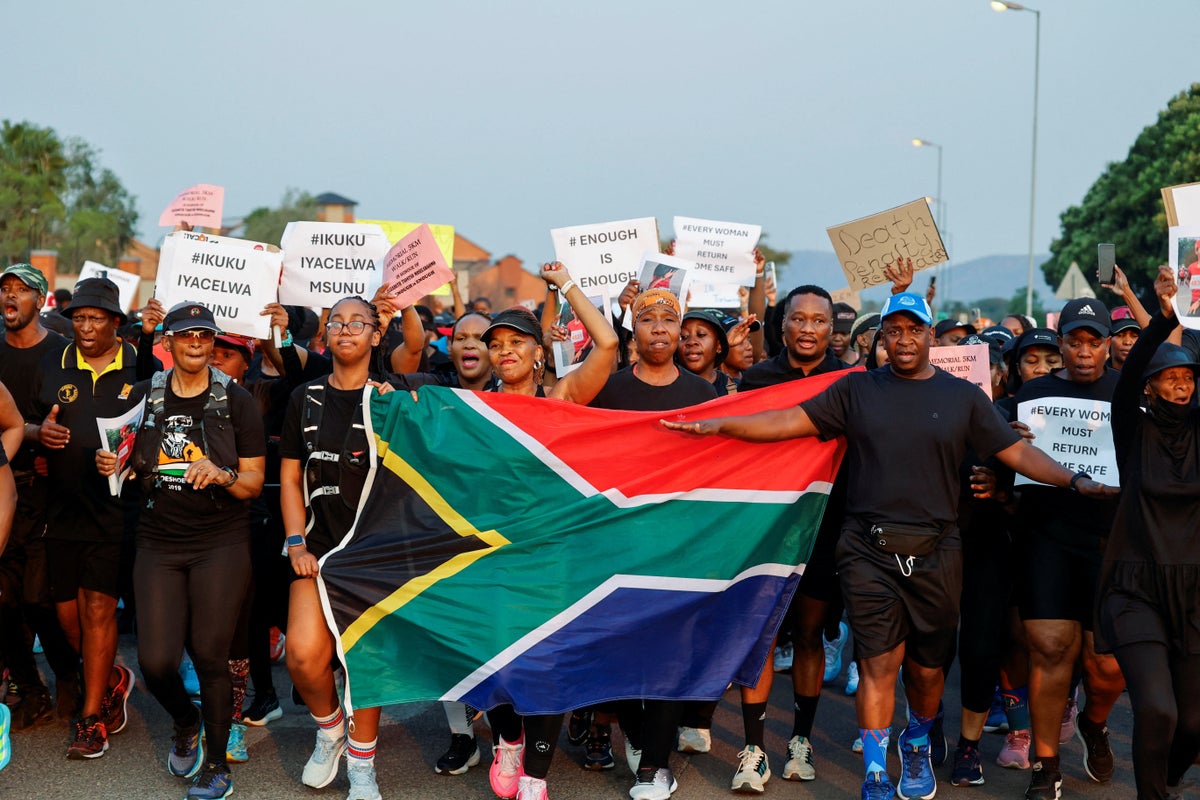
‘We’re terrified all the time’: Fear and anger in South Africa after nine women’s bodies found in three months
Key Points
‘We’re terrified all the time’: Fear and anger in South Africa after nine women’s bodies found in three months A series of gruesome discoveries in Johannesburg have put renewed focus on gender-based violence in the country. But campaigners tell Maira Butt that women have been raising the alarm for years yet little is being done - Bookmark - CommentsGo to comments On September 9, Elizabeth Moselakgomo left her home in East Johannesburg to go for a run.
‘We’re terrified all the time’: Fear and anger in South Africa after nine women’s bodies found in three months
A series of gruesome discoveries in Johannesburg have put renewed focus on gender-based violence in the country. But campaigners tell Maira Butt that women have been raising the alarm for years yet little is being done
- Bookmark
- CommentsGo to comments
On September 9, Elizabeth Moselakgomo left her home in East Johannesburg to go for a run.
When the 38 year-old mother didn’t return home, her eight year-old daughter told relatives, who then contacted police. During her disappearance, family and friends made public appeals to help find her, the case went viral on social media and police launched a task force to investigate.
Five days after she vanished, her body was discovered in a park, half-naked and bruised.
Ms Moselakgomo is one of nine women found dead in the region in recent months in similar circumstances. The first body was discovered in July, naked and bound with cable ties, with two more discovered shortly after but drawing little attention at the time.
“We cannot continue picking up bodies,” said Tebello Mosikili, the deputy police chief, at the scene of the discovery in Dawn Park on Thursday.
It is not yet clear if the cases are connected and police have yet to rule out a potential serial killer.
Regardless, South African women and advocacy groups say the cases highlight the wider epidemic of femicide across the country, with widespread anger that more has not been done to tackle the problem.
In November 2025, president Cyril Ramaphosa officially declared gender-based violence and femicide a national disaster, after campaigning by Women For Change.
According to official statistics by the South African Police Service (SAPS), at least 5,578 women were murdered in a year in South Africa between March 2023 and March 2024, after which figures have not been released.
The UN Office on Drugs and Crime says that the female homicide rate in South Africa is six times the global average at 12.2 per 100,000 women in 2022, with the global average being 2.2.
Police advised women not to run or walk alone in response to the recent killings, prompting swift backlash. President Ramaphosa promised “no stone would be left unturned” in the quest for answers.
Merlize Jogiat, operations and advocacy manager at Women For Change, says that the charity received 3,000 requests for support between Monday and Wednesday this week alone.
Since launching their Survivor Support Line in April 2026, they have had more than 40,000 messages by women and girls on everything from domestic violence, child sexual abuse, as well as the families of femicide victims.
“We speak to families of femicide victims, almost on a daily basis,” says Jogiat. “Rape cases are through the roof. I don’t know a single woman that has not to some degree been sexually harassed, abused, or raped.”
In east Johannesburg, she says that the situation is dire. Women have told her that they are scared to leave their homes, are travelling in groups, and are even learning to operate guns for self-defence.
“As a woman, I’m scared,” writes one woman who works in the area in a text to Merlize. “I have three girls of my own and I’m afraid for them as well as ALL my nieces. It’s like we can’t go to the shop alone anymore, we have to go in pairs or a group.
“It’s truly [sic] been unsettling. Then there’s the anger at this person (or people) targeting women. They feel we’re the weaker sex so they can overpower us.”
Another woman who lives in an area closest to where the bodies were found, sent a picture of herself signing up for a gun course as she advised others to do the same.
South Africa’s gender commissioner says women are being “hunted” and Jogiat says that violence against women is a “crisis” but campaigners say not enough is being done.
The country’s minister for women, youth and persons with disabilities, Sindisiwe Chikunga, said on Friday the government’s mandate for gender-based violence against women remains largely unfunded.
This is reflected in the DNA backlog, with only 3.5 per cent of samples being processed within the legislated 30-day period. Over 175,000 individual samples remain untested and waiting, according to Action Society.
Cultural norms and a history of apartheid, which “fundamentally broke the men in this country”, also plays a part, as Jogiat says men sought to exert control over women in response.
“We’re terrified all of the time,” says Jogiat, who fears for her personal safety as well as that of her 16-year-old daughter. “As South African women we have gotten accustomed to our safety always being in jeopardy.
“Around the world women have to look out for themselves but we have to take it up a notch.
“We are watching our backs when we walk in the street in the morning, now we have the police telling us we need to run in groups. One of my friends said the other day ‘I’m too afraid to go for a coffee and wear this particular thing because I don’t know what kind of attention I’m getting’.
“I've had an incident in Johannesburg when I was there with a guy pulling over on the side of the road and wanted to give me a ride, just randomly. Kidnappings have also gone up quite substantially.”
She worries for her daughter if she does not hear back from her for a couple of hours. “I don’t even want to leave my house,” she said.
But Jogiat believes the onus is on the government to find a way through the crisis beyond “PR”.
“We’ve been screaming about this issue for over ten years,” she says. “All the promises that they give us never translate to anything on the ground.”
She says that even simple issues such as bail conditions for alleged sex offenders and abusers are not enforced and a suspect can be released for as little as £250.
“People who are going through abusive divorces, nine times out of ten, the court is believing the abuser over the victim,” she says. “A man’s word trumps a woman’s abuse in this country.”
Jogiat believes that the recent discoveries were made due to a police presence in the search for Elizabeth and that they may never have been found otherwise.
“They were forced to cut the grass and found the decomposing bodies,” she says.
Meanwhile, the families of the victims are still desperate for answers.
Elizabeth’s aunt Vinah Moselakgomo told ENCA: “It's difficult for Elizabeth’s eight-year-old to come to terms with what's happened, as she still keeps asking where her mother is.”
Join our commenting forum
Join thought-provoking conversations, follow other Independent readers and see their replies
Comments
[Image text:] #IKUKU
IYACELWA
UNU
#IKUKU
IYACELWA
MSUNU
#ENOUGH
IS
ENOUGH
REVERYWOMAN
MUST
RETURN
ME SAFE
#EVERY WOM
MUST
RETURN
MESAFE
South Africa (LOCATION)
Johannesburg (LOCATION)
Maira Butt (PERSON)
Elizabeth Moselakgomo (PERSON)
East Johannesburg (LOCATION)
Ms Moselakgomo (PERSON)
Tebello Mosikili (PERSON)
Dawn Park (LOCATION)
South African (ORG)
Cyril Ramaphosa (PERSON)
Women For Change (ORG)
the South African Police Service (ORG)
The UN Office on Drugs and Crime (ORG)
Ramaphosa (PERSON)
Merlize Jogiat (PERSON)