
Technology
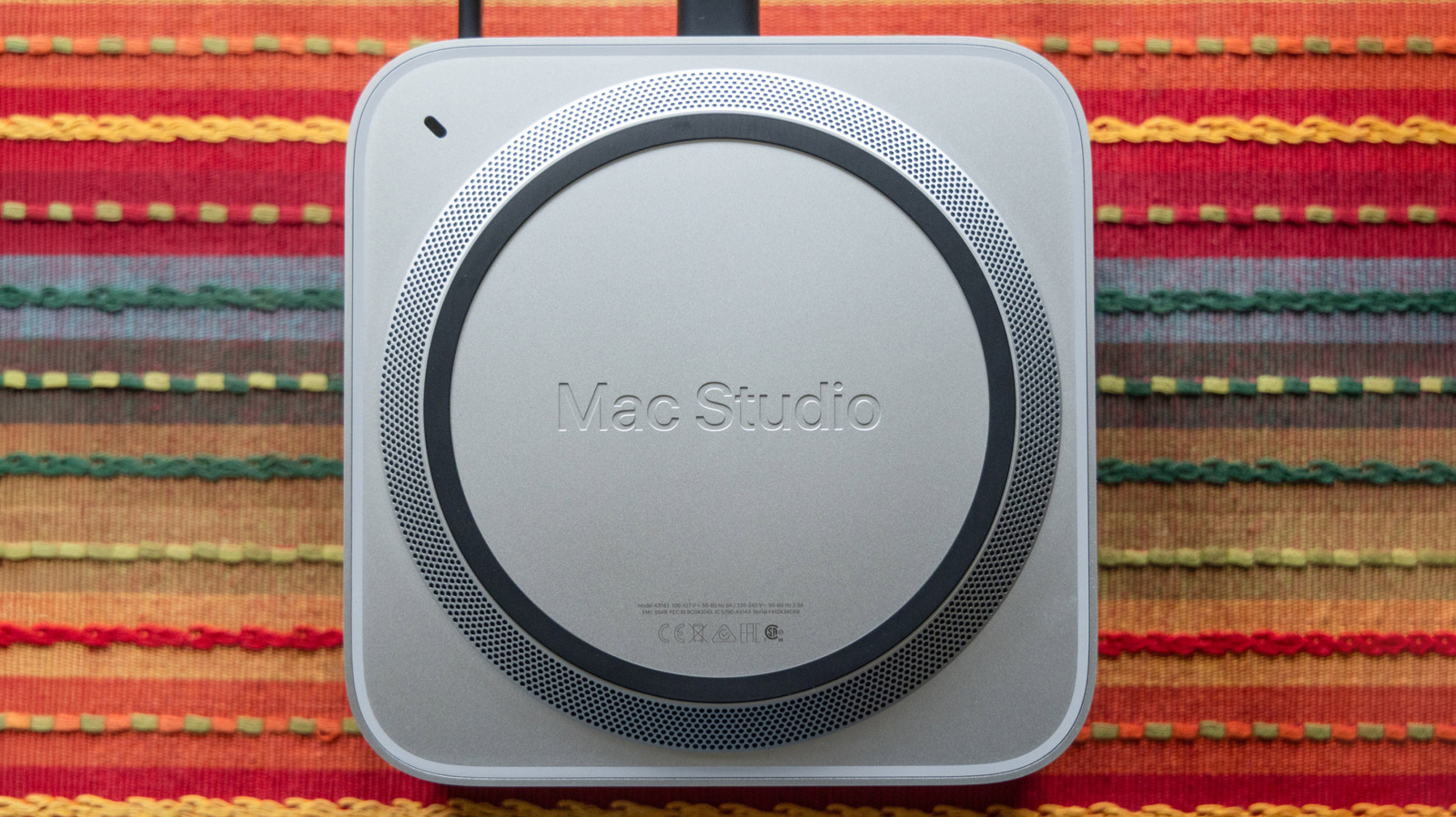
Here's why Apple's Mac Studio has become so expensive
Key Points
Here's why Apple's Mac Studio has become so expensive A big part of the story is soaring memory and storage prices, but other factors come into play as well. If you want to run AI models locally or do high-end Hollywood VFX on Apple products, the Mac Studio is now your only solution. Equipped with a M5 Max or M5 Ultra processor, Apple's compact but powerful desktop delivers gobs of performance both alone and working in a cluster.
Here's why Apple's Mac Studio has become so expensive
A big part of the story is soaring memory and storage prices, but other factors come into play as well.
If you want to run AI models locally or do high-end Hollywood VFX on Apple products, the Mac Studio is now your only solution. Equipped with a M5 Max or M5 Ultra processor, Apple's compact but powerful desktop delivers gobs of performance both alone and working in a cluster.
There's just one issue: the price. In 18 months since the last model, the M5 Max's base price has increased by $500 to $2,500, while the M5 Ultra starts at $5,500, up $1,500 from the M3 Ultra model. Those bumps go well beyond what's typical for Apple device upgrades. So why is that? A big part of the story is soaring memory and storage prices, but hedging and profit margins might come into play as well.
Who is the Mac Studio for?
There's no question that Apple's Mac Mini is a great desktop computer, offering a surprising amount of power in a shockingly small size. However, it tops out at an M5 Pro processor and 64GB of RAM, with 307 GB/s of memory bandwidth. That's enough for many demanding situations, but AI and content creation power users may need more.
Enter the Mac Studio. The "base" version (starting at $2,500) has an M5 Max processor with an 18-core GPU and 32-core GPU, and up to 128GB of unified memory, depending on the option chosen. That goes up to $5,899 for the 18-core CPU and 40-core GPU version with 128GB of RAM and 2TB storage. For AI or video editing pros, it's already capable of tasks "like running large language models and editing 8K video," as Apple says.
Then, there's the M5 Ultra model, squarely aimed at heavy AI power users. It uses an M5 Ultra processor that is two M5 Max processors joined together and supports up to 512GB of RAM. Its typical use case, Apple says, is to "store huge datasets entirely in local memory, increase the tokens-per-second speed and run huge LLMs with hundreds of billions of parameters entirely on device." Moreover, if budget permits, you can triple that performance by clustering four of those together via the high-speed Thunderbolt 5 ports. Demand for this kind of setup for AI reportedly caught Apple by surprise with the last model.
Video users will also be spoiled by the Mac Studio with an M5 Ultra chip. Filmmakers will be able to "color-grade uncompressed 8K footage in real time, VFX artists can render complex simulations... [and it can] simultaneously play up to 33 streams of 8K ProRes 422 at 30 fps."
That model starts at $5,500 with a 30-core CPU and 64-core GPU and 96GB of unified memory. If you really want to kit it out, though, you can get it with a 36-core CPU and 80-core GPU and 256GB of unified storage (512GB is coming next month). Memory bandwidth for that 256GB model tops out at 1.2TB/s, four times that of the Mac Mini.
With 2TB of storage, though, that option will run you $11,299. The Mac Studio M3 Ultra with the same configuration (the flagship 32-core CPU and 80-core GPU, 256GB of RAM and a 2TB SSD) retailed for $7,499 at launch, a cool $3,800 cheaper.
What on Earth happened?
The primary culprits for this massive price increase are the Mac Studio's large amount of high-end memory and storage, "RAMageddon" pricing, hedging and Apple's usual insistence on high profit margins. Apple said so itself when it first bumped MacBook prices back in June: "We've never seen component prices increase this much, this quickly. We've worked hard to absorb these costs and delay price increases for as long as possible, but the current environment has made that unsustainable."
Let's start with the RAM, or what Apple calls "unified memory," because it's shared between the CPU and GPU. With 1.2TB/s bandwidth when fully loaded with RAM, the Mac Studio M5 Ultra uses LPDDR5X memory. That RAM has a maximum throughput of 172GB/s, so Apple installs it right onto the M5 Ultra processor package to maximize speed, in a very wide bus (1,024 bits for the M5 Ultra model), to achieve the highest speeds. It's the fastest and most expensive memory available, other than high bandwidth memory (HBM) used for servers.
It's hard to say exactly how much the RAM makes up the price of a Mac Studio. Apple was reportedly paying around $6 per gigabyte for LPDDR5X memory earlier this year, but that price may be more like $10 or $11 now. Let's say its memory cost for the 256GB Mac Studio M5 Ultra is around $2,500-$2,800. It currently retails for far more than that, but Apple obviously has major buying power. That cost is still a big chunk, though.
Pricing for the NAND storage is also much higher, with Apple's cost is likely around $300 to $500 for 2TB worth based on the current market and high-end PCIe 5.0 memory it uses. Prices are reportedly around quadruple what memory cost when the previous Mac Studio came out, and double the price for storage.
That makes for an increase of about $2,200 to $2,400 at the high end. Rounding that up to account for other component increases, Apple's costs are around $2,400 to $2,600 more, based on those very rough estimates.
You may recall that I said the Mac Ultra with 256GB was $3,800 more expensive this year, so where does the rest of that price increase come in? Apple reportedly shoots for around 40 percent gross margins on its computer hardware, but the new Mac Ultra pricing is nearly 60 percent higher than the estimated cost increase. There are a couple of possible reasons. One is that Apple is hedging against even higher future RAM prices so it can limit Mac Studio M5 price changes later. Another is that Apple is using the memory shortage to lift margins for its flagship desktop Mac. Or maybe it's a little of column A, a little of column B.
Should I wait?
In my review of the Max Studio M5 Ultra, I said that Apple appeared to be targeting AI power users and developers more than ever. The nearly $4,000 price increase on this model for a midrange configuration means it's only affordable by companies or professionals doing high-end, high-paying work. For video or graphics pros, though, the Max Studio M5 Max is a better option at $3,100 to $3,600 for a decently equipped 48GB or 64GB configuration.
If you're thinking these prices might go down, I have bad news — it's rare for Apple to ever lower prices (the polishing cloth notwithstanding). Usually, the only time that happens is at the end of a product's cycle just before it's been replaced by a new version.
The Mac Studio M3 Ultra/M4 Max actually went up over time due to increasing memory prices, and that could easily happen again to the M5 Ultra/M5 Max through 2028 if RAM shortage projections are correct. Yes, they could go down if RAMageddon ends and memory becomes cheaper, but it's hard to say when or if that will happen. Apple has reportedly agreed to pay 30-40 percent higher prices for RAM and storage next year, so it feels safe to say that prices won't be dropping any time soon. In other words, if you need a Mac Studio and can pay for it, you might be better off to bite the bullet and buy one now rather than waiting.