
Science
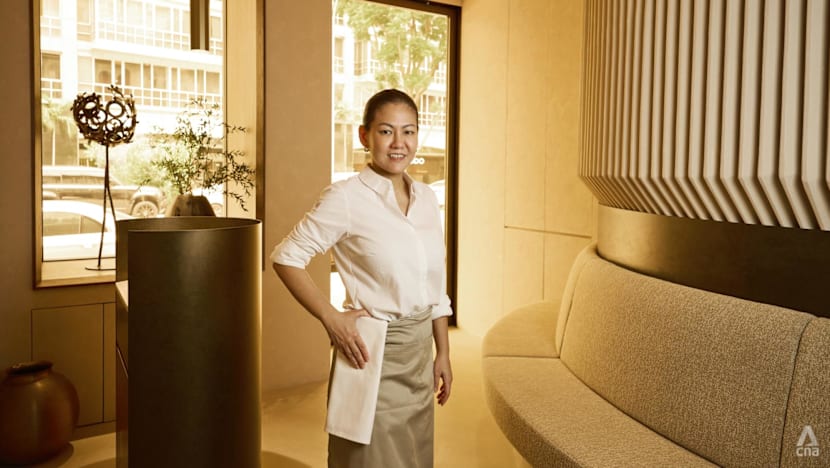
Johanne Siy's new restaurant Aro features rare Filipino seaweed, pili nuts and artisanal salt
Key Points
Johanne Siy's new restaurant Aro features rare Filipino seaweed, pili nuts and artisanal salt Acclaimed chef Johanne Siy's debut restaurant Aro opens on Mohamed Sultan Road on Sep 25 with a menu showcasing overlooked ingredients from the Philippines and beyond. When you hold the title of Asia’s Best Female Chef 2023, and you are putting your name to your very own restaurant for the first time, the pressure is on. “I'm very much afraid.
Johanne Siy's new restaurant Aro features rare Filipino seaweed, pili nuts and artisanal salt
Acclaimed chef Johanne Siy's debut restaurant Aro opens on Mohamed Sultan Road on Sep 25 with a menu showcasing overlooked ingredients from the Philippines and beyond.
When you hold the title of Asia’s Best Female Chef 2023, and you are putting your name to your very own restaurant for the first time, the pressure is on.
“I'm very much afraid. I'm nervous every day,” chef Johanne Siy confided with a smile, seated in her brand new dining room as staff members bustled around fussing over the finishing touches on the table settings.
Aro, opening Sep 25, is the culmination of many years of dreaming for the Philippines-born chef who has called Singapore home for the last two decades. In the year and a half since she left Lolla, the restaurant where she gained 50 Best recognition (which subsequently closed), she’s been travelling the world, visiting producers and gathering the inspiration to orchestrate her much-anticipated comeback.
For Aro – a word that means “love” in her native Pangasinan dialect, which Siy discovered serendipitously while thumbing through an old dictionary – she went all out to convert the conservation shophouse space on Mohamed Sultan Road, previously restaurant Esora, into a stylish living room-like respite of rich wood tones and natural textures. She’s hoping the space will be welcoming for guests to experience the labour of love – or “aro” – that crafting her own cuisine has been.
As to what that cuisine actually is, well, she’s had a hard time putting it into concise words for the people who’ve asked.
The main idea is to “showcase ingredients that are underrated” from all over the world, and Southeast Asia in particular – the ones that excite, challenge or trigger her to see things from new perspectives.
Here, “we celebrate ingredients with amazing people behind them”, including “the craftsmen and the producers, and the communities that actually sustain our food systems.”
She explained: “I think, more often than not, a restaurant becomes about just the chef. It should be bigger than that, because there are so many people who have a hand in how a restaurant operates. The amazing experience is actually the hard work of many people.”
DELICIOUS SIMPLICITY
It’s a culinary philosophy she’s embraced since her days staging at heavyweight Nordic restaurants Noma, Faviken and Relae. Those experiences came after her exposure to fine French techniques in the kitchens of Le Bernardin and Cafe Boulud in New York City, and Restaurant Andre in Singapore.
“I feel like now, as I get older, I'm less hung up on the techniques. When I was younger, I was like, "Oh, I can do this! I can do that!’ The dishes become so complex, and you employ so many techniques you don't really need, that don’t contribute to the taste or the flavour of the dish,” she said. “Now, I let the ingredient shine. If it's an amazing ingredient, we treat it very simply.”
Gillardeau oysters from France, for example, are simply poached in butter. But, the sweet, luscious oyster is actually a supporting actor in the dish, the real star of which is gamet, a rare seaweed from Siy’s mother’s hometown in Ilocos in northern Philippines that is harvested at great risk. That, too, is simply grilled with salt, pepper “and a bit of wok hey. The natural umami comes out.”
The dish is a celebration of seaweed and includes four other varieties – wakame, ayunori, sea lettuce and hijiki – dressed simply in a kombu sauce. “The brininess from the sea is an aroma that is is inspiring for me. Every time we get like a delivery of seaweed, I inhale,” she shared. “We think we’ve seen all the varieties of seaweed, but actually, there's a whole world out there that we are not familiar with, like gamet.”
Other ingredients from the Philippines that have captured her imagination include stingless bee honey from Laguna, pili nuts from Bicol and sea salt from Bohol.
The honey from stingless bees is showcased as the centre of an edible flower cradled by layers of cheese crackers. Open the serving vessel and you’ll find a taste of aged honey, which is wonderfully acidic and fruity, paired with tiny tastes of blue cheese and lime gel.
This honey is “something that we have in Southeast Asia, including Malaysia and Thailand, that is super underrated,” Siy said. In the dish, “we highlight different virtues of the product and even showcase what time does to to that ingredient.”
Pili nuts, which are usually eaten as a sugared treat in most of the Philippines, take centre stage in a savoury, dimensional custard made from pili nut milk and enlivened with jamon, fried capers, egg yolk sauce and Oscetria caviar. Native to the Philippines, pili nuts are foraged from wild trees in volcanic soil, with each nut cracked by hand.
And then there is Asin Tibuok, Bohol’s artisanal sea salt made by filtering seawater through coconut husk ash before boiling the resulting brine in clay pots to form distinctive egg-shaped blocks of salt. Last year, UNESCO inscribed the family-run practice of making Asin Tibuok on its List of Intangible Cultural Heritage in Need of Urgent Safeguarding.
The salt is grated over a cucumber sorbet with citrus granita, pomelo, kaffir lime oil and lime zest.
All of these are ingredients Siy deep-dove into on her travels around the Philippines. But, Aro’s cuisine is not centred around Filipino food. “That's not how I pay tribute to my heritage. The moment you put that label on it, “you box it up and limit creativity… that creates more barriers, rather than unifying us,” she asserted.
Yes, the “maiden menu” does highlight many ingredients of Filipino origin, but that is a “natural”, “organic” result of her recent travels.
The bigger picture is “finding hidden gems and being able to bring them to the table and have the diners enjoy them. That is the part of the work that I enjoy most,” she said, “especially in a place like Singapore, where we have we don't have a connection with agriculture and the land.”
It’s also about “celebrating ingredients that we already know, but talking about a different aspect of them that not many people are familiar with.”
Also on the menu are fan-favourite dishes that have followed her throughout the years — her popular signatures, in slightly evolved incarnations. “Many people, after I left Lolla, would constantly message me and say, ‘When are you opening your own restaurant? We miss your food.’ I want to be able to sustain the relationships I've built over time.”
There’s a spanner crab tart with aligue sauce, enlivened with green apple, pink guava and basil oil. And, a dish of avocado with smoked eel, cucumber, black garlic, yuzu, coconut, dashi and jalapeno granita.
For this dish, “we’ve upped everything and made small tweaks here and there,” said Siy, revealing that she doesn’t order her avocados from a supplier, but rather, employs “an auntie who helps curate avocados for us” from wet market stalls: “She helps us look out for the best avocados!"
A FUTURE OF CHANGE
The menu doesn’t yet incorporate Singaporean influences, but Siy would like it to. One ingredient on her wishlist, for example, is kedongdong, which she hopes to use once she can secure a reliable supply.
Still, the city has undoubtedly contributed to her journey as a chef.
“I think I'm part of the generation that started asking young, 'Is this all there is to life?’,” said the 45-year-old, who moved here when she landed her first job as a marketing executive at Proctor and Gamble.
“It was actually being in Singapore that made me realise you can actually pursue a career in a field like this and still be happy, and have it be lucrative. Here, we are not so hung up on the Asian thing of, ‘You must become a doctor or lawyer’.”
After leaving her corporate job at 29, “I spent all my savings sending myself to culinary school” in New York, working her way from “surviving paycheck to paycheck” to “a place where you are able to execute your vision and hire great talents you can mould and help in their career. It's been quite rewarding.”
While her own training was old-school – “you put in 22 hours and destroy yourself early on” – “I feel like the industry is evolving towards a more sustainable path, and I embrace that,” she said. For instance, within her largely female kitchen team, those who have young children are allowed flexible working arrangements so they don’t have to sacrifice their talents in favour of childrearing.
What excites her about Aro is the menu’s infinite permutations.
“You could have the same menu for 10 years and just have different elaborations of the same ingredient in different ways. You could dive deep into one ingredient if you wanted to. Or, you could explore more ingredients and bring those to the table,” she said. “Keeping it ingredients-focused gives us flexibility to evolve.”
And, “when I think about future collaborations, for example, I'm not thinking about collaborations with chefs per se. I'm thinking about bringing a producer in. We do one menu where it's just that product, and they can talk to guests about it. This is how I would see the restaurant progressing.
“I'm excited because the future holds so many possibilities.”
Aro opens Sep 25 at 15 Mohamed Sultan Road.