
World News
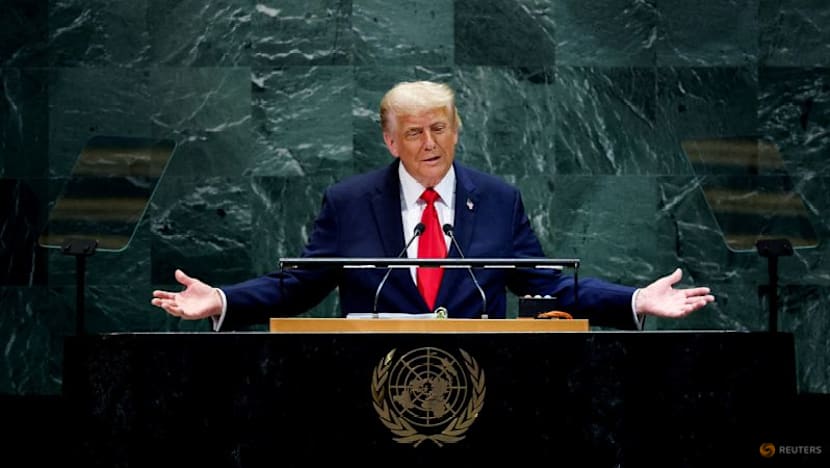
Trump’s a la carte approach to the UN: What’s on the menu – and what’s not
Key Points
Trump’s a la carte approach to the UN: What’s on the menu – and what’s not Washington may be cutting back its multilateral engagement, but it is still keeping a seat at the table, while building alternatives of its own. United States President Donald Trump has dramatically scaled back Washington’s engagement with international institutions since returning to the White House. But he has not walked away from the United Nations altogether.
Trump’s a la carte approach to the UN: What’s on the menu – and what’s not
Washington may be cutting back its multilateral engagement, but it is still keeping a seat at the table, while building alternatives of its own.
WASHINGTON: United States President Donald Trump has dramatically scaled back Washington’s engagement with international institutions since returning to the White House.
But he has not walked away from the United Nations altogether.
Instead, his second administration has taken an increasingly selective, a la carte approach to multilateral engagement – withdrawing from some international bodies and cutting funding, while continuing to support parts of the UN system it believes align with US interests.
That approach will be in focus as Trump heads into a packed day of diplomacy at the UN General Assembly on Tuesday (Sep 22), against the backdrop of continuing conflicts in the Middle East and Ukraine.
He is expected to address assembled delegates before meeting leaders from four continents, with at least 11 world leaders on his schedule in bilateral or group settings.
Ahead of his appearance at the UN headquarters in New York, CNA looks at what Washington is choosing to keep on its plate at the UN – and what it is leaving behind.
WHAT’S OFF THE MENU?
In January, Trump directed the US to withdraw from 66 international organisations that the White House said no longer “serve American interests”.
The move followed a review ordered by Trump in 2025 of US participation in and funding for international organisations.
His administration subsequently directed government agencies to withdraw from and cease funding 35 non-UN organisations and 31 UN entities, including the UN Population Fund, UN Women and the UN Economic and Social Commission for Asia and the Pacific (ESCAP).
Washington has also sharply reduced its humanitarian contributions to the UN.
According to UN data, total US humanitarian contributions fell to about US$3.38 billion in 2025, from US$14.1 billion a year earlier. American contributions had peaked at US$17.2 billion in 2022.
Last December, the US announced a US$2 billion pledge for UN humanitarian aid for 2026 under a new funding model that Washington said would increase efficiency and accountability.
The US State Department said that “individual UN agencies will need to adapt, shrink or die” as the administration pushes the world body to “cut bloat” and “remove duplication”.
But some UN watchers say that in pulling back, Washington risks giving up valuable leverage of its own.
“There's an opportunity here for the US to lay out what it's concerned about, what it would like to see change in these organisations where the US wants to withdraw,” said Brett Schaefer, senior fellow at the American Enterprise Institute, a Washington-based public policy think-tank.
“So, we're missing the opportunity to use US influence, membership and funding to leverage reforms down the line.”
WHAT’S STILL ON THE MENU?
Despite the broader pullback, the Trump administration is continuing to fund selected parts of the UN system.
In June, the US State Department announced more than US$1 billion in humanitarian and disaster response assistance to UNICEF and the World Food Programme (WFP).
The selective approach reflects Washington’s willingness to continue working with parts of the UN where the White House sees its interests served.
The US is also keeping its seat at the UN’s most powerful and influential table.
It remains one of five permanent members of the UN Security Council, alongside China, France, Russia and the United Kingdom. This gives Washington the power to veto Security Council resolutions.
“There are a lot of parts of the UN system that are really important to US interests, even if you don't really think that the UN General Assembly is providing great value for the US,” said Schaefer.
“The US needs to be in the Security Council, if only to exercise (its) veto to make sure that its interests aren't violated.”
Washington also retains considerable influence over another major decision facing the UN: who will become its next secretary-general.
Current UN chief Antonio Guterres’ second and final term ends in December, bringing his decade-long tenure to a close.
The Security Council plays a central role in deciding who takes the top job next, including recommending a candidate to the General Assembly.
As one of the council’s five permanent members, the US can also veto a candidate, giving Washington considerable say in who leads the institution.
TRUMP’S BOARD OF PEACE
At the same time, Trump is building alternatives of his own.
His Board of Peace – originally conceived to oversee efforts to rebuild Gaza – has emerged as one potential alternative forum.
Under its charter, Trump serves as the board’s inaugural chairman and has broad powers over its operations.
Trump gathered leaders in Washington in February for its inaugural meeting, amid questions at the time over whether the board’s role could eventually extend beyond Gaza and overlap with that of the UN in efforts to address international conflicts.
Observers have also raised questions over how the Board of Peace’s role could evolve.
“There are not a large number of significant documents related to the creation of the Board of Peace,” said Esther Brimmer, senior fellow in global governance at New York-based think-tank Council on Foreign Relations, adding much would depend on how Trump chooses to use the board in future.
But even with the current US administration’s approach to the UN, there is still optimism in Washington that support for international engagement remains.
“Many leaders in many places and many levels in the US want to be part of building a better world internationally,” said Brimmer.
“The question will be how and who will lead that movement after the dark days we are experiencing now.”