
Education
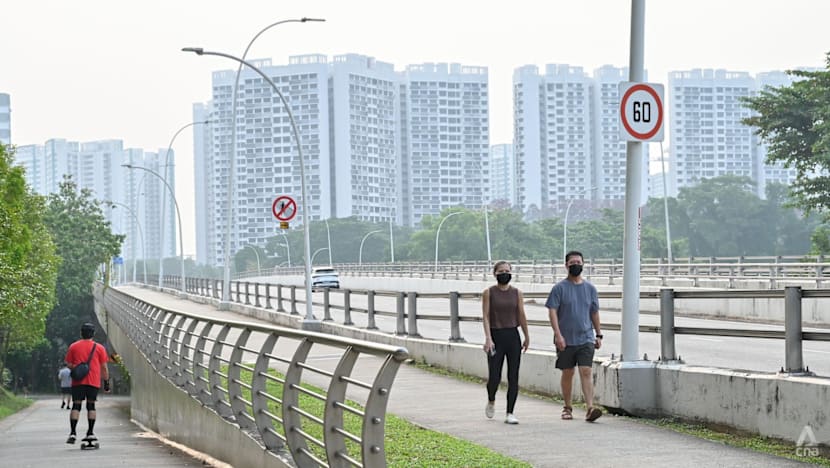
CNA Explains: How does haze reach Singapore and what do air quality readings tell us?
Key Points
CNA Explains: How does haze reach Singapore and what do air quality readings tell us? Smoke from fires hundreds of kilometres away can take days to reach Singapore, with wind conditions affecting how it travels and disperses. CNA looks at how air quality is measured, and why what people see and smell may not always correspond with pollution readings.
CNA Explains: How does haze reach Singapore and what do air quality readings tell us?
Smoke from fires hundreds of kilometres away can take days to reach Singapore, with wind conditions affecting how it travels and disperses. CNA looks at how air quality is measured, and why what people see and smell may not always correspond with pollution readings.
SINGAPORE: Singapore’s air quality hit new highs last week, with the Pollutant Standards Index (PSI) reaching 154 in the central region.
The hazy conditions have prompted schools and companies to limit the outdoor exposure of students and workers.
But why can one part of Singapore experience worse haze than another? And why can the air sometimes smell smoky even when pollution readings are relatively low?
WIND DIRECTION AND SPEED MATTER
Prevailing winds can carry airborne particles hundreds of kilometres from their source.
Assistant Professor Wang Jingyu, a climate and environment researcher at Nanyang Technological University’s National Institute of Education, said wind direction affects whether smoke is carried towards Singapore, while wind speed affects how quickly it gets here.
Using southeasterly winds of about 5 metres per second as an example, he said smoke from Central Kalimantan, about 1,000km from Singapore, could take up to three days to arrive.
“If the fire location is directly located at the upwind side, and the wind speed is strong, smoke can arrive faster,” he said.
The travel time varies depending on where the smoke originates.
Professor Rajasekhar Balasubramanian from the Department of Civil and Environmental Engineering at the National University of Singapore’s College of Design and Engineering said smoke from Sumatra could take about one to two days to reach Singapore, assuming wind speeds of about 3m to 4m per second.
WHY HAZE CAN BE WORSE IN SOME PARTS OF SINGAPORE
Once haze reaches Singapore, it does not necessarily spread evenly across the island.
Local winds affect where pollutants move, while Singapore’s urban landscape can also influence how easily polluted air disperses.
“Certain parts of Singapore could be more exposed to the polluted air coming from the affected areas,” said Prof Balasubramanian.
“But at the same time, we also have tall buildings and other aspects of the urban infrastructure that tend to slow down the movement of air.”
As a result, pollution can become trapped to some extent, worsening air quality in a particular area, he said.
Asst Prof Wang said the higher haze readings in central Singapore could also be influenced by its terrain and the urban heat island effect.
The central region has some elevated terrain, including Bukit Timah Hill, which he said can partially block airflow near the ground and cause haze particles to remain in the area for longer instead of dispersing.
The urban heat island effect can also play a role. Buildings and other surfaces can absorb heat and release it back into the air. This warms the air near the ground, causing some of it to rise and helping smoke particles remain in the air for longer, Asst Prof Wang said.
WHAT DOES HAZE CONTAIN?
Haze is not a single pollutant, but a mixture of particles and gases.
Small particles measuring 2.5 micrometres or less are known as PM2.5, while particulate matter measuring up to 10 micrometres is known as PM10.
Asst Prof Wang said PM2.5 is a major component of transboundary haze because the particles are small enough to remain suspended in the air for days and travel long distances.
But the burnt smell associated with haze does not necessarily come from PM2.5.
Haze can also contain organic compounds and gases produced by burning vegetation and peat. These can produce an odour even when PM2.5 levels are relatively low.
Prof Balasubramanian said gases travel faster than larger particles.
“The odour or smell tends to diffuse or travel relatively faster, as compared to particles that are larger in size,” he said.
“So the rate of movement or the speed with which the particles migrate from affected areas into Singapore is relatively lower as compared to gases.
“And hence, you smell the air first before you see a spike in PM 2.5 concentrations.”
Prof Balasubramanian added that fine particles suspended in the air can absorb or scatter sunlight, reducing visibility.
WHAT DOES THE PSI ACTUALLY MEASURE?
PSI indicates the level of air pollution in Singapore. It is not a direct measurement of haze.
Sensors across Singapore continuously monitor the concentration of six pollutants: PM2.5, PM10, sulphur dioxide, carbon monoxide, ozone and nitrogen dioxide.
A sub-index score is calculated for each pollutant, and the highest of these determines the overall PSI.
The National Environment Agency (NEA) says the PSI is calculated using the concentrations of these six pollutants over a rolling 24-hour period.
Because of this, it takes time for the PSI to reflect sudden changes in air quality.
For a more current picture, the one-hour PM2.5 reading measures the average concentration of these fine particles over the previous hour.
For immediate outdoor activities, NEA advises referring to the one-hour PM2.5 reading.
For activities planned for the following day, it recommends referring to the 24-hour PSI forecast.
Want an issue or topic explained? Email us at digitalnews [at] mediacorp.com.sg. Your question might become a story on our site.
CNA (LOCATION)
Singapore (LOCATION)
Wang Jingyu (PERSON)
Nanyang Technological University’s (ORG)
National Institute of Education (ORG)
Central Kalimantan (LOCATION)
Rajasekhar Balasubramanian (PERSON)
the Department of Civil and Environmental Engineering (ORG)
the National University of Singapore’s (ORG)
College of Design and Engineering (ORG)
Sumatra (LOCATION)
Prof Balasubramanian (PERSON)
Wang (PERSON)
Bukit Timah Hill (LOCATION)