
Politics
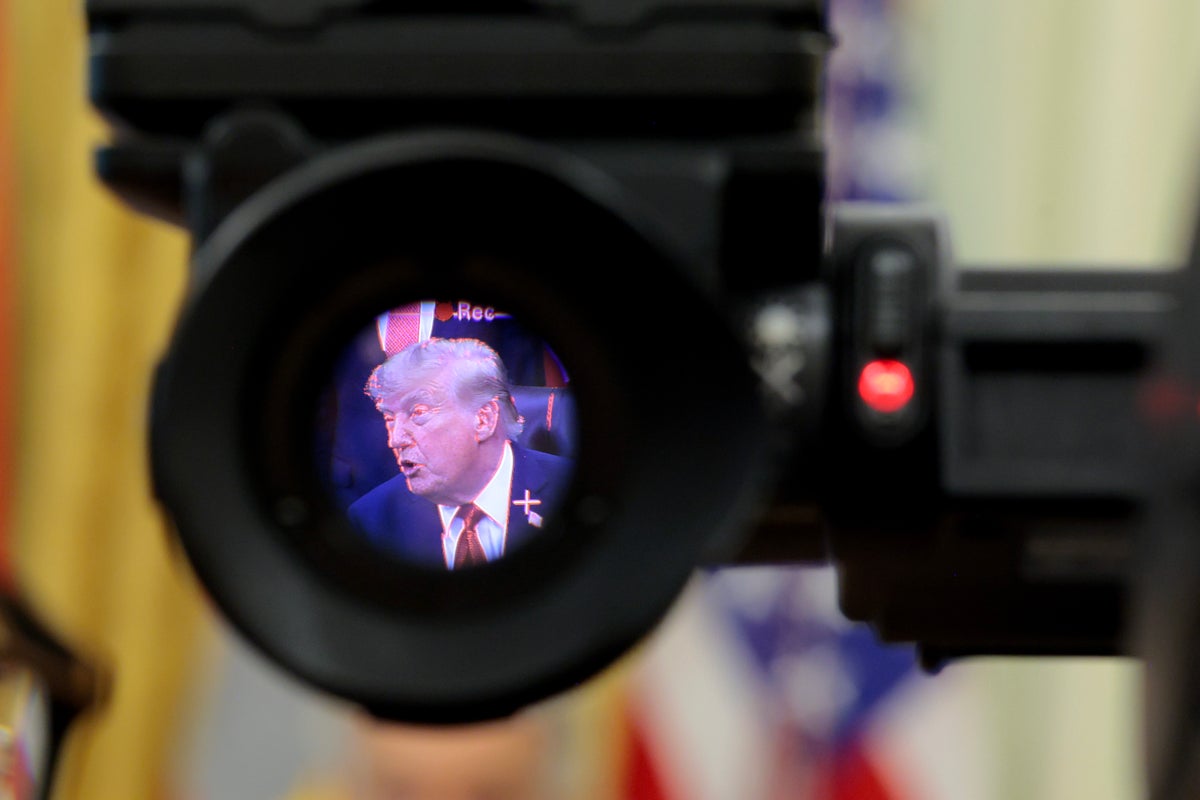
Trump is off American TV — can the world learn to live without him as the star?
Key Points
Trump is off American TV — can the world learn to live without him as the star? The president turned to the media to build his celebrity and political persona. What happens when that toxic relationship ends?
Trump is off American TV — can the world learn to live without him as the star?
The president turned to the media to build his celebrity and political persona. What happens when that toxic relationship ends? Alex Woodward writes
- Bookmark
- CommentsGo to comments
Donald Trump seemed to be yelling into the void.
The president, surrounded by suits in hard hats and neon yellow vests, was inaudible during a Monday ribbon-cutting ceremony for his much-touted helipad after major television networks refused to participate following his decision to ban three outlets from the White House press pool.
He was speaking to an audience that didn’t exist, a near-perfect metaphor for his growing political isolation against his incessant demands to wield unilateral authority.
That same day, his administration launched its own 24-hour “Trump TV” live stream, a curated highlight reel that was immediately panned as state propaganda.
Trump has spent decades cultivating an image of self-made success on television screens that paved his path to celebrity and the presidency But, after relying on those same broadcasters to amplify his endless fountain of lies, insults and threats, the president turned on the networks that shaped him by smearing the press as “fake news,” falsely accusing reporters of lying, publicly suggesting they should be imprisoned for imaginary crimes, and declaring them a national security threat.
The blowback after his latest attempts to ban reporters from covering his administration has been swift and largely unanimous.
After leeching off mainstream media that he believes owes him fawning coverage and a platform to do what he pleases, he now faces the prospect of a break from the toxic relationship he appears to love more than the presidency.
Can he learn to live without it? Will everyone else? Americans, who can’t imagine a day over the last decade without hearing or seeing him, could be getting an early glimpse into a post-Trump media landscape the longer he stays out of it.
Media outlets fostered that symbiotic relationship for access to Trump despite his authoritarian impulses that targeted them and individual reporters.
In his first administration, he called journalists and news outlets “fake news” roughly 2,000 times, averaging more than one daily broadside against the press and continuing a long legacy of attempts to undermine his critics that continued long after he left the White House.
After taking office a second time, Trump’s White House seized control of the press pool. He barred the Associated Press in retaliation for the outlet’s refusal to call the Gulf of Mexico the “Gulf of America,” and the White House website created pages attacking individual reporters and outlets as “media offenders.”
He routinely threatens to pull broadcast licenses and insults women reporters and has launched several unsuccessful defamation lawsuits that dragged networks and publishers into courtrooms for months.
Still, despite his escalating attacks, Trump was a guest of honor at the White House Correspondents’ Association dinner.
After years of compromise with a president and an administration that routinely threatens their existence, publishers tasked with holding him accountable could decide to end the relationship altogether or keep returning to a lucrative source that Trump knows is beneficial to both of them.
But Trump is also rapidly aging on live television. His remarks are often incoherent if not exhausting to untangle from outright lies. A White House-controlled livestream that plays the hits might be his preferred way to stay in the public eye.
His absence also could fill a vacuum in coverage for a new era in the administration’s spin machine, further opening the door to right-wing networks and personalities to amplify bogus statements and platform officials while the rest of the media goes dark, preserving the image of the infallible leader that the “fake news” ignores.
“The public has a vital interest in receiving accurate, independent information about its government,” members of the White House TV pool — including ABC, CBS, CNN, NBC and Fox News — said in a rare moment of solidarity.
“No administration should restrict a news organization because it objects to its reporting,” they wrote.
CNN, MS NOW and Politico — the three outlets barred from Trump’s pool — filed a lawsuit accusing the president of launching “a direct assault on the First Amendment” and a “blatant violation of our most fundamental constitutional principles.”
Trump rejected the idea, calling it instead an “assault on the FAKE NEWS, something that has grown like Cancer in our beloved United States of America,” he wrote Monday. “It is corrupt, purposeful, pervasive, fully coordinated, and totally out of control. It is a threat to our National Security, and must be stopped, NOW!”
By that night, sensing he will lose the latest legal battle, he vowed to appeal any ruling against him.
Media outlets that “violate our National Security by writing false and defamatory stories with unknown ‘sources’ shouldn’t be allowed access to the most important Office anywhere in the World,” he wrote.
“FAKE NEWS IS A THREAT TO DEMOCRACY, and I will do whatever is necessary to make sure that the U.S.A. thrives,” Trump said.
Rep. Robert Garcia, the top Democrat on the House Oversight Committee, is also investigating the ban.
In his letter to White House communications director Steven Cheung, Garcia said “the American people need to understand what consideration — if any — the White House gave to this serious and unprecedented decision to protect the president’s ego.”
Trump’s attacks on the press have reached “a constitutional breaking point,” according to Nora Benavidez, senior counsel at nonpartisan First Amendment advocacy group Free Press.
The president can’t block press access to the White House “simply because he does not like their questions, their coverage or their attitude,” she said.
Join our commenting forum
Join thought-provoking conversations, follow other Independent readers and see their replies
Comments