
Politics
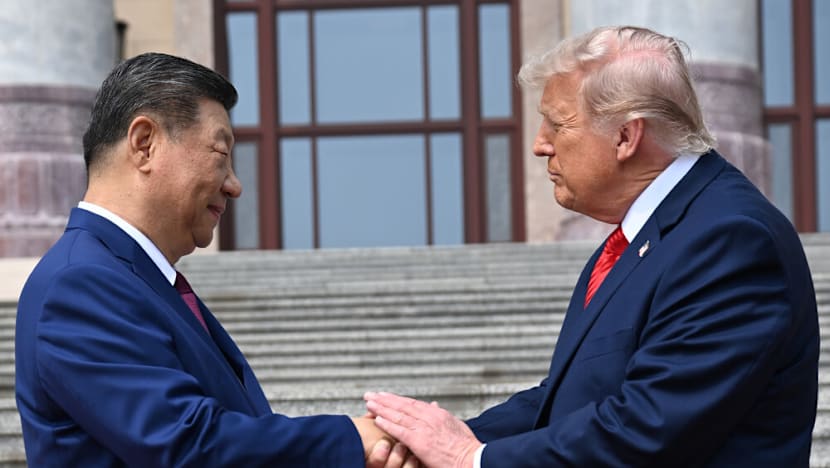
Trump, Xi meet in Washington looking to build on ‘real but shallow stabilisation’
Key Points
analysis East Asia Trump, Xi meet in Washington looking to build on ‘real but shallow stabilisation’ United States President Donald Trump and Chinese counterpart Xi Jinping face a crowded agenda in Washington. Beyond immediate outcomes, a key question is whether their summit can help build a relationship less dependent on them, say analysts. Just four months after United States President Donald Trump travelled to Beijing for talks with Xi Jinping, the Chinese leader is now making a...
analysis East Asia
Trump, Xi meet in Washington looking to build on ‘real but shallow stabilisation’
United States President Donald Trump and Chinese counterpart Xi Jinping face a crowded agenda in Washington. Beyond immediate outcomes, a key question is whether their summit can help build a relationship less dependent on them, say analysts.
BEIJING: Just four months after United States President Donald Trump travelled to Beijing for talks with Xi Jinping, the Chinese leader is now making a reciprocal visit to Washington - with bilateral ties on steadier ground, but the underlying strategic rivalry largely unchanged, say analysts.
They add that the closely watched meeting will offer an early test of the “constructive strategic stability” the two leaders agreed to pursue in May - how far the recent stabilisation in ties has come, and whether the US and China can make it more durable despite deep-seated differences.
Sustained dialogue and mutual economic leverage have given both sides incentives to contain tensions even as disputes over trade, technology and security persist, say analysts.
"I would call it real but shallow stabilisation, driven partly by mutual vulnerability rather than strategic convergence," Chinese policy researcher Li Yaqi told CNA.
"The relationship has become better at recovering from confrontation; it is not yet particularly good at preventing confrontation from recurring."
The stakes extend beyond bilateral ties.
US allies and partners will be watching closely for any shifts over Taiwan, while outcomes on the Iran war - if any - could signal how far Washington and Beijing can cooperate on regional issues, observers said.
THE ART OF MANAGING RIVALRY
Xi will be in the US from Sep 23 to 25 for a state visit at Trump's invitation, China's foreign ministry confirmed earlier this week.
Trump will personally greet Xi and his wife Peng Liyuan when they arrive at Joint Base Andrews outside Washington on Wednesday, according to the White House. News outlets have pointed out the rare move, noting that US presidents typically receive visiting foreign leaders at the White House.
Xi will then visit the White House on Thursday - his first visit there since 2015.
Thursday's state arrival will feature full military honours, including nearly 480 personnel and a flyover by a B-2 bomber and four F-22 fighter jets, followed by a state dinner that evening.
The two couples will have tea at the White House on Friday before visiting the National Archives to view records tracing the history of US-China relations.
One difference from four months ago is the expansion of working-level channels aimed at managing tensions and preventing disputes from escalating, said analysts.
Trade and economic talks have continued, including an eight-hour meeting in New York on Sunday between US Treasury Secretary Scott Bessent and Chinese Vice Premier He Lifeng that laid the groundwork for the leaders' summit.
According to the US side, the talks covered trade, critical minerals and artificial intelligence. China's commerce ministry said both sides had "candid, in-depth and constructive" exchanges on implementing previous trade agreements and promoting bilateral trade and investment, as well as a dialogue on AI-related issues.
The latest talks followed a video call between He, Bessent and US Trade Representative Jamieson Greer on Jul 30, when Beijing raised "serious concerns" after Washington announced new tariffs on goods from China and dozens of other trading partners over forced labour allegations, as well as fresh curbs targeting Chinese robots and power inverters.
Such contacts point to “a period of limited but gradually institutionalising stability", said Sun Chenghao, a senior fellow at Tsinghua University's Center for International Security and Strategy.
"The consensus reached by the two leaders is extending to the working level," he told CNA, citing the Bessent-He channel as an example.
But the relative US-China calm also reflects a mutual recognition of the costs they can impose on each other, analysts said.
China's restrictions on rare earths and critical minerals have exposed US vulnerabilities in supply chains, while Washington retains leverage through tariffs and controls restricting China's access to advanced semiconductors and chipmaking technology.
That exposure to economic pressure has strengthened incentives to keep competition from escalating, analysts said.
At the same time, leader-level diplomacy has taken on a greater role, experts noted.
Sean King, senior vice-president at New York-based business advisory firm Park Strategies, pointed to the striking shift in Trump's posture towards Xi since his first term, when he had called for China to pay damages over the COVID-19 pandemic.
During his May visit to Beijing, Trump repeatedly called Xi a "great leader", said he had "tremendous respect" for the Chinese president and described it as an "honour" to be his friend. He has continued the praise since, calling Xi "very smart" and "all business" in a June interview.
"Xi certainly has charmed the US president," King told CNA, contrasting Trump's increasingly warm treatment of Xi with recent public disagreements with allies including Italy and South Korea.
Trump publicly clashed with Italian Prime Minister Giorgia Meloni in June over Italy's refusal to support the US war with Iran, while in August he ordered joint military exercises with South Korea scaled back after criticising Seoul over its stance on the conflict and the cost of the drills.
Xi and Trump could meet as many as four times this year.
After their May summit in Beijing and the Washington meeting this week, the two leaders could meet again in November at the Asia-Pacific Economic Cooperation (APEC) summit in Shenzhen, and a month later at the G20 summit in Miami, Florida.
Sun from Tsinghua University said the frequency of leader-level engagement reflects recognition in both capitals that their relationship has become too complex to simply "run on autopilot" at the departmental level, with repeated intervention by Xi and Trump needed to recalibrate its direction.
While such diplomacy could break deadlocks on thorny issues and help contain crises, it also carries risks, he said.
"If a large number of issues require the two leaders to personally make the final call, the relationship could take on a more pronounced transactional character," Sun said.
The more durable model, he added, would be one where the leaders set the direction, government departments implement their consensus and established mechanisms manage differences.
DIALOGUE TO DELIVERABLES
At the heart of the Washington talks is whether the two sides can deliver concrete and lasting outcomes, said analysts.
The immediate test is whether the current trade truce, due to expire on Nov 10, is extended.
US officials have said China’s exports of rare earths and other critical minerals will also be on the agenda.
AI is widely expected to be discussed too, having rapidly emerged as a major front in bilateral competition amid a wider global debate over whether development is moving too quickly.
Those issues were already being worked on ahead of Xi's arrival.
At the talks in New York on Sunday, Bessent proposed a US-China mechanism for notifying each other of major AI safety or national security incidents, while Greer said both sides were working to "operationalise" tariff reductions for non-strategic goods.
Chinese policy researcher Li cautioned against judging the summit by its most visible outcomes alone.
"I would look past large purchase numbers or warm rhetoric," he said.
"The real test is whether temporary restraint becomes administrable below the leader level."
Li said he would be watching the terms of any trade-truce extension, clearer procedures for critical minerals and whether existing trade channels and emerging AI mechanisms are given clear objectives and timelines for follow-up.
AI could be a particularly useful area to watch.
"If that develops into recurring expert contacts and agreed procedures, it would show that summit-level stabilisation is beginning to generate actual crisis-management infrastructure,” he said.
Sun from Tsinghua University likewise cautioned against judging the summit only by whether Trump and Xi strike a "grand bargain” - a sweeping deal across multiple areas of contention. Analysts have said neither side is expecting nor seeking one.
"The core measure of progress is not whether differences disappear," Sun said.
"It is whether, when differences arise, the two sides have the ability to keep them contained."
NAVIGATING COMMON GROUND AND RED LINES
The Iran war offers the clearest test of whether calmer US-China ties can translate into cooperation on a major international crisis, said analysts.
The conflict, now in its seventh month, has severely disrupted shipping through the Strait of Hormuz, putting pressure on global energy markets. It is widely expected to be discussed during the Washington summit.
When Trump and Xi met in Beijing in May, both sides agreed that Iran should not possess nuclear weapons and that the Strait of Hormuz should reopen.
Both sides have an interest in containing nuclear escalation, safeguarding shipping and limiting further energy shocks, Li said.
But Beijing opposes US secondary sanctions and has consistently stressed the need for negotiations and a political settlement. It has shown little willingness to adopt Washington's approach of military and economic pressure towards Tehran.
"China will use leverage where its own interests converge with Washington's; that is different from using it simply because Washington asks," Li added.
Sun made a similar point, arguing that the most realistic areas for cooperation lie in preventing the conflict from widening, keeping energy routes open and encouraging a return to diplomacy.
Meanwhile, Taiwan remains one of the most sensitive flashpoints in US-China relations.
Ahead of the summit, China's state-run news outlet Global Times called Taiwan "the most important issue" between China and the US, warning in a Sep 22 editorial that mishandling it could lead the two countries into "confrontation or even conflict".
China regards Taiwan as part of its territory and has not ruled out the use of force to achieve reunification. Beijing is expected to press its concerns over US support for Taiwan, including arms sales, during the Washington summit.
King from Park Strategies was particularly wary of how Trump might approach the issue.
He pointed to Trump's criticism of Taiwan over semiconductors and the administration's delay of a proposed US$14 billion arms package, which the US president remarked in May was a “very good negotiating chip” in talks with Beijing.
"Taiwan is Beijing's core of core interests and Trump appears to be taking Xi's representations on the issue at face value," King told CNA, arguing that Trump's recent approach had already been more accommodating towards Beijing on Taiwan.
At their May summit, Xi told Trump that Taiwan was "the most important issue" in bilateral ties and warned that mishandling it could lead to "clashes and even conflicts", according to the Chinese readout. He also urged Washington to exercise "extra caution" in handling the issue.
Two days later, Foreign Minister Wang Yi said Beijing's impression from the talks was that Washington understood China's position and took its concerns seriously.
The implications extend beyond cross-Strait ties.
Li said Taiwan was also an "alliance-signalling issue", with Japan and other US partners watching closely for any change in Washington's position.
"Language intended to reassure Beijing could simultaneously generate uncertainty in Tokyo or Taipei," he said.
Taiwan therefore highlights a broader challenge - whether the US and China can forge greater stability without creating greater uncertainty elsewhere in the region, Li added.
MAKING STABILITY STICK
The next major gatherings on the diplomatic calendar will offer an early indication of whether any understandings reached in Washington can carry over into wider multilateral settings, analysts said.
"What is really worth watching is whether China and the US can leave room for each other's participation at the major multilateral meetings they respectively host," said Tsinghua University’s Sun, referring to the November APEC summit in Shenzhen and the December G20 gathering in Florida.
China has made "openness, innovation and cooperation" the three priorities of its APEC host year, while the US’ G20 agenda has placed greater emphasis on growth, innovation, supply chains and economic imbalances.
The differing priorities reflect their contrasting approaches to the international system, said Chong Ja Ian, an associate professor of political science at the National University of Singapore (NUS).
"The PRC (People’s Republic of China) seems more interested in shaping regional and global institutions, rules, and norms to their favour at this point in time," he said.
Meanwhile, the US appears "less interested in the mechanics of global governance", he added.
Beyond the diplomatic calendar, Chinese policy researcher Li said a key measure of the relationship's resilience would be whether any agreements reached in Washington can be carried forward without Xi and Trump having to intervene.
"Can what they agree on Sep 24 still function in December without Trump and Xi in the room?” he said.
"If yes, the relationship is becoming more resilient. If every serious dispute still has to be pushed upward to the two leaders, the stability remains shallow."