
Business & Finance
No grand deal expected from Xi’s US visit as China seeks ‘strategic stability’: Analysts
Key Points
No grand deal expected from Xi’s US visit as China seeks ‘strategic stability’: Analysts The visit will be Chinese President Xi Jinping’s first state visit to the United States in more than a decade. Chinese President Xi Jinping’s upcoming state visit to the United States is unlikely to produce a sweeping agreement between the two powers, with analysts instead expecting Beijing to focus on putting more substance behind a framework aimed at managing their long-term rivalry.
No grand deal expected from Xi’s US visit as China seeks ‘strategic stability’: Analysts
The visit will be Chinese President Xi Jinping’s first state visit to the United States in more than a decade.
WASHINGTON: Chinese President Xi Jinping’s upcoming state visit to the United States is unlikely to produce a sweeping agreement between the two powers, with analysts instead expecting Beijing to focus on putting more substance behind a framework aimed at managing their long-term rivalry.
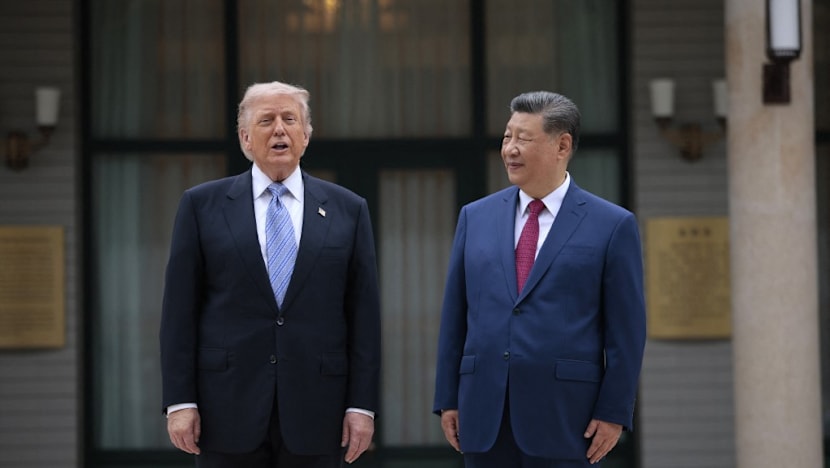
Xi and Trump are expected to hold talks in Washington on Thursday (Sep 24), their second summit this year following Trump’s state visit to Beijing in May.
Trade and tariffs, artificial intelligence, Taiwan and the war in Iran are among the issues expected to feature in their discussions.
The visit will be Xi’s first state visit to the US in more than a decade. His first and only state visit was in 2015, three years after he took over as China’s top leader.
That visit took place during Barack Obama’s presidency, and produced 49 outcomes and areas of consensus spanning trade and investment, climate change and cybersecurity. Then, Beijing had hailed it as taking “cross-Pacific cooperation” to a new stage.
More than a decade later, analysts say the ambition for such a visit is different.
The Communist Party’s flagship newspaper said the two leaders would provide “strategic guidance” on developing a stable relationship, building on the concept of “constructive strategic stability” introduced during Trump’s visit to Beijing in May.
“I think from Beijing's perspective, this visit is not about restoring the kind of relationship China and the US had in, for example, 2015,” said Zichen Wang, deputy secretary-general of the non-government think tank Centre for China and Globalization.
“That era is over. The more realistic objective is to consolidate a framework of strategic stability,” said Wang, who is also the founder of the newsletter Pekingnology.
PUTTING ‘MEAT ON THE BONES’
The upcoming visit could test what that framework means in tangible terms, with much of the focus centred on what analysts call the “three Ts”: trade, technology and Taiwan.
“China obviously would want to have more chips. China would want to have more investment in the United States,” said Damien Ma, director of Carnegie China.
“I think those two are very difficult to achieve in the near term, probably not very possible, but that's not going to stop the Chinese from asking for that,” he added.
He said that Xi would likely push Trump further on Taiwan, including on the question of US arms sales to the island.
“So, in that sense, you sort of have this here's what we want, here's what you want, let's see where we can get to perhaps some kind of deal somewhere,” said Ma.
For Washington, a key priority is greater certainty over rare earth supplies from China.
But expectations for major breakthroughs remain modest, with observers saying Beijing appears to accept that competition with Washington is unlikely to go away.
“I think they've decided that we are going to be competing with the United States in many different ways. So that is not going away, irrespective of these summits,” said Ma.
“They're trying to find equilibrium in which you can manage this competitive dynamic without it completely spilling over and escalating to a point where there's no turning back.”
The question now is what that looks like in practice.
“I think what this summit mostly is about is putting meat on the bone. What is going to be the substance?” he said.
Ma pointed out that Xi had spoken about starting with small steps.
“Xi Jinping is very open about saying we just need to start doing small things and cumulatively, step by step, we'll get to some new equilibrium where we can manage this structural competition going forward.”
ROOM FOR PROGRESS ON TRADE
Trade could offer the clearest room for progress, with analysts saying the current trade truce could be extended.
Beijing and Washington are consulting on a reciprocal tariff reduction framework covering US$30 billion worth of goods on each side, China’s commerce ministry has said.
The timing of the summit may also work in favour of greater stability, with both leaders mindful of their domestic audiences.
Trump is heading towards US midterm elections later this year, while Xi has key Communist Party meetings of his own ahead, including a five-yearly Party Congress next year, where a leadership reshuffle is expected.
Managing the China-US relationship could help limit a source of uncertainty.
For Xi, the visit also comes amid economic challenges in China, including weak domestic demand and a prolonged property downturn.
But analysts say Beijing does not see itself as seeking accommodation from a position of weakness.
“China has been through tariffs, export controls, technology restrictions, and efforts at de-risking,” said Centre for China and Globalization’s Wang.
But he said Beijing does not believe those measures have fundamentally stopped China’s development.
“In some strategic sectors, China believes it has actually become stronger. So I think that's actually built up China's confidence in trying to maintain this strategic stability.”
Trump has said that artificial intelligence will be among the issues he discusses with Xi.
The technology could provide an early test of their approach to managing an area of intense competition, but also one with potential for cooperation.
"It's not like the US and China will suddenly become friends and jointly develop AI and work out a lot of problems," said George Chen, partner and chair of the digital practice at The Asia Group, a strategic advisory firm.
"China and the US will still clash on the world stage. Automatically the question is who's going to write the global rules for AI, or whether the US wants to have its own set of rules and ask other countries to follow."
But Chen said there was still scope for the two powers to cooperate in specific areas such as AI safety and the weaponisation of AI.