
Science
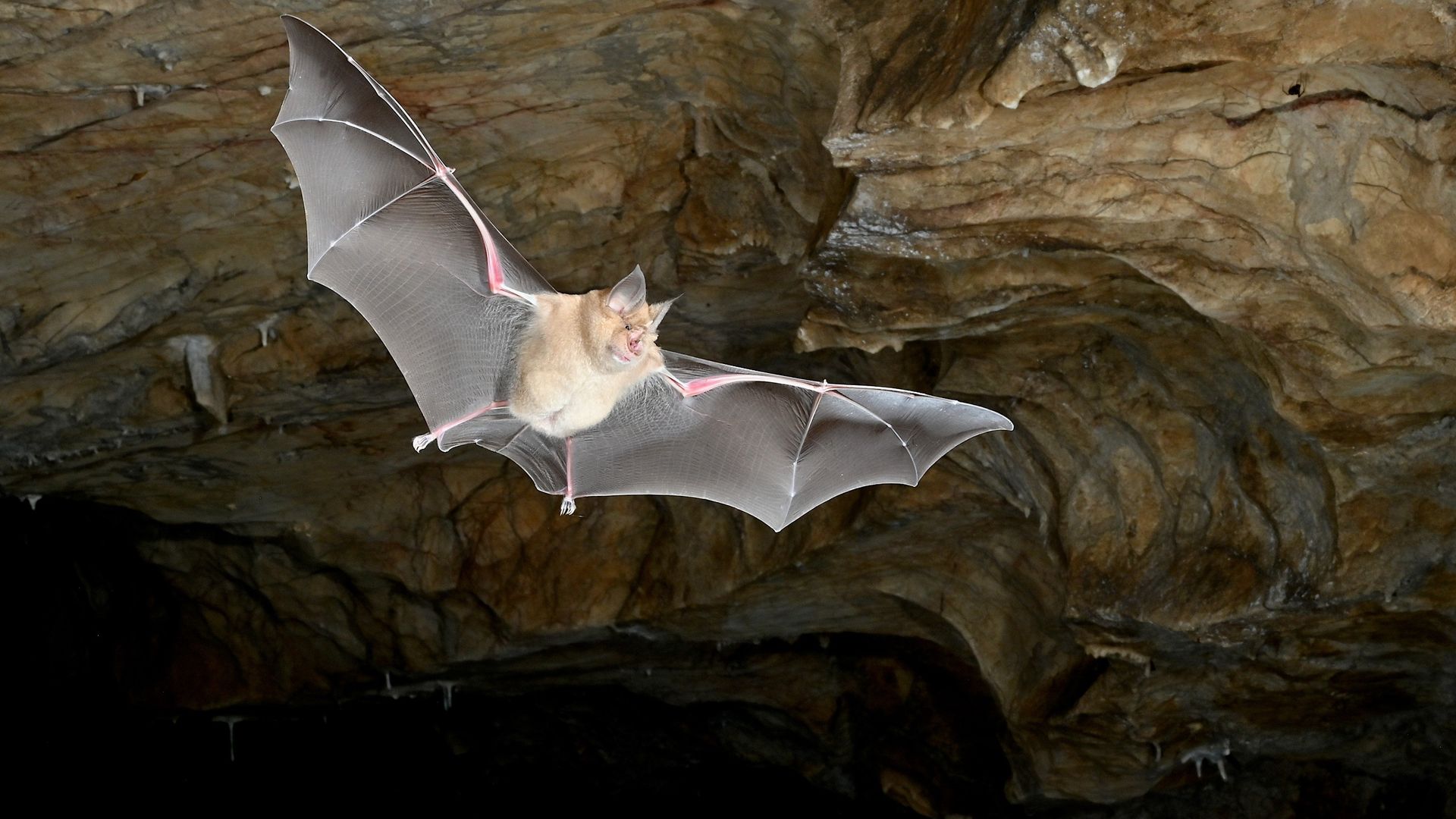
Earth's first bats didn't come from where we thought, landmark genetic study reveals
Key Points
Earth's first bats didn't come from where we thought, landmark genetic study reveals In the largest study of its kind to date, researchers compiled data from 103 bat genomes and 44 fossils to rewrite the bat family tree and determine where these animals first evolved. Scientists may have settled a decades-long debate about bat evolution, including controversial questions about when bats began to communicate and fly, a landmark study shows. The new research, published Wednesday (Sept. 23) in...
Earth's first bats didn't come from where we thought, landmark genetic study reveals
In the largest study of its kind to date, researchers compiled data from 103 bat genomes and 44 fossils to rewrite the bat family tree and determine where these animals first evolved.
Scientists may have settled a decades-long debate about bat evolution, including controversial questions about when bats began to communicate and fly, a landmark study shows.
The new research, published Wednesday (Sept. 23) in the journal Nature, is the biggest bat DNA and fossil study ever conducted. Researchers created new, top-quality genome assemblies for 41 bat species, which they analyzed together with 62 existing sequences, providing a record dataset of 103 bat genomes and 44 bat fossils.
"It is extraordinary," study co-author Emma Teeling, a professor of molecular evolution and mammalian phylogenetics at University College Dublin, told Live Science in an email; "after decades of research and conflicting findings, we finally have uncovered how and when bats evolved."
The analysis suggests that bats arose in Europe around 65 million years ago, contradicting previous hypotheses proposing Asian, African or North American origins around 50 million years ago. Additionally, the researchers found that echolocation and true flight evolved early in bats, roughly 50 million years ago, rather than multiple times after modern bats began to diversify.
"This study transforms bat evolution research because it finally gives us a robust, resolved family tree and biogeography, something that's eluded scientists for decades," study co-author Sonja Vernes, a professor and head of the Neurogenetics of Vocal Communication Research Group at the University of St Andrews in the U.K., told Live Science in an email. "Get the tree right, and everything else about bat evolution starts to fall into place."
The study included members of all 21 recognized bat families, as well as some of the most remarkable bat species known on Earth. For example, the dataset contained the bumblebee bat (Craseonycteris thonglongyai, also called the Kitti's hog-nosed bat), which, at about 1 inch, or 2.5 centimeters, long, is thought to be the smallest mammal on Earth; and the Madagascar's sucker-footed bat (Myzopoda aurita), which has suction cups on its wrists and ankles to help it cling to smooth surfaces.
The research team — which comprised 137 scientists affiliated with Bat1K, an international project to map the genomes of all living bat species — used advanced DNA sequencing and computational techniques to identify individual genes and redraw the bat family tree.
Get the world’s most fascinating discoveries delivered straight to your inbox.
"The value we bring is in innovative methods and unparalleled data that together yield an evolutionary tree that includes all these key fossils," study co-author Liliana Dávalos, a professor of phylogenetics and tropical deforestation at Stony Brook University in New York, told Live Science in an email.
Among other discoveries, the researchers found that a 50 million-year-old fossil from southern France of the extinct species Vielasia sigei, which shows signs of advanced echolocation, sits within the oldest branch of the bat family tree, indicating that echolocation predates the diversification of modern bats. This finding, together with the result that true flight appeared early in bats, helps to explain why this lineage has been so successful and evolved into more than 1,500 species worldwide today, according to the study.
After emerging in Europe, bats quickly dispersed into Africa, establishing a Europe-Africa hub from which they expanded into Asia, the Americas and Australia, the results suggest. Bats are the only mammals capable of true flight, meaning they flap their wings and don't simply glide or parachute. Throughout their evolution, they have acquired longer lifespans than other mammals of similar body size, surviving eight to 10 times longer than might be expected and showing few signs of aging and cancer, according to the study.
"Some bat species live remarkably long lives for their size, and can shrug off diseases that would make us seriously ill," Vernes said. "Until now, we didn't have a solid enough foundation to properly understand how bats evolved their most extraordinary traits, from flight and echolocation to their remarkable lifespans and resistance to disease. Now we do."
RELATED STORIES
The genomic resource built for the study lays the foundation for future research into bats' longevity and disease resistance, with potential benefits for humans, Vernes said. "If we can understand how they do this at the genetic level, it could eventually help us design bat-inspired approaches to improve human health," she said.
The findings could also aid bat conservation through genomic methods. Protecting bats is important because they help to maintain healthy ecosystems by pollinating plants, dispersing seeds and consuming huge numbers of insect pests, Vernes said. There is also more work to be done to identify the ancestor of all living bats, whose genome the researchers took a first stab reconstructing.
"For me, this isn't the end of the story," Vernes said; "it's just the first chapter."
Morales, A. E., Liang, Y., Thomas, W. R., Leushkin, E. V., Castellanos, F. X., Larkin, D. M., Brown, T., Fromm, B., Hand, S. J., Huang, Z., Hughes, G. M., Jones, M. F., Lim, B. K., Mai, M., Myers, E. W., Pippel, M., Puechmaille, S. J., Simmons, N. B., Abueg, L. A. L., ... and Teeling, E. C. (2026). Reference genomes and fossils revise bat family phylogeny and biogeography. Nature. https://doi.org/10.1038/s41586-026-11007-3
Sascha is a U.K.-based staff writer at Live Science. She holds a bachelor’s degree in biology from the University of Southampton in England and a master’s degree in science communication from Imperial College London. Her work has appeared in The Guardian and the health website Zoe. Besides writing, she enjoys playing tennis, bread-making and browsing second-hand shops for hidden gems.
You must confirm your public display name before commenting
Please logout and then login again, you will then be prompted to enter your display name.
Earth (LOCATION)
Emma Teeling (PERSON)
University College Dublin (ORG)
Live Science (ORG)
Europe (LOCATION)
Asian (ORG)
African (ORG)
North American (ORG)
Sonja Vernes (PERSON)
the Neurogenetics of Vocal Communication Research Group (ORG)
the University of St Andrews (ORG)
U.K. (LOCATION)
Craseonycteris (LOCATION)
Kitti (ORG)
Madagascar (LOCATION)