
Technology
Over 80,000 finance workers to get AI training by 2028 as industry launches job transformation initiative
Key Points
Over 80,000 finance workers to get AI training by 2028 as industry launches job transformation initiative 23 financial institutions have committed to training their entire Singapore workforce in critical artificial intelligence skills by 2028 through programmes recognised by the Institute of Banking and Finance. SINGAPORE: More than 80,000 finance workers in 23 financial institutions will be trained in critical artificial intelligence skills by 2028, Deputy Prime Minister Gan Kim Yong said...
Over 80,000 finance workers to get AI training by 2028 as industry launches job transformation initiative
23 financial institutions have committed to training their entire Singapore workforce in critical artificial intelligence skills by 2028 through programmes recognised by the Institute of Banking and Finance.
SINGAPORE: More than 80,000 finance workers in 23 financial institutions will be trained in critical artificial intelligence skills by 2028, Deputy Prime Minister Gan Kim Yong said on Thursday (Sep 24).
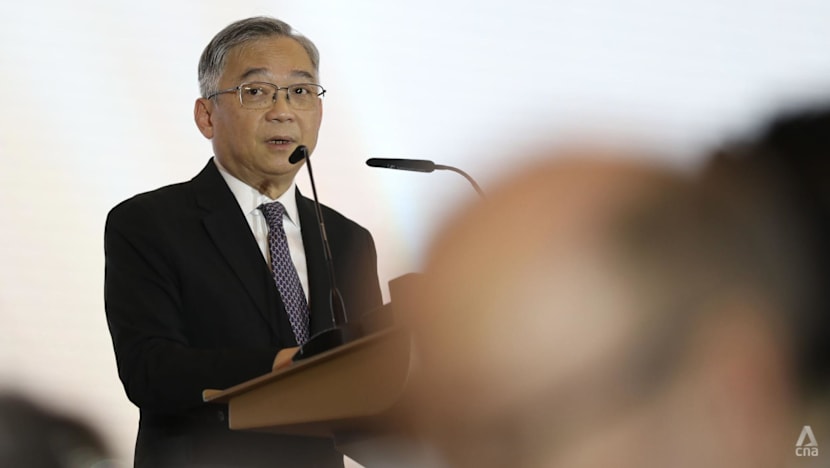
Speaking at the Institute of Banking and Finance's (IBF) annual Distinction Evening, Mr Gan officially launched a collaborative initiative formed by these financial institutions to assess how AI is changing jobs and to test practical approaches to training and job redesign.
Called the IBF AI Workforce Co-Lab, the 23 institutions have committed to training their entire Singapore workforce in AI skills through IBF-recognised programmes, said Mr Gan, who is also chairman of the Monetary Authority of Singapore (MAS).
More than half of their employees have already been trained, he said, adding that the training will give employees a common foundation for working with AI.
The 23 institutions, which cut across the banking, insurance and asset management sectors, include DBS, OCBC, UOB, AIA Singapore and Prudential.
Employees will also need skills suited to their specific roles, so the Co-Lab will develop pathways to help workers acquire the necessary skills.
"I encourage more financial institutions to join the Co-Lab and make the commitment to your people," he said.
IBF chief executive Carolyn Neo said the pioneer institutions who formed the Co-Lab employ around 40 per cent of the financial services workforce. They have adopted AI use cases and are committed to workforce development initiatives, she added.
AI IN THE FINANCIAL SERVICES SECTOR
The announcement comes as AI becomes more pervasive in workplaces, including financial institutions.
Mr Gan said AI is already changing operations in customer service, financial advisory, credit underwriting, fraud detection, market analysis and software development.
There are "tremendous opportunities" to use AI to raise productivity, serve clients better, strengthen risk management and develop new areas of growth, he said.
Roles will expand and change as AI adoption grows, so developing Singapore's workforce must be part of the effort from the outset.
"We want AI to translate into better careers for Singaporeans and a more productive workforce," he said, adding that this will require commitment and action by financial institutions, and partnership and support from the government and unions.
Financial institutions must plan for their people as they plan for AI by identifying how jobs will change, preparing employees early and helping them benefit from new opportunities.
In the past, the financial industry has done well to equip its workforce for new growth areas, said Mr Gan, noting that professionals in the sector have recorded over 21,000 training completions in sustainable finance since the Sustainable Finance Jobs Transformation Map was launched in 2024.
Such training has helped professionals apply sustainable finance knowledge in their work.
"AI may bring even greater changes, and will require more effort from our tripartite partners to prepare our workforce," he said.
The strategy will have three prongs: uplift the workforce with critical AI skills, upskill professionals for specific AI-enabled roles and upbuild a stronger pipeline or AI- and job-ready young talent, he said.
CO-LAB PATHWAYS
At the launch on Thursday, Mr Gan also outlined three pathways that the Co-Lab has come up with for leaders, wealth managers and operations staff.
The pathway for leaders will equip them to identify valuable applications of AI, establish sound governance and lead workforce transformation.
Leaders should consider where new opportunities will emerge and how to prepare their employees accordingly when developing AI strategies, he said.
For wealth managers, AI can help relationship managers analyse information more quickly. IBF and several private banking employers are working to develop practical courses that combine AI skills with client engagement and advisory expertise.
The pathway for operations staff involves bringing major banking and insurance employers together to redesign operational jobs and develop ways for workers to progress.
Staff in operations roles will need to develop capabilities in areas such as process improvement, risk oversight and validating the AI output, said Mr Gan.
Most of the time, it will involve more responsibilities in an existing role, but it may also mean moving to a related role or a new role involving AI, he said.
Singapore (LOCATION)
the Institute of Banking and Finance (ORG)
Gan Kim Yong (PERSON)
the Institute of Banking and Finance's (ORG)
IBF (ORG)
Gan (PERSON)
the IBF AI Workforce Co-Lab (ORG)
Mr Gan (PERSON)
the Monetary Authority of Singapore (ORG)
MAS (ORG)
AI (ORG)
DBS, OCBC (ORG)
UOB (ORG)
AIA Singapore (ORG)
Prudential (ORG)