
Science
Scientists reveal how dogs decode what humans are saying
Key Points
Scientists reveal how dogs decode what humans are saying The furry friends are able to process words in a similar method to babies learning language, new study finds - Bookmark - CommentsGo to comments Become an Independent member to bookmark this article Already a member? Log in If you needed any more convincing that dogs are truly man’s best friend, this latest discovery from scientists might just do it. Dogs process speech in a human-like way, researchers in Hungary have discovered,...
Scientists reveal how dogs decode what humans are saying
The furry friends are able to process words in a similar method to babies learning language, new study finds
- Bookmark
- CommentsGo to comments
Become an Independent member to bookmark this article
Already a member? Log in
If you needed any more convincing that dogs are truly man’s best friend, this latest discovery from scientists might just do it.
Dogs process speech in a human-like way, researchers in Hungary have discovered, demonstrating an ability unique for any animal.
Canine brains were found to take special note of consonant sounds, in a technique also used by babies when learning to decipher language.
“Words are made up of two main types of speech sounds: vowels and consonants. Although vowels are louder and more noticeable, consonants usually form the skeleton of words,” explained Attila Andics, cognitive neuroscientist, head of the ERC-funded Neuroethology of Communication Lab, at ELTE Department of Ethology, Budapest.
“In a continuous speech stream, it is easier to detect individual words when we focus on consonants. And from infancy onward, this is exactly what the human brain tends to do. This phenomenon is known as the consonant bias.”
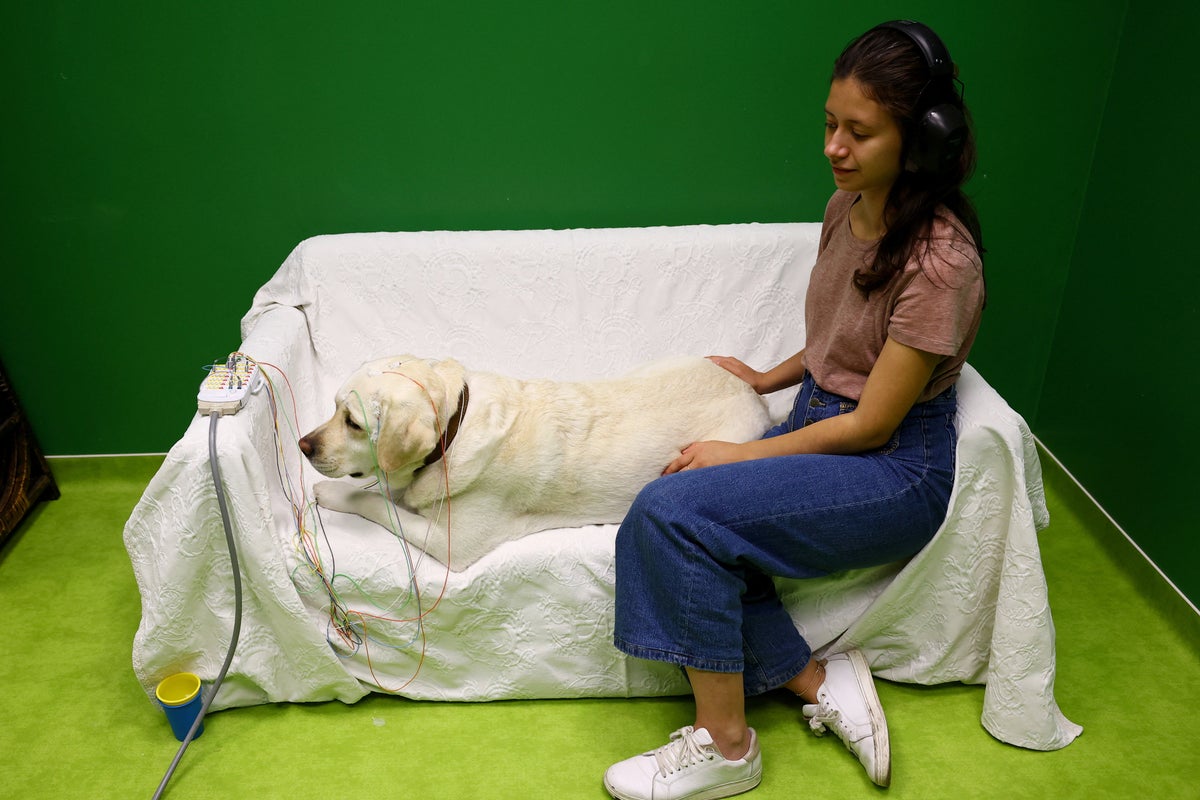
Researchers from the Neuroethology Research Group compared the brain responses of 20 humans and 20 companion dogs to speech.
The human and dog participants listened to continuous, unsegmented speech streams. Consonants and vowels alternated throughout these streams, with no pauses or other acoustic cues separating them.
In the first one, recurring consonant patterns formed consecutive three-syllable words.
In the second type, recurring vowel patterns formed the skeleton of the words instead.
Finally, the third, control type contained no recurring patterns at all, so the syllables did not form words but followed one another in a random order.
Using electroencephalography, or EEG, which measures electrical activity in the brain, the researchers looked at whether the brains of each species began to track the hidden rhythm of the words.
For both humans and dogs, the brain response was much stronger when the repeating structure involved consonants.
“In the consonant-structured speech streams, the dog brains, just like the human brains, successfully synchronised with the rhythm of the words.
“In both species, this synchronisation was stronger than in either the vowel-structured or the control streams. This is the first evidence that a consonant bias can also emerge in the brain of a species other than humans,” said Kinga G. Tóth, psychologist, the study’s other co-first author and a doctoral researcher in the group.
Around 400 ms after the beginning of each word, a distinct change appeared in the brain’s electrical activity in both humans and dogs—but only for consonant-structured words.
This time window is precisely the one known to reflect the segmentation of continuous speech into individual words.
The findings suggest that the brain’s understanding of speech “does not require a pre-wired brain and human-like language abilities”.
Prof Andics continued: “Instead, regular exposure to speech may be enough to change how the brain functions and to give rise to processing characteristics previously observed only in humans—even in a species evolutionarily distant from us.”
This study was published in the journal Science.
Join our commenting forum
Join thought-provoking conversations, follow other Independent readers and see their replies
Comments