
Business & Finance
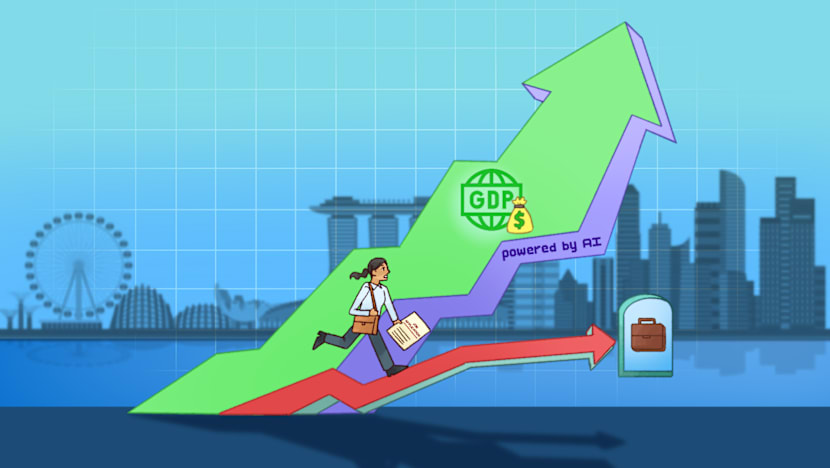
More growth but fewer workers needed? Countries grapple with the risk of 'jobless growth' amid AI boom
Key Points
More growth but fewer workers needed? Countries grapple with the risk of 'jobless growth' amid AI boom What happens when an economy keeps getting richer, but no longer needs as many new workers to grow? As AI reshapes how companies operate and where economic value is created, Singapore may need to rethink the relationship between growth, jobs and prosperity, experts say.
More growth but fewer workers needed? Countries grapple with the risk of 'jobless growth' amid AI boom
What happens when an economy keeps getting richer, but no longer needs as many new workers to grow? As AI reshapes how companies operate and where economic value is created, Singapore may need to rethink the relationship between growth, jobs and prosperity, experts say.
Against a backdrop of global geopolitical tensions and economic headwinds, Singapore's optimistic gross domestic product (GDP) growth outlook stands as a bright spot.
And yet that positive outlook has also been accompanied by concerns about "jobless growth" – a paradoxical combination of a strengthening economy with a stagnant job market.
At the heart of the paradox lies artificial intelligence (AI), which has been driving economic growth through corporate investments, without the need for additional manpower.
The data tells the story: Following a “better-than-expected performance” in the first six months of 2026, the Ministry of Trade and Industry (MTI) in August upgraded its economic growth forecast for Singapore this year to 4.5 per cent to 5.5 per cent, up from its earlier forecast of 2 per cent to 4 per cent.
The improved outlook for the rest of the year is expected to be supported by an acceleration in global AI-related capital expenditure, MTI said.
And yet, retrenchments in the second quarter of the year, driven by business reorganisation and restructuring in some sectors, rose to 4,620, their highest level since the fourth quarter of 2020. While overall employment did grow, resident employment growth slowed to 2,200 from 5,400 in the previous quarter.
To be sure, this spectre of jobless growth is not confined to Singapore and warnings have come from authorities around the world.
The Bank of England in July noted how the adoption of AI has led to firms "often slowing hiring or leaving vacancies unfilled to increase output without a proportional rise in headcount".
International Monetary Fund (IMF) chief Kristalina Georgieva said in April that "the jobs that are routinely starter jobs for young people, this middle is shrinking fast" amid AI disruption.
In Singapore, Prime Minister Lawrence Wong acknowledged the concerns over jobless growth in his round-up speech after the Budget 2026 debate in February. Mr Wong, who is also Finance Minister, said that "we will not have jobless growth in Singapore", adding that the government will ensure that growth translates into good jobs and better wages.
In May, parliament also unanimously backed a motion affirming that Singapore must not have jobless growth amid AI transition.
All this is happening as leading AI companies and some world leaders are calling for a slowdown of AI development amid mounting worries over the risks of "superintelligent" computer systems.
While the long shadow of jobless growth looms, economists and business experts who spoke to CNA TODAY generally agreed that a broad-based labour market slump isn’t happening locally or globally – for now.
The experts noted how a report by the Ministry of Manpower (MOM) in April found that among companies here that have adopted AI, only 6.2 per cent reported reduced headcount, while another 8.5 per cent reported lower hiring activity.
The vast majority of the other companies reported that they had redesigned jobs, created new AI-related jobs or redeployed workers to new roles, among other moves.
That said, jobless growth, along with its repercussions, remains a risk to keep firmly on everyone’s radar, experts said.
Labour economist Walter Theseira, from the Singapore University of Social Sciences (SUSS), said: "Given the direction of technological developments, and given what basically the economics tells us could happen if this continues, I think it would be irresponsible not to plan for it."
MORE THAN JUST PRODUCTIVITY GAINS
Singapore has long pushed hard on productivity to prevent its small labour pool from hamstringing economic growth – an urgency that has only intensified amid an ageing population and falling fertility rate.
Given this long struggle with a tight labour market, why the anxiety over “jobless growth” or its milder variant, “job-light growth”?
The extent to which economic growth outpaces job creation, and whether those gains trickle down to regular workers, makes all the difference, said experts.
Mr Seng Bingxun, partner at global consulting firm EY-Parthenon, said: "Healthy productivity growth raises the value created by workers broadly, supporting better wages and continued demand for labour.
"Jobless growth occurs when GDP rises but the gains are concentrated in a small number of highly productive firms, industries or workers."
Agreeing, Dr Eugene Or, a lecturer in applied economics at SUSS, said that economic growth at a faster speed than employment in itself is "not automatically undesirable" if it reflects strong productivity growth in a tight labour market.
"It becomes more concerning when workers who want jobs increasingly cannot find them, or when labour incomes fail to share in the gains from growth," he said.
A distinguishing feature of AI is that, unlike the technological advances that came before, it goes beyond simply reducing workload or automating.
Earlier forms of general-purpose technology grew the economy by making workers more productive and then inventing new tasks for them to do – in a process called reinstatement effect, noted Professor Will Cong, associate dean of Nanyang Business School (NBS), Nanyang Technological University (NTU).
That reinstatement effect is why employment kept rising through previous technological leaps, such as computing, he added.
However, AI agents are themselves capital-manufactured labour that can take on the new tasks as readily as the old ones, he said.
"Firms can now expand productive capacity by training and deploying more agents rather than hiring more people," said Prof Cong. In the national accounts, this will show up as growth through software and compute investment, not wages.
In the bigger scheme of things, AI is fuelling the rise of capital-intensive companies and sectors that inherently generate high economic value with comparatively fewer – and arguably more niche – employment opportunities.
"AI can expand high-value, capital-intensive activities such as software, advanced manufacturing, semiconductor production and data centres. These can generate considerable value-added with relatively few direct operating jobs," said Dr Or of SUSS.
He added, however, that such activities could still create indirect employment through construction, maintenance, professional services and supply chains.
UNEVEN GROWTH, UNEVEN BENEFITS
Associate Professor Theseira of SUSS argued that the underlying concern is not jobless growth per se but "desirable job-less growth" – or economic growth that still sees jobs being created, but much less growth among job types deemed desirable by the society.
A problem may arise, he said, when there's a bifurcation of job growth: where AI expands a certain set of very elite jobs but at the same time reduces middle-level jobs, leaving behind what is deemed by some as lower-skilled or manual jobs that are harder to replace by AI.
"People might say: 'Oh, I thought my kid should be a computer engineer or AI programmer or something. I don't really think it would be a success if my kid became a dog walker'."
Experts also noted that not all industries or companies can equally benefit from AI, thus giving rise to concerns over uneven growth.
"For companies, gains land first with MNCs (multi-national corporations) and large firms that can build and govern (AI) agents; SMEs, which employ the majority of the workforce (in Singapore), risk falling further behind," said Prof Cong of NTU.
"Firm-level productivity dispersion is the number to watch."
When it comes to job displacement, entry-level roles are widely acknowledged to be more at risk of being supplanted by AI. But such work, while relatively lower in economic value, makes for an important training ground for juniors to cut their teeth and hone their skills before climbing the ladder.
"Automate the junior work and in 20 years there are no seniors able to verify what the machines produce, and verification is precisely the human skill that AI makes most valuable," said Prof Cong.
"Machine-learning researchers call it ‘model collapse’ when a model trains on its own output. A society that stops training its people faces the human version. I cannot underscore enough the importance of human experts who can verify and govern machines and machine outputs."
These risks have revived an age-old debate dating to the industrial revolution: who benefits the most from this form of growth, the capital owner or the labour?
Dr Or from SUSS noted that AI is likely to increase returns to capital and workers whose skills are highly complementary to AI.
"IMF research suggests that AI could increase wealth inequality through higher returns to capital, while its effect on wage inequality depends partly on which workers AI complements and which workers it substitutes for."
Assoc Prof Theseira of SUSS added that during the time of the industrial revolution, capital owners may have owned the factories, but they needed workers to run them.
"In that sense, part of the returns to capital actually got shared with labour because without the labour you couldn't do anything."
Newer concerns in this AI age are that capital investment can be self-sustaining "in terms of no longer needing complementary labour", he noted.
GENERATING GROWTH THE RIGHT WAY
Indeed, globally it is easy to find examples of staunch advocates promoting AI as a way to generate growth without labour, and cases of companies which have successfully done just that, hence stoking concerns over jobless growth.
For example, e-commerce platform Shopify CEO Tobi Lutke, in an internal memo to his managers in April 2025, said: “Before asking for more headcount and resources, teams must demonstrate why they cannot get what they want done using AI.”
The following month, JPMorgan Chase shared with investors that the business had grown by more than 25 per cent in the preceding five years, while headcount grew only 13 per cent over the same period. The bank attributed this to automation, organisational efficiency tune-ups and AI.
“We expect headcount will trend down by about 10 per cent over the next five years or so, even as the business grows by another more than 25 per cent," said its then-CEO of consumer and community banking Marianne Lake.
Yet, experts said that a stagnating or shrinking headcount amid AI-driven business growth is not necessarily a given.
Experts like Associate Professor Trevor Yu from NBS acknowledged that companies should not be expected to maximise headcount for its own sake, as it is unlikely to be a commercially sustainable move.
"But commercial incentives and employment creation are not necessarily in conflict. The key question is what companies do with productivity gains," said Assoc Prof Yu.
The fundamental difference lies in whether a company uses such technology simply for efficiency to do the same thing with fewer resources, or for innovation to do things that were previously difficult, expensive or impossible.
"If technology lowers costs, improves quality, enables new products and services or allows a Singapore company to enter new markets, commercial success can itself generate new demand for human talent," said Assoc Prof Yu.
Mr Marcus Lam, executive chairman and CEO of PwC Singapore, noted how the company's 2026 Job Barometer report found AI-related job postings in Singapore had risen from around 54,000 in 2024 to about 84,000 in 2025, thereby "signalling a labour market in transition".
"Additionally, our global analysis also found that the most AI-exposed companies recorded stronger headcount growth than the least AI-exposed companies, at 52 per cent versus 36 per cent," he said.
AI-exposed companies refer to companies which operate in industries or sectors where a significant share of work tasks is susceptible to change brought about by AI.
"These findings suggest that greater AI exposure can coincide with workforce growth."
Experts pointed out that there are top AI companies whose business models are capital-intensive, generating high value but requiring low labour. Think of the big AI players, such as OpenAI and Anthropic.
Such companies may "hold all the cards" and it would be more challenging for a country to negotiate terms with them, such as hiring a certain number of local workers when setting up shop, because these companies are in high demand and could easily relocate to another country.
"But one reason why you need to have (such top companies) here is that when they're here, they'll actually incentivise a lot of the other companies to come, which you have more negotiating power with (in terms of creating employment opportunities)," said Assoc Prof Theseira.
The government’s constant clarion call for workers facing disruption has always been to upskill, which experts said is important but, on its own, insufficient.
"You can train someone very well for a particular occupation, but if firms collectively require fewer workers in that occupation, training alone cannot create the vacancy," said Dr Or of SUSS.
"Training therefore works best when it is closely connected to employers, expanding sectors, actual vacancies, job redesign, work attachments and placement outcomes."
This is where the government plays an important role, to ensure that affected workers pick up skills that are relevant and that they transition to growth areas in the economy, said the experts.
Assoc Prof Theseira said the roll-out of autonomous vehicles (AVs) can "serve as a test" in how to handle broader AI-related jobs displacement and transition.
The case of AVs shows how the correct policy solution would not be to protect the drivers' jobs, given how this would be less competitive in terms of cost and safety, but to help the workers.
"It's about how do you find ways to warn the affected workers ahead of time, encourage those who can to leave the industry preemptively, and then also to prepare transition plans for the rest."
The government also needs to play a part in encouraging the use of AI in ways that drive innovation and expansion, not only in productivity.
For its part, the government has given assurances that it would encourage the adoption of AI in a manner that will benefit Singaporeans.
Acting Minister for Manpower Jasmin Lau earlier this month acknowledged "some groundswell" of anti-AI sentiment among workers and younger students who, among other things, fear how the technology will be taking away many of their jobs and aspirations.
Ms Lau, who is also Senior Minister of State for Digital Development and Information, said that Singapore is “not blind in our pursuit for AI” and that the technology will be used "for good".
“We will do so if it means giving our workers better jobs, and we will do so if it means providing better services for our people.”
You can train someone very well for a particular occupation, but if firms collectively require fewer workers in that occupation, training alone cannot create the vacancy.
In a joint response to CNA TODAY's queries, MOM and MTI acknowledged Singaporeans' anxiety about job prospects even as both retrenchments and resident unemployment remain low as hiring sentiments have strengthened.
"In our latest survey, hiring sentiments have improved – in July, 48.7 per cent of businesses indicated they intended to hire in the next three months, compared to 43.9 per cent in June," said the ministries. "However, we observe that job searches have taken longer, and job openings have dipped. We understand the concerns of our workers."
MOM and MTI said that creating good jobs for Singaporeans "remains the central objective" of the nation's growth strategy.
"In line with the Economic Strategy Review, we are shaping growth towards activities that generate sustainable employment opportunities," said the ministries.
"We will also deepen partnerships between multinational corporations (MNCs) and local SMEs through schemes such as the Partnerships for Capability Transformation, so that the MNCs’ investments translate into wider employment and progression opportunities for Singaporeans."
The ministries will also support firms in transforming their workforce, help fresh graduates find jobs and those already in the workforce transit to new careers by working together with tripartite partners, while at the same time providing support for workers who lost their jobs.
Beyond encouraging the use of AI that still generates employment, and preemptively nudging workers to new areas of growth where their old roles are affected, the government will also have to consider the wider societal impact that possible jobless growth may bring, experts told CNA TODAY.
"If there's a more society-wide impact, in other words, of general shifting towards perhaps less desirable jobs and so on, that's when I think you have to look more carefully at it. Do we need to actually take some of the excess returns from capital in the very high-skilled workers and see what we can do with them on a society-wide basis?" asked Assoc Prof Theseira.
"For example, uplift wages, provide more income support and things like that."
Offering some sparks of optimism amid this uncertain outlook, some companies in Singapore report that they are harnessing AI to pursue growth without eliminating jobs – and in some instances creating more employment.
Local technology startup SimpleAI, which develops AI agents for clients to automate processes like accounting and bookkeeping, has itself deployed AI internally since 2025, including in product development.
Their team of five engineers used to ship 40 releases a month, including features, updates and fixes.
"Most of an engineer's time went into writing code line by line, testing it and fixing issues after release. Every new feature or customer request competed for the same limited engineering hours, so we had to be very selective about what we built," said co-founder and chief technology officer Shim Young Jun.
Now with AI producing the first draft, the engineers only need to review the output and validate that it works correctly. The same team now ships about 200 releases per month.
CEO Bryan Ng added that in that period, the company had only three new hires bringing in new specialisations, such as knowledge in a new geographical market that SimpleAI is entering.
Other companies here, like Singapore-based financial technology company Aspire, go a step further by expanding both the company and headcount.
CEO and co-founder Andrea Baronchelli shared how AI has been used since the start of the year to reduce engineers' coding work by about 60 per cent, and help their analysts identify, in a matter of minutes, patterns across thousands of transactions that they are monitoring.
Key to all these is how the firm invests in their employees.
"One thing we’ve been doing consistently is investing a lot of time in enabling employees to use AI. We run weekly internal workshops led by our own teams, rather than external vendors," said Mr Baronchelli.
He said that the company of about 500 employees now is expanding headcount by 10 per cent by the end of the year, with more hires planned next year.
"(With AI), we can build more products, enter new markets and pursue opportunities that previously would have been beyond our capacity," said Mr Baronchelli.
"And that creates a strong business case for hiring. We still need people who understand our customers, exercise judgment, make decisions and take responsibility for outcomes."
Like Aspire, Singapore-headquartered cybersecurity solutions and hardware manufacturing company Flexxon, too, has been hiring even as AI helped the company grow.
Flexxon CEO Camellia Chan said the company began deploying AI at the end of 2024 in its daily operations, covering "every function" in the company including sales, marketing and logistics.
Over the same period, headcount grew by about 30 per cent to about 100 employees globally.
"The shape of our workforce changed. The growth went into product development, field engineering and new market coverage, and almost none of it into administrative roles, because the (AI) agents absorb that work. No role at Flexxon has been cut because of an agent," said Ms Chan.
"On the commercial side, business activities like sales and inbound inquiries have grown around five times over this period."
Asked why the company chooses to add headcount when AI has clearly lightened its staff workload and allowed the same number of workers to do more, Ms Chan said that AI does not replace high-value human work.
"What they do is clear the ground for it. Every hour an (AI) agent takes off a product manager’s inbox or a salesperson’s data entry is an hour that goes back into development, innovation and expansion."
At the end of the day, Mr Lam of PwC Singapore said everyone has a part to play in ensuring AI-led economic growth remains inclusive for all.
Companies need to create opportunities in redesigned jobs; employees need to retrain to benefit from said new jobs; and the government needs to provide transition support, accessible retraining and incentivise enterprise transformation in the right direction, he said.
"Ultimately, the test of a successful AI transition is not whether every existing job remains unchanged, but whether Singapore can create new sources of growth while enabling workers to remain relevant, productive and able to share in the gains," said Mr Lam.
[Image text:] GDP
powered by AI