
Politics
Houthi strikes on Saudi Arabia? Pakistan's role under lens; pact without an impact
Key Points
As Houthi missiles and drones continue to pound southern Saudi Arabia, a glaring question has emerged from the crisis: where is Pakistan? More than a month after Islamabad signed a landmark mutual defence pact with Riyadh, its much-publicised commitment to the kingdom's security appears to exist only on paper. On August 7, Saudi Crown Prince Mohammed bin Salman, Turkish President Recep Tayyip Erdoğan and Pakistani Prime Minister Shehbaz Sharif signed the Mecca Joint Defence Agreement (MJDA),...
As Houthi missiles and drones continue to pound southern
Saudi Arabia, a glaring question has emerged from the crisis: where is Pakistan? More than a month after Islamabad signed a landmark mutual defence pact with Riyadh, its much-publicised commitment to the kingdom's security appears to exist only on paper.
On August 7, Saudi Crown Prince Mohammed bin Salman, Turkish President Recep Tayyip Erdoğan and Pakistani Prime Minister Shehbaz Sharif signed the Mecca Joint Defence Agreement (MJDA), a pact explicitly stating that an armed attack on any one of the three nations would be treated as an attack on all. Framed as a NATO's Article-5 style collective security arrangement, it was meant to signal a new era of coordinated deterrence among the three states.
Yet since Iran-backed Houthi rebels intensified missile and drone strikes on Saudi cities including Abha, Khamis Mushait, Jizan, Najran and Taif, as well as a drone interception near the city of Mecca. These strikes have injured dozens of civilians and setting oil installations ablaze. The Houthi's have also launched unsuccessful strikes on Saudi Arabia's capital Riyadh as well. Pakistan has been conspicuously silent on the ground.
There has also not been a formal invocation of the collective response clause that Islamabad itself helped negotiate just weeks earlier.
A press release from Saudi Arabia, dated April 11, 2026, states that Pakistani air force fighters and support aircraft have been deployed at the Abdulaziz Air Base in the kingdom's eastern sector. This airbase is close to Bahrain on the Persian Gulf. This deployment is in accordance with the Strategic Mutual Defense Agreement signed between the two countries, as per the Saudi release. Meanwhile Pakistani media has put troop numbers at approximately 8,000, or a brigade level and a squadron of JF-17 Thunder fighters, which has been assembled in Pakistan. Two squadrons of military drones, and a Chinese-origin HQ-9 long-range air defence system. Crucially, all this equipment is operated exclusively by Pakistani personnel, while Saudi Arabia foots the entire bill, covering deployment, operational and logistical costs, along with per-soldier compensation paid to Islamabad.
Pakistan has boots, jets and air defence systems already stationed in Saudi Arabia, fully funded by Riyadh, and yet none of it has been visibly activated even as missiles rain down on Saudi soil and alerts have been sounded over the holy city of Mecca itself. The contrast between a paid, standing military presence and its complete absence from the current conflict has not gone unnoticed.
Pakistan's inaction stands out further given its central role in two other Saudi-led security frameworks. The Islamic Military Counter Terrorism Coalition, a 43-nation alliance, has been commanded by former Pakistani army chief General Raheel Sharif since 2017, yet despite the Houthis being designated a terrorist organisation by Saudi Arabia and other states, the coalition has not been mobilised against the ongoing campaign. Pakistan also holds the deputy command of the newly formed Multinational Maritime Defense Coalition, set up specifically to counter Houthi threats to shipping in the Red Sea and Bab el-Mandeb, yet here too, no visible operational response has followed.
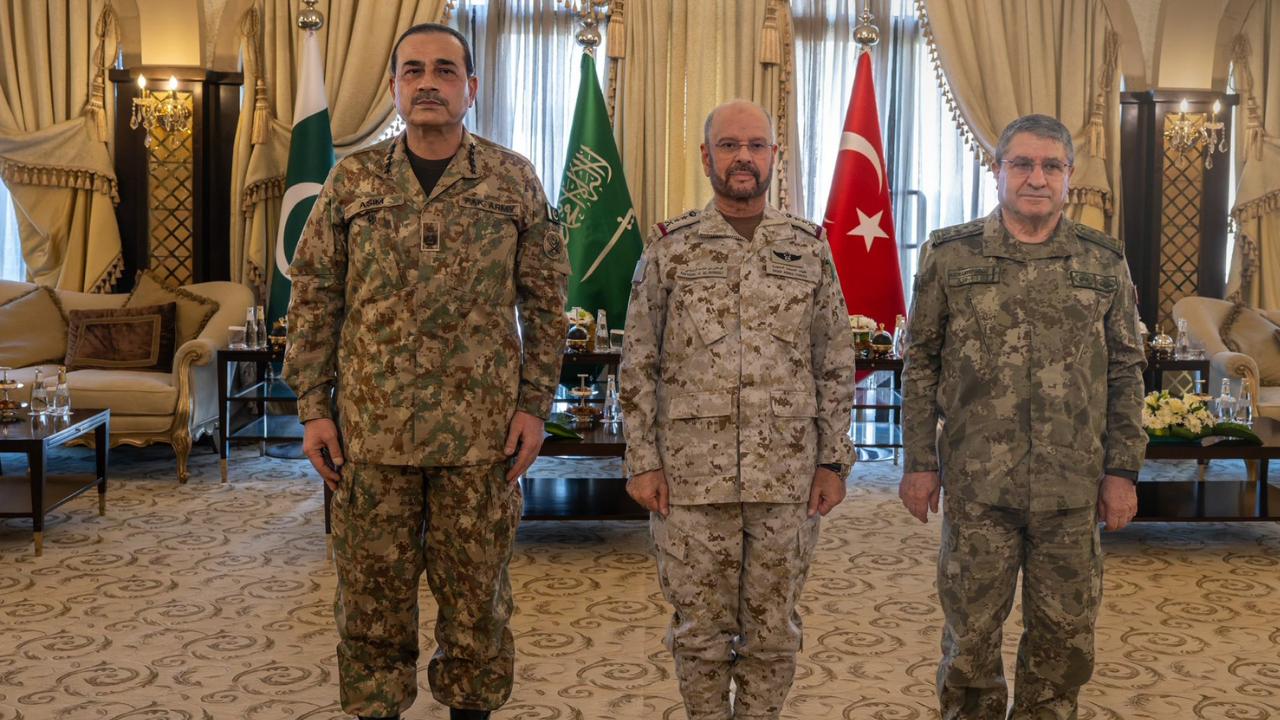
Although, on September 25th Turkish and Pakistani army chiefs held talks in Riyadh to discuss support for the Kingdom under the ambit of the MJDA, according to Saudi Arabia. The Turkish and Pakistani military chiefs agreed to deepen their military and intelligence cooperation and enhance the integration of defensive capabilities, as per the same document. The release stated that 'they reaffirmed their commitment to collective defence and the determination of the three countries to defend Saudi Arabia's security, sovereignty, and territorial integrity', but the document did not state how the Pakistanis and the Turks would strengthen the Kingdom's defence or an timelines to bring in any strong defensive capabilities. Just hours after the meeting Houthis launched missiles towards Khamis Mushait in Saudi Arabia, which were intercepted by Saudi air defences, even as the army chiefs of Pakistan and Turkey were in country.
The pattern raises questions about the substance behind Pakistan's defence partnerships in the Gulf. Islamabad was quick to project the Mecca agreement as a major diplomatic and strategic win in August. But when Saudi Arabia has actually come under sustained attack, that momentum has not translated into action, so the Mecca Joint Defence Agreement for now seems to be a pact without an impact.