
Science
Sea level rise is reshaping a beloved California beach town and threatening a busy rail line
Key Points
Sea level rise is reshaping a beloved California beach town and threatening a busy rail line After years of erosion, California is bracing for flooding and landslides ahead of this year’s expected super El Niño - Bookmark Become an Independent member to bookmark this article Already a member? Log in For years, residents of a Southern California beach town could walk a mile along a stretch of cream-colored sand while ocean waves lapped at their feet. That journey has now been cut short.
Sea level rise is reshaping a beloved California beach town and threatening a busy rail line
After years of erosion, California is bracing for flooding and landslides ahead of this year’s expected super El Niño
- Bookmark
Become an Independent member to bookmark this article
Already a member? Log in
For years, residents of a Southern California beach town could walk a mile along a stretch of cream-colored sand while ocean waves lapped at their feet. That journey has now been cut short.
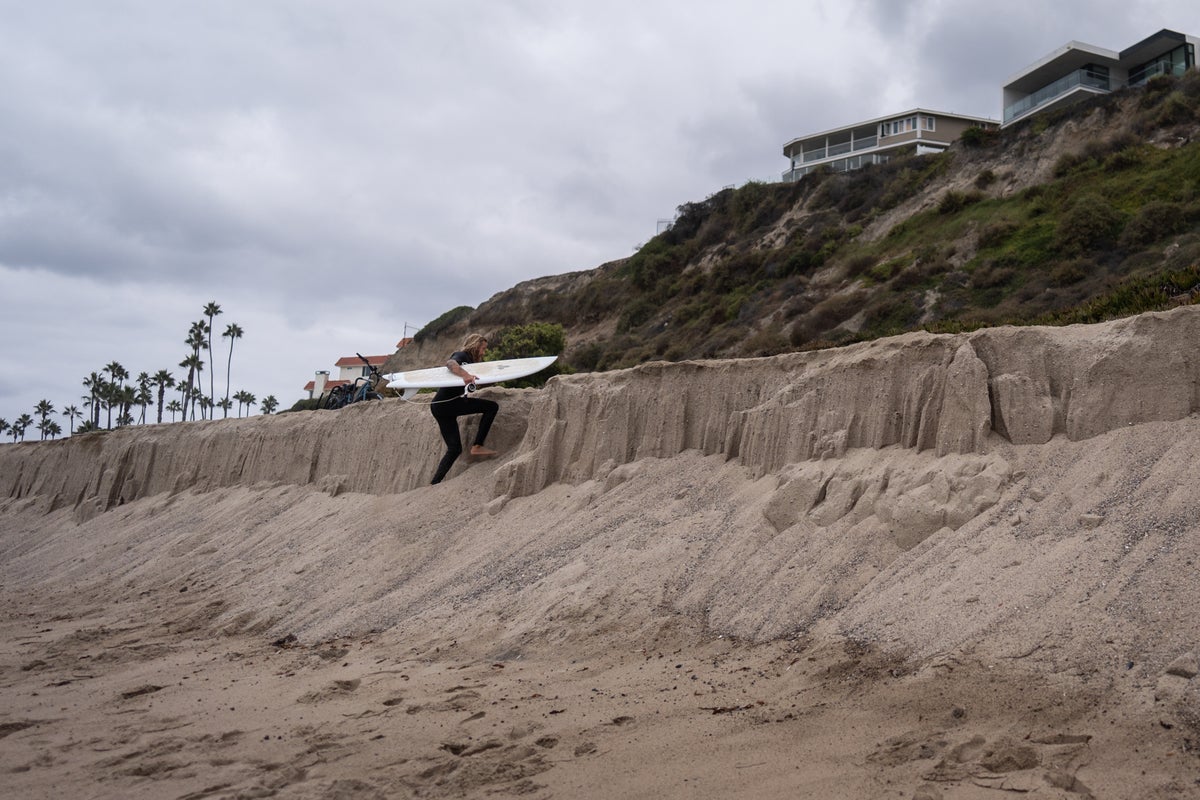
San Clemente, recognized for nearly a century as a "Spanish village by the sea," is losing its shoreline to erosion. Rising seas and crashing waves have bisected the city's picturesque North Beach, while eroding bluffs threaten waterfront homes and have repeatedly forced the closure of a passenger train route considered the second busiest in the country.
It is one of numerous California coastal communities confronting the effects of sea level rise. Nearly a decade ago, scientists forecast that more than half of Southern California’s beaches could significantly erode by 2100, radically altering how people live and recreate along the state’s famed coast.
"The constant pressure is sea level rise," said Sean Vitousek, research oceanographer with the U.S. Geological Survey. "It is going to keep rising, and rising, and the beaches will retreat landward."
Following years of erosion, California is preparing for flooding and landslides ahead of this year’s expected super El Niño, a temporary warming in parts of the equatorial Pacific that warps weather worldwide. Already this year, seawater flooded residences in Long Beach near Los Angeles during a hurricane-driven storm surge, and the town of Pacifica south of San Francisco closed its cracked concrete pier. A recent study indicated that El Niño events are strengthening due to human-caused climate change.
In San Clemente, a town of 62,000 people, urban development has restricted the flow of sediment that historically replenished local beaches, while warmer waters drive waves higher and further ashore. The challenge has led residents of the largely Republican city to consider taxing themselves for beach restoration. A measure adding a 1% sales tax to fund wildfire protection and sand replenishment is on the November ballot.
Crumbling hillsides disrupt seaside rail
Over the past five years, the rail line operating along the coast for more than a century has faced recurring closures due to encroaching surf on one side and fragile bluffs on the other. The 7-mile (11-kilometer) segment belongs to a 351-mile (565-kilometer) passenger rail corridor connecting San Diego with Los Angeles County's major port complex and San Luis Obispo. It is also used by freight and the military.
Transportation officials have reinforced the tracks to ensure passenger safety by laying down rock. But as waves slam against the rocks, they sweep more sand offshore and accelerate erosion that will eventually threaten the rail line again.
Locals say the erosion is dramatically altering their community.
"We've lost our walkable beach," said Cameron Cosgrove, a San Clemente resident who wrote the tax measure. "It used to be you could come to North Beach, walk the beach trail, or on the beach to the pier and actually all the way down to the south end of town. Can’t do either anymore."
City and transit officials agree more sand is needed and note that coastal communities, including surf hub Huntington Beach, have nourished their beaches for years. Opponents of the measure want sand — but not the tax — and argue San Clemente should work with other communities on a regional approach.
"Fighting Mother Nature is very expensive," said City Councilman Zhen Wu, who opposes the measure.
City Manager Andy Hall said San Clemente faces a sand deficit of about 3 million cubic yards. Getting that much sand to the beach is no easy task, he said, adding that trucking it would require 300,000 trips.
Darrell Johnson, chief executive of the Orange County Transportation Authority, said a challenge has been getting state permits for more sand. He hopes California's recent emergency declaration ahead of El Niño will speed up the process. In the long run, Johnson said officials will study moving trains inland — an idea previously deemed too costly. A third option is to halt the line, he said.
"If we can’t figure out how to shore up properly in a way that is long-term in nature, and we can't figure out how to relocate, I think that is a question that’s going to have to be asked," Johnson said. "'What happens to passenger rail? What happens to freight?'"
More sand will also shape wave breaks
Further south, transportation officials have been working to stabilize coastal bluffs to shore up the rail line in the community of Del Mar. The plan is to eventually move the tracks, but officials have not decided where.
Charlie Fox, a 56-year-old San Clemente resident and marine meteorologist, said sand provides a critical buffer between whatever structures — train tracks, homes, lifeguard headquarters — are built along the coast. The lifelong surfer said sand also helps waves roll gently onshore, creating a steady wave break for surfing.
On a recent morning, surfers bobbed in the water off North Beach, not far from the rocky structure shoring up the train tracks by the sea.
"When you see those rocks, that's them attempting to fight the ocean," Fox said. "That is a futile endeavor."
"The ocean wins," he added. "Ocean always eventually wins."
California (LOCATION)
Sea (LOCATION)
El Niño - Bookmark (ORG)
Independent (ORG)
Southern California (LOCATION)
San Clemente (LOCATION)
Spanish (ORG)
North Beach (LOCATION)
Southern California’s (LOCATION)
Sean Vitousek (PERSON)
the U.S. Geological Survey (ORG)
El Niño (ORG)
Pacific (LOCATION)
Long Beach (LOCATION)
Los Angeles (LOCATION)