
World News
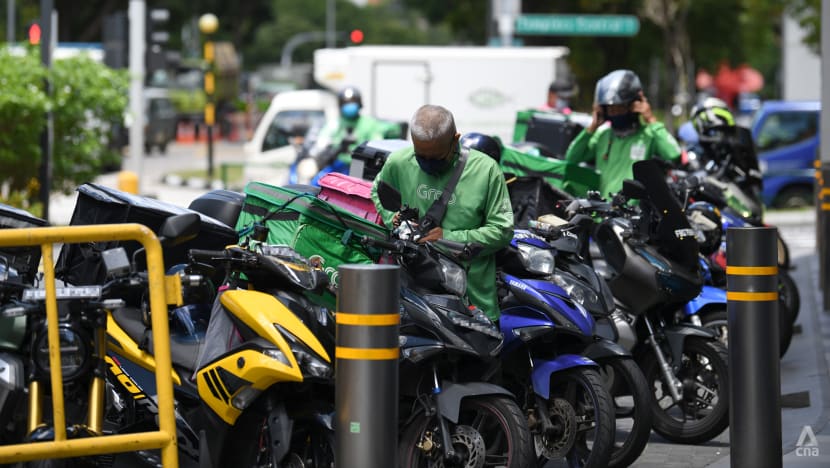
Commentary: Pressures of platform work in Singapore push drivers and riders to take risks
Key Points
Commentary: Pressures of platform work in Singapore push drivers and riders to take risks Platform workers operate in an environment shaped, in part, by the expectations of the people they serve, says SUSS’ Victor Seah. SINGAPORE: Construction, manufacturing, platform work, or transportation and storage: Which is the most dangerous work in Singapore? Many might guess construction, the sector many might associate with workplace accidents and fatalities.
Commentary: Pressures of platform work in Singapore push drivers and riders to take risks
Platform workers operate in an environment shaped, in part, by the expectations of the people they serve, says SUSS’ Victor Seah.
SINGAPORE: Construction, manufacturing, platform work, or transportation and storage: Which is the most dangerous work in Singapore?
Many might guess construction, the sector many might associate with workplace accidents and fatalities. But the Ministry of Manpower’s (MOM) workplace safety and health data for the first half of 2026 gives a different answer.
It is platform work, by a long shot.
The fatal and major injury rate for platform workers stood at 92.1 per 100,000 workers in the first half of 2026, compared with 24.1 for construction, 28.4 for manufacturing, and 19.8 for transportation and storage. In other words, the rate for platform workers was approximately 3.8 times that of construction workers.
Of the nine fatal workplace incidents attributed to vehicular causes, four involved platform workers: three delivery workers and one ride-hailing driver.
These numbers deserve attention when Singapore’s pool of platform workers is growing. The risks that come with the job are now impossible to ignore.
A ROAD SAFETY PROBLEM ABOVE ALL ELSE
The data points clearly to what kind of safety problem this is. Approximately 86 per cent of platform worker deaths and serious injuries arose from vehicular incidents. This is not a conventional workplace safety problem, where machinery safeguards or site supervision might suffice.
Platform worker safety is, above all, a road safety problem.
This coincides with growing concerns about Singapore’s roads more broadly. An inaugural road safety survey this year found that only 61 per cent of respondents considered Singapore’s roads safe. Accidents involving cyclists hit a four-year high in 2025, with 772 incidents, of which 17 were fatal.
For platform workers whose livelihoods depend on navigating these roads under time pressure, in bad weather and unpredictable traffic, the risks are compounded daily. Minister of State for Manpower Dinesh Vasu Dash has described the rise in fatal injuries from vehicular incidents as “a serious concern”.
NOT ALWAYS RECKLESS
It is tempting to attribute accidents to individual recklessness. We have all seen delivery riders run amber lights or weave through heavy traffic. Similarly, clips of dangerous driving from private-hire vehicles are readily available online.
While poor judgment and human error may contribute to accidents, this framing is incomplete and may lead to solutions that are poorly targeted.
In interviews with more than 50 platform workers conducted at the Behavioural Insights Centre of Excellence at SUSS, a more nuanced picture emerged. Many workers describe themselves as problem solvers who genuinely want to do a good job.
For instance, delivery riders cope with slow kitchens, bad weather and difficult traffic, and must use soft skills to manage the fallout. “We’ll be the one who gets scolded by the customer. So we are the person who is being targeted,” one delivery rider told us.
For private-hire drivers, a similar tension plays out on the road itself. As one explained: “(Passengers) say, uncle, can you drive faster? So I just fakely oblige. I will say, okay, I will try, but I will still drive as per normal because I don’t want to get traffic summons, or worse, get into an accident.”
What these accounts describe is what organisational psychologists call prosocial rule-breaking: voluntary rule-bending driven not by indifference to safety, but by a genuine desire to serve customers and protect one’s income and ratings.
Research suggests this kind of rule-breaking tends to backfire: It does not improve performance or customer satisfaction, and it increases the risk of accidents. Perhaps more importantly, it can be contagious – workers are more likely to bend rules when they observe colleagues doing so for seemingly good reasons.
This reframes the problem. The question is not simply, “Why are some platform workers reckless?” It is, “What features of the system make conscientious workers feel they have little choice but to take risks?”
WHAT CAN BE DONE
A platform worker safety workgroup, formed in March, is studying measures including training, safety technology and data collection, and is expected to conclude its work by end-2026. Separately, three groups can act now.
Policymakers and unions have a role in addressing the structural conditions of platform work. Questions have been raised in parliament about whether platform incentive structures encourage workers to rush, and MOM’s investigations have not found direct local evidence of this.
But the pressure workers describe is real even when it is not formally encoded. Initiatives like free monthly defensive riding sessions, offered through driving schools in partnership with the National Delivery Champions Association and platform operators, are a step in the right direction.
Expanding access to such programmes, and ensuring they are practically accessible to workers who operate on irregular schedules, matters.
Platform companies have both the reach and the data to make a significant difference. Some already use algorithms to identify risky riding behaviours and prompt rest breaks, and some inform customers of longer wait times during difficult conditions rather than penalising workers.
More can be done. Soft skills training designed to give workers concrete ways to manage difficult customers and de-escalate impatience deserves more investment, given what our interviews reveal. When a worker feels unable to reassure an agitated customer, the temptation to speed up becomes harder to resist.
Platforms might also consider moving beyond advice to take breaks, toward stronger interventions such as temporary suspensions of job allocation when the algorithm detects that a worker has been on the road for an extended period without rest.
Making break time mandatory and paid when risk thresholds are exceeded would go further still, directly addressing the financial pressure that keeps fatigued workers from stopping.
Finally, there is a role for all of us as patrons. Platform workers operate in an environment shaped, in part, by the expectations of the people they serve. A delay caused by a slow kitchen, heavy rain or a traffic jam is beyond a rider’s control, but whether we penalise them with a low rating is our choice.
Understanding this, and resisting the impulse to press a driver to go faster, can make a small but meaningful difference to the choices workers feel they must make. Your fast food or milk tea can wait.
Victor Seah is Director of Behavioural Insights Centre of Excellence at the Singapore University of Social Sciences.