
Science
Towering 'sponge' dome in Brazil is the secret source of nearby hot springs
Key Points
Towering 'sponge' dome in Brazil is the secret source of nearby hot springs — Earth from space A 2025 satellite photo shows the Caldas Novas dome, a 12-mile-long monolith that towers above the Brazilian state of Goiás. The structure acts as a giant sponge, soaking up water that helps fuel nearby hot springs. QUICK FACTS Where is it?
Towering 'sponge' dome in Brazil is the secret source of nearby hot springs — Earth from space
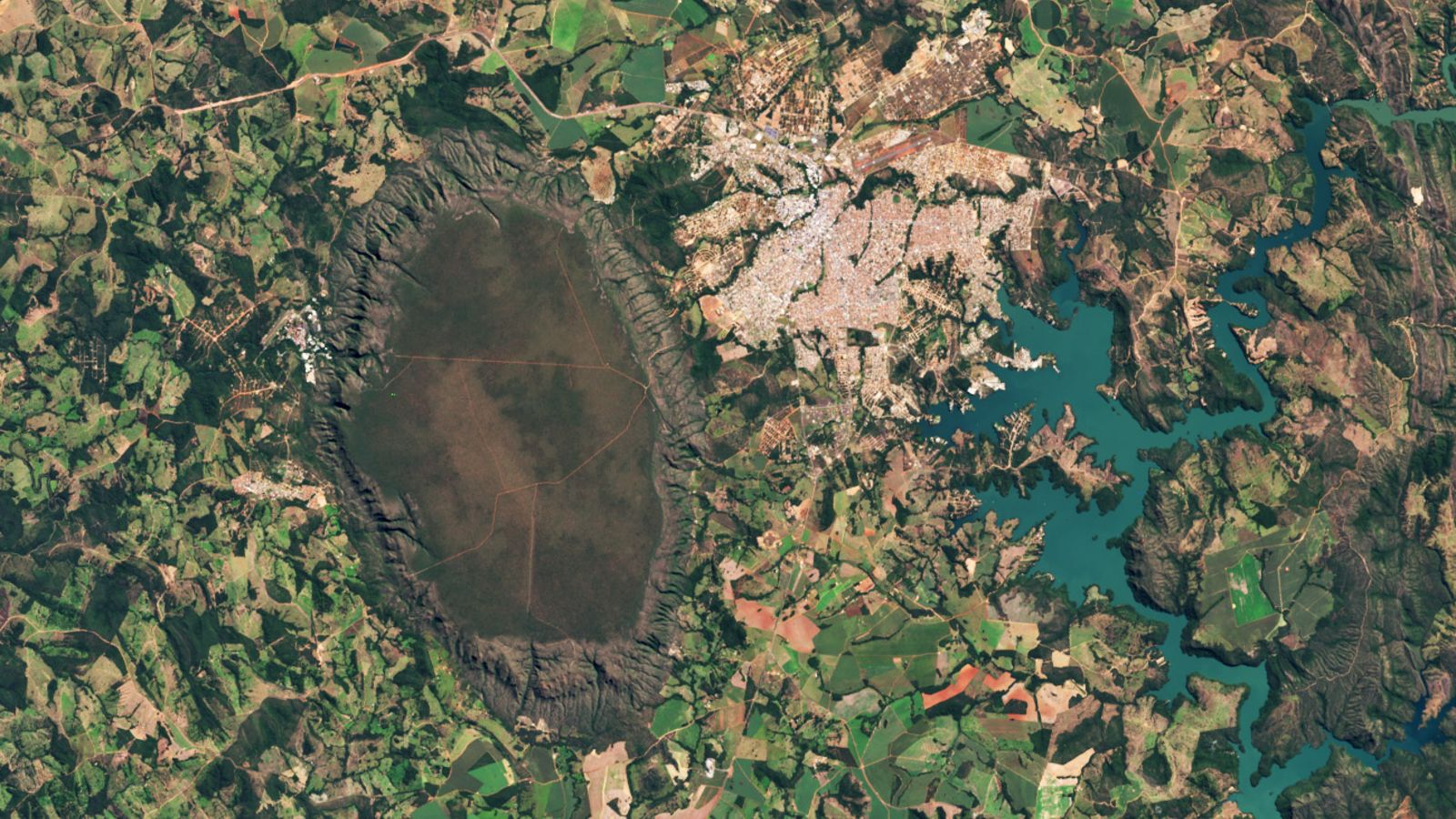
A 2025 satellite photo shows the Caldas Novas dome, a 12-mile-long monolith that towers above the Brazilian state of Goiás. The structure acts as a giant sponge, soaking up water that helps fuel nearby hot springs.
QUICK FACTS
Where is it? Caldas Novas, Goiás, Brazil [-17.788739460, -48.70589106]
What's in the photo? A giant, sponge-like dome towering above its surroundings
Which satellite took the photo? Landsat 9
When was it taken? May 19, 2025
This striking satellite snap shows a giant, "sponge-like" dome towering over central Brazil. The dark monolith and the rare biome that covers it are key to the region's famed hot springs.
The imposing oval structure, which is around 12 miles (20 kilometers) long and 7 miles (12 km) across, is known as the Caldas Novas dome, or Serra de Caldas, according to NASA's Earth Observatory. It is located in southeast Goiás state and towers up to 1,000 feet (300 meters) above the surrounding landscape, although an optical illusion known as relief inversion may cause some viewers to see the raised land as a bowl-like depression.
The monolithic feature, which one 2004 study predicted could be at least 600 million years old, gets its name from the town of Caldas Novas, which is visible in the satellite image, sandwiched between the dark-green dome and Lake Corumbá, an artificial reservoir created by a nearby hydroelectric dam. The town is home to around 100,000 people but receives hundreds of thousands of visitors a year, many of whom travel there to bathe in its famous hot springs.
The dome is blanketed by savanna known as the Cerrado, which covers around a quarter of Brazil and is the second-most-abundant biome in South America, behind rainforests like the Amazon.
This biome is a tropical savanna. It is much more ecologically diverse than most savannas and is often described as a mix of woodland, grassland and wetland.
The Cerrado readily soaks up rainwater, making the dome act like a giant sponge. The collected liquid percolates through the monolith's inner structure, refilling submerged groundwater reservoirs that help feed the nearby hot springs with a regular supply of warm water, even throughout the region's dry season, according to the Earth Observatory.
The Cerrado is often called the "cradle of waters" in Brazil because of its role in recharging groundwater and feeding major rivers across the country. It also helps to feed several waterfalls around the dome's edges (see below).
Get the world’s most fascinating discoveries delivered straight to your inbox.
Unlike most thermal baths, the hot springs surrounding Caldas Novas are not heated by volcanic activity. Instead, water within deep fractures in the rock is "heated by Earth's naturally higher temperatures at depth before it circulates back to the surface," Earth Observatory representatives wrote.
Many experts previously thought the monolith was formed by an ancient "magmatic intrusion," in which molten rock burst through the planet's crust. However, a 2021 study largely disproved this theory, suggesting instead that the structure was most likely created by other geological processes, instead.
The dome and its surroundings are protected as part of Caldas Novas State Park, which was established in 1970. It is home to several unique species, including the red-legged seriema (Cariama cristata) birds, the pequi tree (Caryocar brasiliense), and the wolf's plant (Solanum lycocarpum), according to the Earth Observatory.
But the park's main purpose is to protect the Cerrado covering the dome. In recent decades, large swaths of the biome have been cleared across South America to make way for more agricultural land, similar to the deforestation that plagues the Amazon rainforest.
You can see this issue in the satellite photo. The region surrounding the dome was likely once covered with the Cerrado, but it is now a patchwork of farms and fields.
See more Earth from space
Ghana's 'lake of souls' glitters
A 2015 satellite photo shows a series of golden tendrils surrounding Ghana's Lake Bosumtwi. The lake and its surroundings were shaped by a massive meteor impact around 1 million years ago.
Ghostly lakes merge in Australia
A 2024 satellite photo shows a series of ephemeral lakes that merged into a single emerald structure in Australia's Northern Territory following two years of extreme rainfall.
Indonesia's 'Twin Peaks' volcanoes
A 2021 astronaut photo shows the surprising similarities between Mount Sundoro and Mount Sumbing, which lie at the heart of Java, Indonesia.
Harry is a U.K.-based senior staff writer at Live Science. He studied marine biology at the University of Exeter before training to become a journalist. He covers a wide range of topics including space exploration, planetary science, space weather, climate change, animal behavior and paleontology. His recent work on the solar maximum won "best space submission" at the 2024 Aerospace Media Awards and was shortlisted in the "top scoop" category at the NCTJ Awards for Excellence in 2023. He also writes Live Science's weekly Earth from space series.
You must confirm your public display name before commenting
Please logout and then login again, you will then be prompted to enter your display name.