
World News
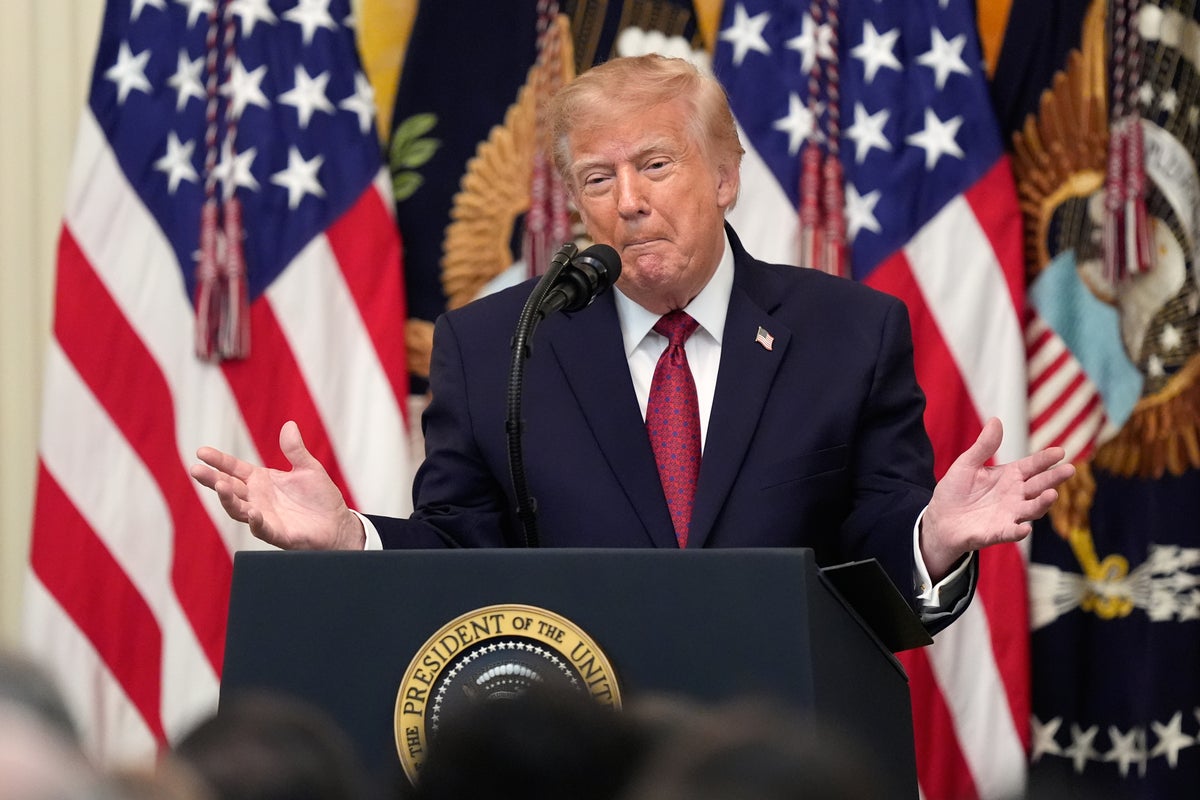
Trump celebrates US military exit from Iraq as the end of a ‘very expensive excursion into Hell’
Key Points
Trump celebrates US military exit from Iraq as the end of a ‘very expensive excursion into Hell’ The withdrawal, agreed on two years ago, comes against the backdrop of the ongoing war between the US and Iran that has also sometimes spilled over into Iraq - Bookmark - CommentsGo to comments Become an Independent member to bookmark this article Already a member? Log in President Donald Trump has praised the United States military’s exit from Iraq after a 12-year mission to fight the Islamic...
Trump celebrates US military exit from Iraq as the end of a ‘very expensive excursion into Hell’
The withdrawal, agreed on two years ago, comes against the backdrop of the ongoing war between the US and Iran that has also sometimes spilled over into Iraq
- Bookmark
- CommentsGo to comments
Become an Independent member to bookmark this article
Already a member? Log in
President Donald Trump has praised the United States military’s exit from Iraq after a 12-year mission to fight the Islamic State group as the end of "a very expensive excursion into Hell."
The U.S. military said Wednesday that it completed the withdrawal of all American troops after the final service members left an air base in northern Iraq under a deal between Baghdad and Washington.
Describing the drawdown ahead of a Sept. 30 deadline as "orderly," Trump wrote on social media: "It has been a long time, with very bad decision-making that got us involved in this quagmire in the first place, but soon, that will be part of History."
He framed the move as a joint victory for both the U.S. and Iraq, as well as a triumphant mark against the Islamic State group.
Negotiated two years prior, the departure comes amid an ongoing war between the United States and Iran that has occasionally extended into Iraqi territory, marked by exchanges of fire between U.S. soldiers and Iran-backed militia strongholds.
The remarks by Trump coincide with criticisms comparing his decision earlier this year to launch a military conflict with Iran to the original Iraq war, citing an ill-defined mission as it approaches its seventh month.
Over recent years, Washington has sought to reorient its global strategic priorities away from the Middle East and toward Asia, though that pivot has proved erratic as the Pentagon alternates between downsizing its regional footprint and becoming entangled in fresh hostilities, including the war in Iran.
Leaders in Baghdad welcomed the termination of the U.S. presence, framing it as proof of the nation's rising sovereignty and internal strength.
Although Iran-backed factions celebrated the pullout, anxiety mounted among other Iraqi populations, notably within the Kurdish territory, where fears persist regarding a potential resurgence of the Islamic State group alongside escalated strikes by Iran-aligned factions emboldened by the U.S. departure.
Meanwhile, uncertainty continues to surround the future of armed Iraqi militias, which the central government in Baghdad has attempted to disarm with minimal progress to date.
A new phase in Iraq after decades of US involvement
Pentagon spokesperson Sean Parnell confirmed in a statement that U.S. forces and equipment had achieved an "orderly departure" from the air base in Irbil, located in northern Iraq’s semi-autonomous Kurdish region.
"This milestone reflects the success of a 12-year campaign that defeated ISIS as an organized military threat in Iraq and across the region," he said. "It also marks a transition from a wartime coalition mission to an Iraqi-led security effort supported by a more normal bilateral security relationship."
He further stated that the U.S. military "will continue to provide targeted training and intelligence support to our Iraqi partners."
Iraqi Prime Minister Ali al-Zaidi led the formal handover proceedings, characterizing the American pullout as the launch of a "new phase, one defined by Iraq’s sovereignty, the strength of its institutions, the readiness of its forces, the unity of its decision-making, and balanced partnerships with its friends."
He assured that Iraqi security forces would persist in fighting IS and promised that the administration would ensure non-state groups are stripped of their weaponry.
American forces originally entered Iraq in 2003 to oust Saddam Hussein. They withdrew in 2011, only for Iraqi officials to request a smaller U.S.-led coalition three years later to combat the Islamic State group after it swept across the country and seized substantial territory.
Following the reduction of the extremist network to fragmented sleeper cells, officials in Washington and Baghdad reached an agreement in 2024 to wind down the coalition.
U.S. troops vacated installations across most of Iraq last year, maintaining only a modest contingent of several hundred troops in the semi-autonomous northern Kurdish region. Facilities in that area have faced regular strikes since the U.S. and Israel initiated their war against Iran on Feb. 28. Concurrently, Iran-backed Iraqi factions have collaborated with Yemen’s Houthi rebels to strike targets in Saudi Arabia.
The future of militias remains unclear
The government in Iraq initially tied the Sept. 30 timeline for the U.S. departure to the complete disarmament of all non-state armed groups.
Although several minor militias consented to surrender their arsenals, prominent groups closely aligned with Iran rejected the demand or imposed conditions for disarming that the authorities are unlikely to fulfill.
Al-Zaidi has since adjusted that position, disclosing to The New York Times earlier this month that the deadline to disarm these armed groups has been extended to June 2027.
The broader ramifications of the American exit may not be immediately obvious, given that the U.S. presence was already substantially reduced. Nevertheless, officials in Iraq's Kurdish area have voiced deep concern regarding the departure, particularly citing the removal of U.S. air defense infrastructure.
According to the Kurdish regional government's Peshmerga Ministry, the northern territory endured more than 1,000 drone and ballistic-missile strikes throughout the recent U.S.-Iran conflict.
"The departure of the United States from the Kurdistan Region under these complex regional circumstances, without the provision of a defense system, is a matter of concern," the statement said.
Factions linked to Iran, by contrast, welcomed the U.S. exit.
"The expulsion of the occupation forces, defeated, from the land of Iraq is the beginning of full sovereignty," Abu Mujahid al-Assaf, a security official with the powerful Kataib Hezbollah militia, said in a statement.
He also issued a warning to al-Zaidi and the government against pursuing American objectives, threatening that "any government that does not work for the benefit of the people will be overthrown by all means."
The Islamic Resistance in Iraq, an umbrella coalition of Iran-backed militias, stated that talks with the administration concerning weapon regulations have yielded no resolution, adding that it remained "not bound by any timeline or agreement" declared by the government or any political entity. The organization noted it remains receptive to "any dialogue that guarantees Iraq’s sovereignty and dignity."
Join our commenting forum
Join thought-provoking conversations, follow other Independent readers and see their replies
Comments